While the Sicilian city of Messina celebrated its most important religious summer holiday, thieves carried out a heist at the regional museum, making off with several works by Renaissance painter Antonello da Messina.
The thieves stole four of Antonello’s works from the Regional Museum of Messina (MuMe), local officials said on Sunday. The 15th century artist is credited with revolutionizing Renaissance portraiture by popularizing elements of Flemish realism and oil-painting techniques in Italy.
“We are devastated by what happened. They were among Antonello da Messina’s most important and best-known works. It is a tremendous loss for the museum, the city, the community and the art world,” MuMe director Marisa Mercurio told Italian news agency ANSA on Sunday.
“Messina without Antonello is deprived of the very essence of the greatest artist of the European Renaissance,” Enzo Caruso, Messina culture councillor, told broadcaster Sky Italia.
The theft is the latest high-profile heist in the art world. Days before, Italian police said they recovered three artworks by Renoir, Cézanne, and Matisse that had been stolen from Parma’s Magnani Rocca Foundation in March. Five people were detained in connection with the theft.
MuMe was closed to the public on Sunday amid ongoing investigations.
Here’s what we know so far about the heist.
How the theft happened
At least three masked people approached the museum at around 9:50 p.m. on Saturday, Italian media reported, citing museum officials and preliminary investigative materials. The theft took place during the Vara procession marking the Ferragosto holiday, which commemorates the feast of the Assumption of the Virgin Mary.
Italian media outlet TempoStretto reported that part of the perimeter railing near a side gate of the museum appeared bent or cut, and an exterior door had been forced open. The thieves appeared to target the Antonello works, going directly to the rooms after entering the museum, according to newspaper La Sicilia.
The theft took place over a few minutes, local media reported.
Marisa Mercurio, director of the museum, told Italian media that the museum’s alarms and cameras were working. Police are investigating how the thieves managed to bypass the security system. Investigators are reportedly reviewing surveillance footage of the theft.
What was stolen
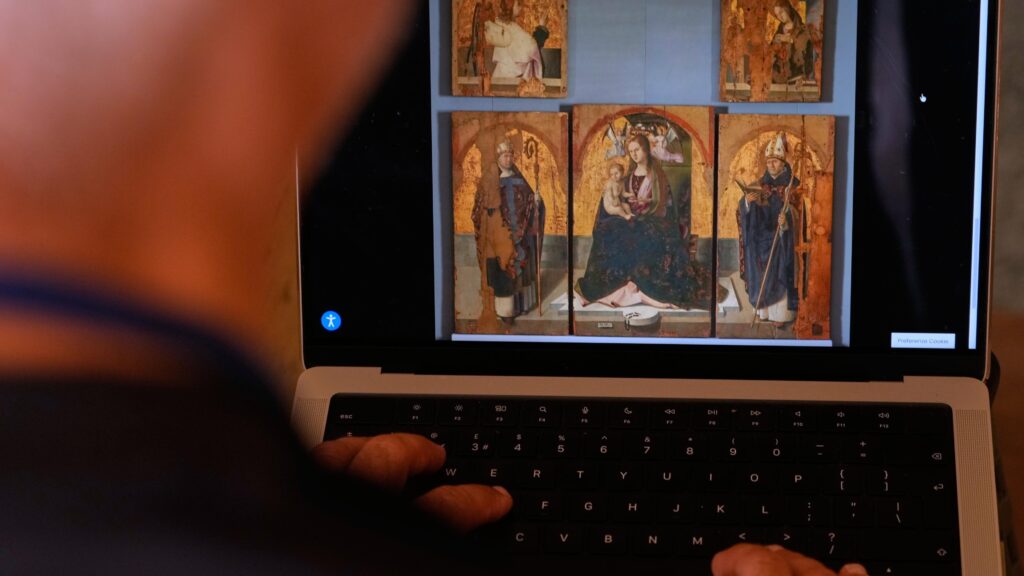
All five surviving wooden panels of the San Gregorio Polyptych, an altarpiece signed and dated to 1473, were removed, while another small double-sided panel was removed from a secure display case. But authorities later recovered two of the polyptych panels that appeared to have been abandoned on a low wall outside the museum. A citizen had noticed the abandoned panels and made the first call to police.
The San Gregorio Polyptych, commissioned for the San Gregorio monastery, originally consisted of six panels but an upper-central panel believed to have portrayed the dead Christ supported by angels disappeared possibly in the 16th century. The surviving polyptych was seriously damaged in an earthquake in 1908 and subsequently underwent restoration, although large portions of lost paint were not reconstructed.
Of the remaining five panels, the two upper panels depicted the “Annunciation of the Virgin.” The middle panel portrayed “Madonna and Child Enthroned,” flanked on either side by depictions of Saints Gregory and Benedict.
The work, considered one of the masterpieces of the Sicilian Renaissance, was the only by the painter to have never left his home city of Messina. Antonello is believed to have been born around 1430 in Messina.
Another work, a small double-sided panel portraying the Virgin Mary and Child with a Franciscan friar in adoration on one side and the dead Christ in Pietà on the other, was also stolen. The painting is dated to between 1465 and 1470. The work was attributed to Antonello in 2003 and acquired by Sicily at Christie’s auction house that same year. Based on its small size, it is believed to have been created for private worship.
No official valuation of the stolen paintings has been made public, but art experts have estimated that they are worth around 70 to 80 million euros ($81 to 92 million).
Earlier this year, Italy acquired Antonello’s devotional painting “Ecce Homo” for $14.9 million from Sotheby’s in New York.
Although “Ecce Homo” is housed permanently in Abruzzo, Messina had hoped to capitalize on increased international interest in the artist following the acquisition. The city was in the midst of developing its “Messina, Città di Antonello” initiative which included exhibitions and other cultural events, as well as a possible new museum dedicated to the artist.
What comes next
Prosecutors in Messina opened an investigation into the theft. Several officials, including Caruso, suggested that the heist could have been carried out by professionals or on commission for the black market, although the prosecutor’s office have not confirmed any theories.
Investigators are reportedly also interviewing museum staff to determine how the thieves managed to evade security.
But some observers have criticized the museum’s security arrangements after the theft, raising concerns about staffing levels. Others have criticized the broader political and administrative management of Sicily’s cultural heritage.
The heist has reminded many of Sicily’s most notorious art theft from more than half a century ago. In October 1969, thieves entered Palermo’s Oratory of San Lorenzo, cut Caravaggio’s “Nativity with Saint Francis and Saint Lawrence” from its frame and carried it away. The painting, which had hung in the oratory for more than three centuries, has never been recovered.
Selling famous stolen art through legitimate channels is virtually impossible. “Stealing an Antonello may be far easier than selling one. If these are ordinary thieves, they will soon discover that—to their cost,” Lynda Albertson, director of the Association for Research into Crimes against Art (ARCA), told the Italian daily La Repubblica.
Rather than selling the artworks, stolen art is instead often used as collateral among criminals for other illicit activities, Albertson said.
Last year, a similarly brazen theft at the Louvre in Paris, France, put international attention on museum security. In October, thieves broke into the Louvre’s Galerie d’Apollon in broad daylight and escaped with eight pieces of crown jewellery valued at 88 million euros. Although several suspects have been arrested, the stolen jewels remain missing.
The post How a Renaissance Art Heist Happened in Sicily appeared first on TIME.