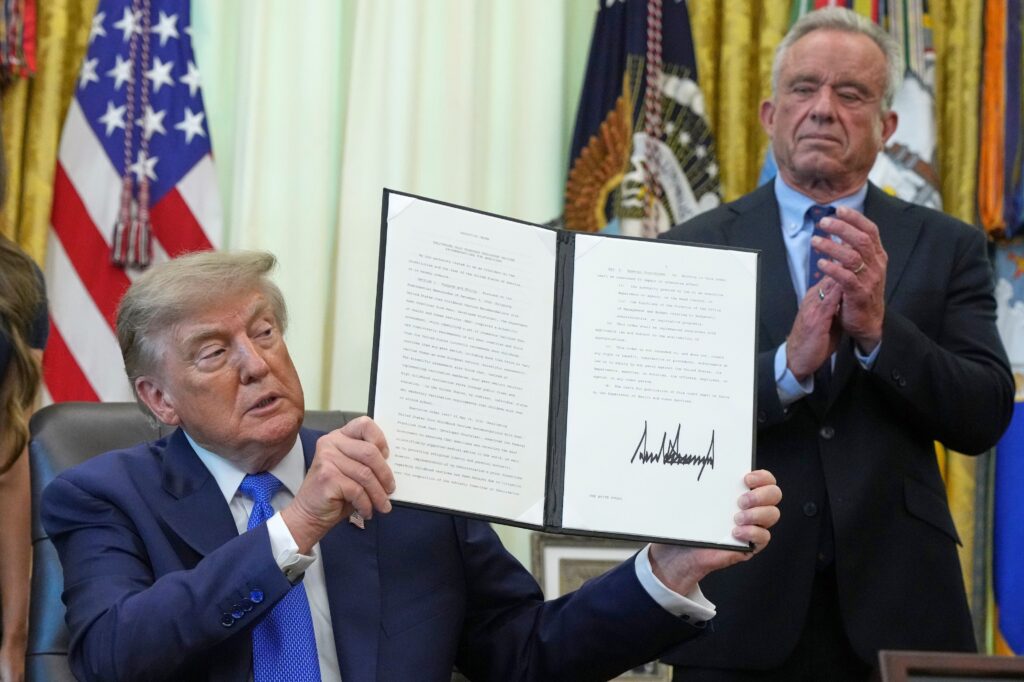
The Aug. 11 front-page article “Plan upends schedule for children’s vaccines” reported that President Donald Trump signed an order to decrease the number of childhood vaccines. Flanked by Health Secretary Robert F. Kennedy Jr., the president once again implicated vaccines in the pathogenesis of autism. We are researchers that study exactly this, and we disagree with Trump. There is strong evidence that vaccines do not cause autism.
Autism can be a devastating condition, but our research shows its increase in prevalence is not due to vaccines.
The diagnosis is today based on substantially fewer symptoms than previous decades. And in a 2015 study, our research showed that the occurrence of autism symptoms has remained stable despite rising diagnoses. This suggests that the increase is due to administrative changes rather than a true rise in the prevalence of autism. It also seems that today’s parents are more concerned by autism-like symptoms than they were in 2000, further driving the demand for autism investigation and diagnosis.
Our research has consistently shown that vaccines are not linked to autism development. The myth of a link between vaccines and autism should be debunked once and for all. Science should be based on evidence.
Jonas F. Ludvigsson, Stockholm
Anders Hviid, Copenhagen
Sebastian Lundström, Malmö, Sweden
Jonas F. Ludvigsson is a pediatrician and epidemiologist. Anders Hviid is head of epidemiology research at Statens Serum Institut. Sebastian Lundström is a psychologist.
I’m a pharmacist, and I am deeply committed to ensuring that decisions about childhood vaccination remain grounded in evidence-based practice. In response to the current shifts in U.S. vaccine recommendations, maintaining public confidence in immunization is more essential than ever for protecting community health.
In particular, the proposal to split combined immunizations like the measles, mumps and rubella vaccine is not only unsupported by scientific evidence. It would also be a logistical nightmare to produce due to a lack of available single-dose manufacturing.
Vaccines remain among the most thoroughly studied interventions in medicine. It is important that policy shifts and public discussions refrain from spreading unsupported claims that could undermine trust in established scientific guidance. I fully respect the importance of autonomy and shared clinical decision-making. Families deserve clear, accurate information that allows them to make choices that align with their values. A health care professional’s role is to support that process and ensure every decision is informed by the best medical evidence rather than by assertions that lack grounding.
Muhibo Abdalla, Leicester, England
The medical establishment’s condemnation of the childhood vaccine executive order conflates two issues and, in doing so, obscures a more important truth.
The vaccines essential for community protection — including measles, pertussis and polio — remain on the universal schedule.
The current measles outbreaks are a predictable consequence of coercive pandemic-era policies. Kindergarten vaccination rates were 95 percent during the 2019-20 school year and declined steadily throughout the Biden years. That is the origin story of the measles outbreak.
The executive order distinguishes between community and individual protective vaccines, applying shared decision-making to the latter. It is a move toward technology-enhanced, precision medicine. Parents can make decisions for their children based on that child’s health and have control over timing while still protecting their community. Offering alternatives brings people in. Mandating compliance pushes them out. Haven’t we already learned our lesson on this?
Americans will never get an apology from those who hid evidence and made the draconian decisions that shattered trust in public health. Rebuilding that trust requires meeting people where they are. The new childhood vaccination schedule is an important step in that direction.
Monique Yohnan, Washington
The writer is director of the Center of Better Health at the nonprofit Independent Women.
Don’t let China set the rules for 6G
Matthew Gould’s Aug. 10 online op-ed, “6G is coming. Will the West let China write the rule book?,” was right to warn about China’s aggressive efforts to write the rules for 6G artificial-intelligence-native networks and the technologies that will define the next decade. Global standards matter, and Beijing’s coordinated strategy deserves scrutiny.
When it comes to 6G, the key global discussions involve spectrum, which is the airwaves that carry 5G and 6G traffic. Freeing up more of it is critical to the integrated sensing and AI capabilities that 6G promises. The Trump administration’s 6G call to action, joined by more than 20 allied governments, is a welcome step. That vision should be backed with action: Accelerating the domestic spectrum pipeline will enable the United States to lead global spectrum discussions.
The Trump administration and Congress deserve credit for reopening the U.S. spectrum pipeline with the Federal Communications Commission’s Upper C-band auction scheduled for next year. The next step is to finish the job and finalize plans to auction the 2.7 GHz, 4 GHz and 7 GHz bands on an accelerated timeline, so America arrives at next year’s World Radiocommunication Conference with a credible pipeline that others can follow.
China understands that whoever controls the airwaves shapes the standards. America should, too.
Ajit Pai, Washington
The writer, a former FCC chair, is president and CEO of CTIA, which is a trade association representing the wireless communications industry.
Letter submissions
Send letters to [email protected].
Submissions must be exclusive to The Post and should include the writer’s address and day and evening telephone numbers. Letters are subject to editing and abridgment. Please do not send letters as attachments. Because of the volume of material we receive, we are unable to acknowledge submissions; writers whose letters are under consideration for publication will be contacted.
The post We study autism and vaccines. Trump’s executive order rests on flawed science. appeared first on Washington Post.