Tommy John, a canny left-handed pitcher who won nearly 300 major-league games, more than half of them after recovering from the innovative, often career-saving elbow surgery that came to be known by his name, died on Saturday at his home in Lakewood Ranch, Fla. He was 83.
The cause was bladder cancer, said his wife, Cheryl John.
John pitched for 26 seasons; only Nolan Ryan lasted longer in the big leagues in the modern era. At the height of his success — and after his recovery from the risky surgery — he won 37 games for the Los Angeles Dodgers from 1977 to 1978 and then 43 for the New York Yankees from 1979 to 1980, for a cumulative four-year record of 80-35.
A four-time All-Star who played in three World Series (though he was never on a championship team) and three times led the American League in shutouts, John won 288 games overall — the second-largest total for any pitcher not in the Hall of Fame, and more wins than many who are in the hall.
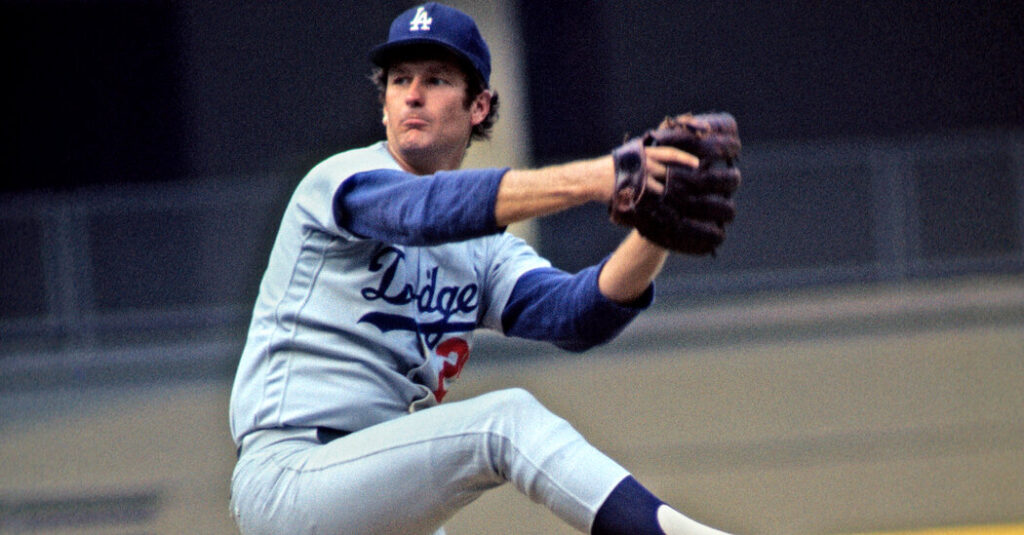
In 1974, the year that derailed his career — and, it can fairly be said, changed baseball — John was in his 12th major-league season and his third with the Dodgers. It was in Los Angeles that John had come into his own. Unlike his previous teams, the Dodgers had no qualms about the relative lack of juice on his fastball and urged him to rely on it. In his first two seasons with the team, he went 27-12, and at the All-Star break in 1974 he was 13-3, the best record in the National League.
On July 17, however, in the third inning of a game against the Montreal Expos, John threw a pitch to a hitter named Hal Breeden.
“As I came forward and released the ball,” he recalled in a 1991 memoir, “T.J.: My 26 Years in Baseball,” written with Dan Valenti, “I felt a kind of nothingness, as if my arm weren’t there, then I heard a ‘pop’ from inside my arm, and the ball just blooped up to the plate.”
After years of wear and tear from hurling the baseball, John had torn the ulnar collateral ligament on the inside of his left elbow.
“The only thing holding my elbow together was the skin and the nerve running through the joint,” he wrote. “The ligament was torn in two. The muscles on the inside of the arm were ripped loose and were sitting two inches out of place, toward my wrist. The ulnar nerve was badly bruised.”
At the time, any surgery on the arm, the elbow or the shoulder of a pitcher was rare and career-threatening, and John’s injury was so severe that his only hope of continuing to play was to undergo a procedure that had never been tried on a ballplayer.
The operation, performed by Dr. Frank Jobe on Sept. 25, 1974, consisted of replacing the ligament with a tendon grafted from John’s right wrist. Holes were drilled in the humerus and ulna bones, above and below the elbow, and the tendon was wound through the holes in a figure-8 shape.
The doctor’s uncertainty was whether the body would accept the new “elbow” or reject it. For John, the additional question was whether a long and grueling rehabilitation could return him to the mound — let alone in elite condition. (When he awoke from surgery, John later wrote, Dr. Jobe placed the chances of his pitching again at one in 100.)
It took a year and half to answer those questions, but John pitched his first post-surgery game on April 16, 1976, and went on to win 10 games that season, and lose 10 as well, with a better-than-average 3.09 earned run average.
Nicknamed the Bionic Man, he was named National League Comeback Player of the Year by The Sporting News and, as a religious Christian, he spent much of the off-season telling charity banquet audiences and civic organizations how God had helped him overcome the odds.
John followed his comeback year with his best seasons, and he won 164 games after receiving his new elbow. But the surgery was more than a personal triumph. It became commonplace in baseball — in 2023, about a third of active major-league pitchers had undergone the procedure — and has saved dozens of careers, for both pitchers and position players.
While not all players return, or return at the same level, at least three Hall of Famers (Paul Molitor, John Smoltz and Billy Wagner) had the operation. So have numerous other stars, including Shohei Ohtani, Stephen Strasburg, Jacob deGrom, Chris Sale, Jose Canseco and Justin Verlander; deGrom, Verlander and Sale even won Cy Young Awards after recovering.
The procedure, whose formal designation is ulnar collateral ligament reconstruction, swiftly became commonly known as Tommy John surgery.
Thomas Edward John Jr. was born in Terre Haute, Ind., on May 22, 1943, the second of two children of Thomas E. John Sr., a lineman for a utility company, and Ruth (Woods) John, who managed the home.
He played basketball as well as baseball for Gerstmeyer Technical High School in Terre Haute and was recruited by several college basketball powers, including the University of Kentucky. But he preferred baseball, and in 1961, at 18, he signed with the Cleveland Indians (now Guardians) organization and began his professional career in the low minor leagues in Dubuque, Iowa. Late in the 1963 season, he made his major-league debut.
He had a two-pitch main repertoire and lacked an intimidating fastball. His was usually clocked between 85 and 87 miles per hour — a turtle of a pitch, really, compared to those in the mid-90s and above thrown by many big leaguers.
But John’s fastball had natural movement, a downward fade — he often spoke of it as a sinker — that caused hitters to swing above it and either miss or hit the top of the ball, resulting in a plethora of groundouts.
His other pitch was a swooping curve that caused left-handed batters to wave desperately at the ball as it ran away from them and surprised right-handers when it returned from the opposite batters’ box to clip the outside corner on the way to the catcher.
The Indians, however, were wary of his lack of a power pitch. Early Wynn, the Hall of Famer who was then the team’s pitching coach, encouraged him to develop a slider — a breaking pitch thrown harder than a curve, with a shorter, sharper break. John adopted it, but throwing it frequently hurt the movement on his fastball.
The team quickly lost confidence in his promise and traded him to the Chicago White Sox. There he became a legitimate starter over seven up-and-down seasons. In 1971, the White Sox traded him to the Dodgers for the slugger Dick Allen.
In 1975, while John was recovering from his arm surgery, an arbitrator ruled that baseball’s reserve clause, which contractually bound players to their teams as long the teams wanted them, should be invalidated, thus beginning the era of free agency. After the 1978 season, John tested the market and was signed by the Yankees.
His first two seasons in New York were stellar, but at 39 his talent began to decline, and in midseason 1982, the Yankees traded him to the California Angels. Tenaciously, he hung on for seven more seasons; in addition to the Angels, he pitched briefly for the Oakland A’s in 1985 and returned to the Yankees in 1986.
For mediocre Yankee teams in 1987 and 1988 — and by then in his mid-40s — he started more than 30 games each year, going 22-14. His career ended the following May, when the Yankees released him.
After his playing career ended, he worked as a television analyst, as a coach, in the front office for minor-league teams and as a motivational speaker. He also came to criticize the ballooning — and, in his view, reckless — use of Tommy John surgery on increasingly hard-throwing preprofessional players; today, more than half of the surgeries are performed on teens.
John married Sally Simmons in 1970; they were divorced in 2013. He married Cheryl Beecher Zeldin in 2021. She survives him, as do three of his children from his first marriage, Tommy III, Travis and Tamara Mannelly; a sister, Marilyn Hyde; and two grandchildren. His son Taylor died in 2010, reportedly because of a seizure and heart failure caused by an overdose of prescription drugs. After some years living in New York and California, he and his wife moved to Lakewood Ranch in 2021.
John’s 26-year career totals include a 288-231 won-lost record, a 3.34 earned run average, more than 4,700 innings pitched, 2,245 strikeouts and a 1.28 WHIP (walks plus hits per innings pitched).
While those statistics are borderline Hall of Fame-worthy, he never came close to being voted in. Many have felt he should be inducted given the importance to the sport of the surgery named after him.
Baseball history might very well have been different if John had decided against the operation — or if the surgery had come along earlier and reclaimed lost careers like that of Sandy Koufax, the great Dodger left-hander who retired in 1966, at 30, with unendurable elbow pain.
“Sandy Koufax teases me,” Dr. Jobe, who performed the first Tommy John surgery, said in 2013. “He said: ‘Why weren’t you smart enough to come up with that 10 years before? Then it could be called the Koufax operation.’”
Alex Traub contributed reporting.
The post Tommy John, Pitcher Who Gave His Name to Career-Saving Surgery, Dies at 83 appeared first on New York Times.