14 years after the first “Avengers” movie hit theaters, superheroes have become a bore. Their supernatural strength, their predictable near-indestructibility, their vehicles or magical powers that whoosh them in and out of multiverses galore. Can any of it stand up to what is happening to the world outside? And when the stakes are so ridiculous, does any of it actually resonate?
We don’t need Mr. All-American-From-Krypton or a showboating billionaire with a bat attitude. Not with the federal government currently at war with itself, its populace, its Constitution, all common decency and Iran. Even Lex Luthor might cringe at the brazen corruption of our oligarchs. No, this is not a job for Superman. Nor is it one for several gaggles of superheroes — the Avengers, the X-Men, the New Avengers and sundry others. Sure, they know how to oust alien invaders, but they also tend to destroy entire cities in doing so, leaving the normies to clean up their messes.
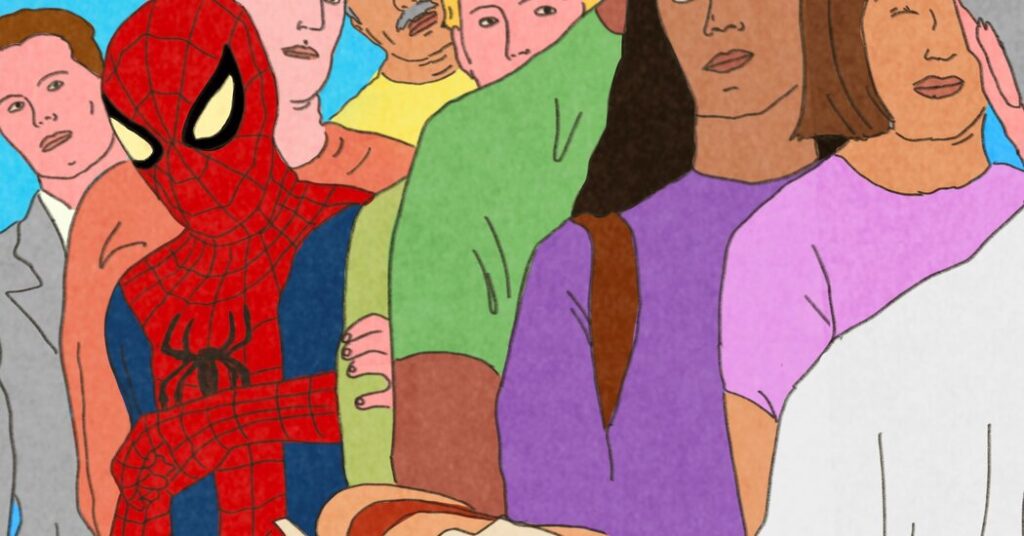
We need just a spider. Two weekends ago, the perpetually put-upon Peter Parker swung into action again in “Spider-Man: Brand New Day” in almost 4,500 theaters across North America, frantically juggling supernatural, romantic, financial and psychological battles. He doesn’t get through them with ease, but along the way he handily broke the domestic box-office record for a movie’s opening week, surpassing $500 million. The worldwide gross may well reach $2 billion this weekend. The success affirmed what many of us felt in our gut: If you want or need any superhero right now, you’re better off with Spider-Man.
Which is funny because, by most Marvel measures, Spider-Man is not particularly impressive. He can scamper up walls, can shoot and swing from sticky webbing and has superhuman strength and that spider sense. That’s about it. He can’t fly; one of the reasons he is so identified with New York City is that he needs the architecture to get around. Plunk him down in an Iowa cornfield, and the guy has to walk. He’s not immortal or immune from injury. Bullets don’t bounce off him; he even gets shot in the new movie and ends up in the hospital.
He doesn’t have a hidden high-tech lair filled with an endless arsenal of deadly crime-fighting gadgets. In “Brand New Day” he has an attic workshop where he makes his own devices. And he’s not superhero hot. Yes, he’s impressively jacked in the new film, but when he has to strip off his kit to meet with Black Widow in a Russian bath, he still looks like a nervous teen.
Believe it or not, Spider-Man was almost doomed to the wastebasket before he ever existed. In the early 1960s, Stan Lee pitched his publisher the idea. The response: “Stan, that is the worst idea I have ever heard,” Mr. Lee recounted to BBC Radio 4 in 2015. “First of all, people hate spiders, so you can’t call a book ‘Spider-Man.’ Secondly, he can’t be a teenager — teenagers can only be sidekicks. And third, he can’t have personal problems if he’s supposed to be a superhero — don’t you know who a superhero is?” But Mr. Lee pulled together a story and published it in the final issue of a canceled comics title in the summer of 1962, and Spider-Man took off.
That’s because Spidey’s limitations make him more, not less, of a superhero. He’s finite right down to his crime-fighting brief and his classic territory — baddies in New York City, no more, no less. That’s a powerful part of his unspoken mission statement: Act locally. Be the friendly neighborhood Spider-Man. Plus, he’s entangled. Yes, he has archenemies like Green Goblin and Doctor Octopus. But he has friends and frenemies, a horrible boss, that on-again, off-again romance and a secret he does everything to protect. That pretty much describes me and everyone I know.
That’s what made me love Spider-Man as a kid. When I was growing up in rural Wisconsin in the late ’70s, far from any place you could buy a 45 record or comic book, The Milwaukee Journal had “The Amazing Spider-Man.” He was the only superhero I ever imagined being — a young man living in the city, trying to keep it all together with a combination of frayed nerves and spider silk.
It was impossible to be Superman. I was never going to be as rich as Bruce Wayne. But, hey, I was good at science. For all I knew, I could visit a lab on a school trip, get bitten by a radioactive spider and start transforming. And this fantasy came with a bonus, which any teenage boy going through the agonizing social-sexual changes and perplexities of puberty could relate to. (If only every adolescence came with one supercool secret instead of 1,000 embarrassing ones.)
Peter Parker is finally an adult in “Brand New Day,” but he’s still fighting the same demons. That’s what makes him burn so bright right now: how refreshingly uninfected he is by the shallow, deluded fantasies of power being sold like snake oil on our national stage every day. He’s not a fitness influencer selling deep thoughts and peptides. He’s not a culture-warmonger pushing machismo and hate against a trumped-up enemy. He’s not a dark-money tech titan mythomaniac propping himself up on a pedestal as humanity’s savior. What these master of the universe wannabes have in common is that they are selling you a superhero fantasy you can’t afford — a dream of unlimited muscle, longevity, wealth or power, of living your true potential.
Spider-Man lives in the here and now — New York City, today, give or take — and he’s fully entangled with all the obligations that entails. It might seem that his stakes are low compared with the world’s. But then, he is actually interested in facing up to his mistakes. Doing the right thing.
The greatest challenge Spider-Man always has to contend with is the oft-repeated words of his ill-fated uncle Ben: “With great power comes great responsibility.” It’s something that those with great power today might want to consider.
David Colman has been contributing to The New York Times since 1996.
The Times is committed to publishing a diversity of letters to the editor. We’d like to hear what you think about this or any of our articles. Here are some tips. And here’s our email: [email protected].
Follow the New York Times Opinion section on Facebook, Instagram, TikTok, Bluesky, WhatsApp and Threads.
The post He’s Awkward. He’s Sticky. He’s the Best Superhero. appeared first on New York Times.