Judith Zilversmit, a journalist in Amsterdam, was checking her Instagram in October 2023 when she noticed a new message. A woman she did not know said she had information about Zilversmit’s family.
“For several months now, I’ve had a knot in my stomach,” the message read. “I would like to share something with you, but I am so afraid of writing something wrong. Two years ago, I discovered in an old newspaper article that my grandmother, who lived at home until I was 18, had a dark past. She betrayed your father and the rest of the family, among others.”
The writer identified herself as Ingeborg Boelen, a Belgian woman who lived near the Dutch border. She talked of how she had obtained her “sweet grandma’s” criminal file from a Belgian judicial archive and that it included the details of her grandmother’s collaboration with the Nazis during World War II. She invited Zilversmit to contact her if she wanted more information.
Zilversmit, 49, remembers being so startled that she swiped the message off her screen.
Who was this stranger reaching out about the wartime betrayal of her family? What did she know? What did she want?
“My first reaction was, ‘What am I supposed to do with this?’” Zilversmit said in an interview.
Zilversmit already knew the broad outlines of her family’s Holocaust history. Her father, Hans, who died in 2014, told her that as a child, he, his parents and his sister had fled to Belgium when Germany invaded Holland in 1940.
They were hiding in a town near the border in 1943 when someone betrayed the family. The Gestapo showed up suddenly at their hiding place. The family tried to escape by climbing onto the roof and dropping into the yard.
Hans, then 14, and his parents got away. His sister, Helga, 19, was captured and, like some one million other Jews across Europe, sent to Auschwitz.
Did Zilversmit need to know more precise details about who, exactly, had betrayed them? She wasn’t sure.
These sorts of questions have become increasingly relevant as some European governments create access to enormous, once-sealed archives related to the postwar judicial trials of accused and suspected Nazi collaborators.
For many, the trauma of the Holocaust has lived beneath the surface of daily life for decades, too painful to confront. But now second- and third-generation family members are getting access to archives of collaboration. In some cases, it’s opening old wounds.
In Zilversmit’s case it is also inflicting new ones, as her renewed curiosity about her family’s past has erupted into a dispute over who has the right to tell their story, and how.
Hidden History
Months after the Instagram message, Zilversmit decided as a journalist that there might be value in sharing her family history and her interactions with a collaborator’s granddaughter. Others might be grappling with similar encounters.
She discussed it with Annet Röst, who makes podcasts for Dutch newspapers including Het Parool, where Zilversmit then worked. They decided to make a podcast that would end up being six parts — “The Betrayal of the Zilversmit Family.” It would focus not just on the past, but on events of the present as well.
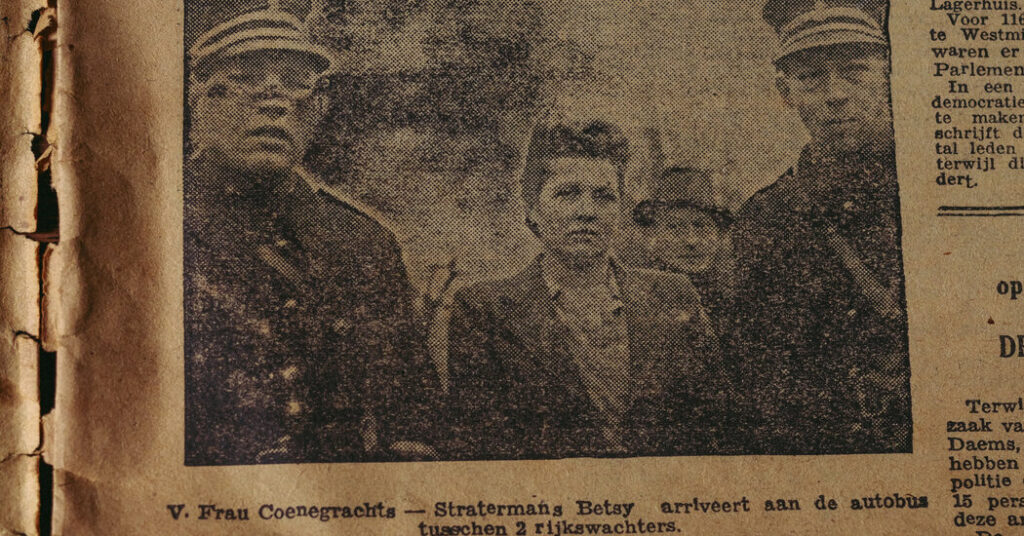
To prepare, Zilversmit began her own research, scouring her mother’s cellar for boxes with her grandfather’s and father’s files and talking to relatives, historians and other experts. Boelen had already filled her in on some basics about her grandmother, Maria-Elisabeth Stratermans-Coenegrachts, the informant, who went by Betsy. There was other material online.
Boelen’s grandmother and her husband, Lambert, had run a cafe in Vroenhoven, on the Belgian side of the Dutch-Belgian border. But her grandmother had also worked as an undercover informant for a leading German Gestapo agent, Richard Nitsch.
She infiltrated resistance groups, turned in their members and caught at least one Jewish family in her net — the Zilversmits. Tried and convicted after the war, Stratermans-Coenegrachts was sentenced to life in prison, but gained clemency and was released in 1951.
Boelen had gone to some lengths to learn about her grandmother. In Belgium, those seeking such records from judicial archives must petition the state to see them. Usually they need to prove a direct familial link to the accused collaborator, or approval from a family member — with a few exceptions for researchers and the like.
Such restrictions are designed to protect the families of collaborators, who after the war had been vilified, their heads sometimes shaved, their clothes torn off. But descendants of the Holocaust victims must request permission from the collaborator’s family members.
In her Instagram note to Zilversmit, Boelen effused about what she had found in the files.
“I also have the voluminous testimonies of your grandparents, M. Zilversmit and Th. Lebenstein, your aunt Helga, and those to whom she entrusted items, Hazelet, Kraay, Franssen, etc.” She added encouragingly, “Should you wish to know more, you are always welcome.”
Who Gets to Tell the Story?
Zilversmit was not the only person interested in reviewing Boelen’s materials. When Boelen realized what was in the documents, she had asked a historian to read them because the historian had published a book that touched on some of the same figures.
The Dutch historian, Marie-Cécile van Hintum, had decided to write a book, with the tentative title “The Betrayal of the Zilversmit Family.” Van Hintum has asserted she came up with the title first; Zilversmit said Röst came up with it independently for the podcast.
Van Hintum, a well-regarded author who specializes in World War II topics, coauthored two books edited by the Dutch historian Ad van Liempt. He described her as “a very talented writer and a very good and serious researcher.” Her 2019 book, “Lokerman,” focused on a Dutch resistance leader from the southern Netherlands, in the region where Boelen lives.
Zilversmit said van Hintum reached out to her and they met at a local cafe, then at Zilversmit’s home, where they discussed their backgrounds and looked at Zilversmit’s family photos together.
Months later, van Hintum biked over to Zilversmit’s mother’s house in a leafy district of Amsterdam. The two women and Zilversmit’s mother, 80, sat in the living room with Röst, going through her father’s and grandfather’s boxes. There were letters, newspaper clippings, a yellow Jewish star, documents stamped with swastikas, and lists of looted property. Zilversmit agreed to let the historian take the boxes as research for her book.
“I thought we would work together, each on our own separate projects,” Zilversmit said. She said she assumed van Hintum would write a book focusing on Boelen’s grandmother and she would tell a personal story in her podcast.
Van Hintum declined to give an interview to The New York Times until after her book is published (no date has been set). But Zilversmit and Röst recorded their conversations with her and allowed The New York Times to hear the tapes.
During the conversation, some of which was included in the podcast, van Hintum said the material was fascinating but much more than she had anticipated or could carry off on a bicycle. She called a friend with a car to pick her up.
While they waited, Zilversmit mentioned that she looked forward to hearing from van Hintum if she discovered something exciting in the boxes. Van Hintum paused.
“I don’t know what you expect,” she said. “What you’re expecting from me. I can’t contribute much in terms of content. So it depends on the focus of your podcast.”
Van Hintum explained that she was on a tight schedule with her book, and could not simultaneously do research for the podcast.
The collegial tone of the conversation quickly evaporated.
“You can probably tell what would be interesting for us,” Zilversmit said. “If you come across something interesting, you could just say, ‘Hey, look at this letter …’ That would be enough for us.”
Van Hintum repeated her concerns about her book and said she didn’t have enough time to “report to you about what I come across.”
Zilversmit took offense. “I find it strange that I’m giving you all this information, all this stuff,” she said, “and you won’t share with me what you find. That’s crazy.”
“I’m going to share it,” van Hintum replied. “But in my book.”
Zilversmit described in her podcast what happened next.
“I looked at the table,” she narrated, “at these boxes that were so carefully preserved by my grandfather and then by my father.” She continued, “I understand what’s she’s saying, but I can’t comprehend it. She would rather keep anything that she finds for her own research. She’s not going to do any work for us.”
“I’m sure you can imagine how I feel,” van Hintum said in the recording.
“Actually, I can’t,” Zilversmit replied. “It is my family, my material, and you want to hold onto it so you can have success for your book. I find that very unpleasant.”
The argument escalated. The podcaster, Röst, turned off the recording device.
When van Hintum’s ride arrived, she walked out, leaving the boxes on the table.
Across the Border
Van Hintum has argued that Zilversmit’s podcast, which streamed in the Netherlands last year, mischaracterized her as “someone who does not want to share and cooperate and who wants to run off with her family archive.”
“I shared my initial research results with Judith in confidence, long before she came up with the idea of making a podcast,” she said in a statement she sent in May to members of a panel in Amsterdam that invited Zilversmit to speak about intergenerational feelings of World War II trauma and shame.
“My information and book outline titled ‘The Betrayal of the Zilversmit Family’ played a crucial role in her plan for a podcast,” van Hintum said in her statement.
Zilversmit, who disagrees with that contention, still had another avenue to learn more about her family’s history — Boelen. After the initial Instagram message, Zilversmit said she and Boelen continued to chat online, and that Boelen kept promising Zilversmit could “come with all your questions,” and look at the judicial dossier.
Before visiting Boelen in Belgium, Zilversmit spoke with Esti Cohen at Jewish Social Work in the Netherlands, which helps descendants of Holocaust victims with research and with the processing of difficult histories. She advised Zilversmit to set appropriate expectations.
“Sometimes people want to have some kind of acknowledgment from the Jewish side that they have also suffered, or that they also have trans-generational trauma,” Cohen said in an interview. “While that may be true, most of the Jewish people from the second or third generation are not ready to give that. We see here that it’s too painful.”
Boelen declined to speak with The New York Times until van Hintum’s book is published. But Zilversmit and Röst recorded their conversations with her during their visit. At Boelen’s home, a spacious, three-story house, she served Zilversmit and Röst an enormous lunch — egg salad, fish, salads and other dishes that she had been preparing for days. While they ate, Boelen talked nonstop about her family, her childhood and her health, which she said wasn’t good. After lunch, she led them upstairs to a library full of books where they continued talking.
Zilversmit asked Boelen about looking at the archival material she had received from the government. Boelen balked.
“Oh, yeah, I’m going to keep that closed for now,” she said, according to the recording. She explained that she had promised van Hintum that she would not let Zilversmit see it until the historian was finished with her book. “I hope that the trust between you returns,” Boelen said.
Zilversmit said her project would not interfere with van Hintum’s book, that she only wanted to tell her own family story. Boelen said at one point that perhaps the argument between the historian and the journalist boiled down to who should make them public first.
“The two things can exist completely side by side,” Zilversmit replied.
But Boelen would not budge.
When the conversation was over, Boelen took the women upstairs to the attic and showed them paintings she had made. Zilversmit was surprised — some depicted scenes from a book that Zilversmit’s aunt, Helga, had written about her experience in surviving the Holocaust.
The memoir, “Through the Eye of the Needle,” published in 2006, describes the terror of the family’s betrayal: Helga’s mother jumping from the roof, hitting an electrical pole and plunging the neighborhood into darkness. Her father hiding behind a chimney. Helga falling to the ground, hurt and captured. Her brother, Hans, able to escape and climb on a passing train.
Imprisoned for time in a military barracks, Helga was later sent to the Nazi death camp Auschwitz-Birkenau, where, healthy and young, she was picked to make hand grenades and to move the baby carriages of murdered children. Some of the carriages held teddy bears and milk bottles.
“We still heard their screams,” she wrote.
One Boelen painting showed the carriages in flames. Another the gates of Auschwitz. Hans was depicted running for the train, Helga at her typewriter.
“I found it completely surrealistic, to find that there were pictures of my family, here in a Belgian attic,” Zilversmit said in an interview.
The Podcast
Zilversmit’s podcast began streaming last November. The episodes drew more than half a million listeners, which ranks as very popular in the Netherlands, a country of 18 million people.
Zilversmit told her listeners that her family’s greatest betrayal was initiated by Boelen’s grandmother. But she said she thought they had been mistreated again. She could not make sense of van Hintum’s unwillingness to share information with her. And why would Boelen reach out to offer access to the records only to withhold them?
Yes, she said in an interview, she might be able to access the records herself through a researcher — and still might — but that wasn’t the point.
In May, Zilversmit was invited to participate in the panel on intergenerational trauma and shame. The discussion, “Descendants: Dealing with a loaded family past,” was held at De Balie, a prominent Amsterdam cultural venue that hosts lectures and debates.
Before the event, van Hintum wrote to De Balie, to Zilversmit and to other members of the panel to express her feelings. Zilversmit and the organization shared copies with The New York Times.
Van Hintum said she felt that she had shown respect for Zilversmit as a descendant of Holocaust victims and did not think she had been treated fairly.
“It is, of course, not a question that Judith has a right to her family’s war history,” she wrote. “However, she seems to think that she is also automatically the owner of many hours of research work by someone else — in this case, mine.”
“Against my will and without my permission,” she continued, “I play a significant role in her podcast that is damaging to my reputation as a researcher and as a human being.”
She disputed that she had given her permission to be in the podcast and said some of the recordings had been “partly covert.”
On the tapes, there is no discussion of whether van Hintum consents to being in the podcast. But Zilversmit says the historian was fully aware she was being taped, as van Hintum spoke into the microphone and introduced herself. Röst has a photo of what she said was their meeting in Zilversmit’s apartment and the recording equipment is visible in front of van Hintum.
At De Balie, the discussion in the theater began with Zilversmit discussing her podcast with the moderator, Ianthe Mosselman. She outlined her concerns over access to her family’s records and spoke of her surprise at seeing “hundreds” of paintings of her family members in Boelen’s house.
Suddenly someone began shouting from the audience. It was Boelen. She wanted to correct something Zilversmit had said.
Tension filled the room. Mosselman asked Boelen to reserve her comments and questions for the end of the discussion.
Roughly an hour later, Boelen was given the opportunity to speak from the audience. She said she thought the podcast was well done and effective in creating drama and drawing in listeners.
“But there are things where I think that, well, this is no longer an objective representation of realities,” Boelen said, “but a subjective work that you have created, and in some parts that no longer corresponds with reality at all.”
There weren’t hundreds of paintings, she added, just 30 or so. They weren’t about the Zilversmit family, just images from Helga’s book. She went on for a bit, and then the moderator stepped back in.
“You have, of course, your story, and Judith has her story,” Mosselman said. “It will never be one story, and maybe these two stories can never really come together.”
Zilversmit, onstage, took stock.
“Maybe it’s what Esti Cohen said in the podcast,” she offered. “Maybe the time is just not yet ripe in this generation, for this kind of conversation. Maybe in the next generation.”
The post As the Old Files Open, One Family Confronts Another’s Dark Nazi Past appeared first on New York Times.