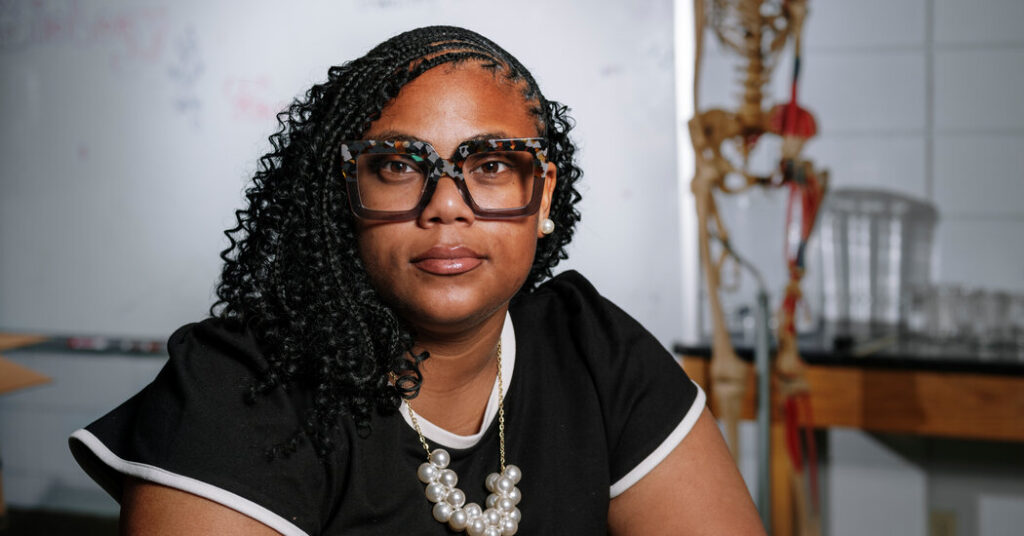
Crystal Barnes teaches high school biology in Pine Bluff, Ark., and in March she had a student who kept falling asleep in class.
Barnes could have scolded the girl, sent her to the principal’s office or simply let her fail. Instead, she asked the student why she was always sleepy.
It turned out that the girl’s parents were out of the picture, so she had been sent to live with her grandmother. The grandmother didn’t have a bed for her, so the girl didn’t get much sleep.
Barnes then bought a bed frame and mattress topper on Amazon for $119.97 and a mattress for $43.80 from a shop owner who gave her a discount when he heard the purpose. Barnes made the purchases with savings from her $50,000-a-year teacher’s salary. Another teacher contributed sheets and a comforter.
Barnes went to the girl’s house and set up the bed — and found that termites were devouring the house and that the electricity had been turned off for nonpayment of bills. And the student was also helping to raise two younger children living in the house.
The girl was very grateful for the bed but had one more worry. “Can you give me some food?” Barnes remembered her asking. “I’m hungry.”
The student’s plight — effectively orphaned, no bed to sleep in, little food to eat, dozing in class in an impoverished school district that the state rated as failing — is a reminder of how many American children face immense challenges.
“This is my life, this is what it’s going to be for me, and hey, that’s all, and that’s it,” Barnes recalled the girl telling her.
Those challenges — and our national failure to address them — were the topic of my recent columns from a 1,000-mile road trip from Oklahoma to Kentucky. As I interviewed one desperate young person after another on the trip, I fumed that we squandered tens of billions of dollars bombing Iran but couldn’t afford modest sums to adequately feed and educate hungry American children.
That national failure is acute. But something more must be said: There’s another side of America that you also see in towns like Pine Bluff. It’s the ordinary heroes like Barnes who step up to help.
Barnes can’t undo the crisis caused by the Trump administration’s pushing 1.5 million children off food stamps over the last year. But she buys snacks with her own money and keeps a cart of them in her classroom for hungry children like her sleepy student. It’s not a solution. It’s not enough. But it’s something. It’s a way of pushing back at the night.
This is my annual “win a trip” journey, where I take a university student along on a reporting trip. I wanted my winner, Brunella Tipismana of Yale University, to see the most critical needs and failings of this country, but I also wanted her to see the heroic responses of volunteers and donors.
I see leadership not so much in Washington as at America’s grass roots. Our president and his family are enriching themselves even as he cuts funds supporting struggling families, but many ordinary Americans like Barnes are reaching into their own pockets to try to meet the needs of those with less. I’m awed by the church-run pantries, volunteer mentoring programs, after-school sports leagues coached by moms and dads — the army of good-hearted people across the country who try to keep their fingers in the dike. This is what Tocqueville admired about America almost two centuries ago, and it remains one of our strengths.
Yes, this is a dispiriting time. Two-thirds of Americans say our country is “pretty seriously” on the wrong track. But maybe we can find a dollop of inspiration from those who selflessly step up to do what they can. Their efforts ripple through the lives of others in ways that are difficult to foresee.
Why is Barnes a dedicated teacher? In part it’s because when she was a teenager — pregnant at 15 — she found a refuge in a nonprofit called TOPPS, for Targeting Our People’s Priorities With Service. It was founded in 2002 by Annette Dove, a former teacher who wanted to help young people hungry for food and guidance. (I’ve described Dove as America’s Mother Teresa.)
Dove provided food for Barnes’s son, and later after-school tutoring and guidance, while mentoring Barnes and helping her graduate from high school and then from college. “It was life-changing for me,” Barnes said, and now, in turn, she helps young people through TOPPS.
“People make bad choices,” she acknowledged, but she also questions whether young people are set up to make the right choices. So she decided to repay the help she got by becoming a teacher, the kind who feeds her students.
Secular liberals point to the hypocrisy of some evangelical Christians who proclaim their piety while acting as if Jesus’ central message were about banning abortion or shunning gay people rather than feeding the hungry and healing the sick. The criticism seems fair to me: White evangelicals have been strong supporters of President Trump, even as he has cut food stamps and Medicaid.
Yet it’s also true that in small-town America, programs to help the homeless and hungry are often organized by churches, including evangelical ones funded by the generosity of conservative Christians who tithe 10 percent of their incomes. In a complicated world, those efforts deserve admiration, respect and thanks.
“Before I found out about this place, I was struggling,” Myriha McNeel, 30, told me as she gathered groceries at Caring Community Friends, an antipoverty nonprofit in Sapulpa, Okla., for her three children. The group’s food pantry, backed by local churches and businesses, operates four days a week and is staffed in part by 20 regular volunteers.
The pantry also runs a community garden and a Christmas “shop” for children’s gifts. “Local churches are a pillar of this,” said Lanaya Johnson, a greeter at the pantry. “They’ll call and say, ‘We have a new family with no food,’ and we’ll step in.”
To me, morality encompasses both personal behavior and public positions, so I wish that more religious conservatives would support government programs for the needy and that secular liberals were more personally charitable. Giving patterns are complex, but researchers have generally found that conservatives donate more to charities, largely because of religious giving; secular liberals are generous with government funds but less so with their own money.
And nonprofits can provide opportunities that transform lives. I saw that in Manchester, Ky., an area hard hit by drugs and the loss of coal mining, where I met an astonishing young man named Dylan Grace.
Grace’s father was never around, he said, and Grace has lost his mother and sister, plus a brother who was shot and killed. Now 18, Grace lives in a dilapidated home with his stepfather, who he said does odd jobs and earns $400 or $500 in “a really good month.” The household had its $560 a month in food stamps cut off in May, apparently part of a nationwide crackdown under Trump that has trimmed about 11 percent of recipients from the food stamp roster over the last year.
“We’ve had to cut back on luxury foods,” Grace said. I asked for an example of a luxury food. Frozen lasagna, he offered.
Yet Grace is determined. He worked 40 hours a week in high school while excelling academically and finding time to earn college credits online. This summer he’s working full time at a Dollar General at $10 an hour.
Grace attends Alice Lloyd College on a full scholarship from the school and a program called the Thompson Scholars Foundation, which works with Save the Children and supports young people in Appalachia with mentoring and scholarships. Grace is hoping to be an elementary school teacher — because his own teachers so inspired him, especially an English teacher who treated all her students with great respect and dignity, he said.
Bravo to the donors of Thompson Scholars and Save the Children, for they have transformed Grace’s life and perhaps those of children he will teach for decades to come. But while driving on this road trip, I kept thinking: When we built the Interstate highways that revolutionized America, we didn’t rely on volunteers each paving 100 square feet of road. Rather, we had the government invest in highways that knit states together, because it was a national priority.
It seems to me that it should be just as much a priority today to ensure that our children are fed and educated and have a fair shot at life. That, too, might knit our country together and help rekindle the American dream.
The Times is committed to publishing a diversity of letters to the editor. We’d like to hear what you think about this or any of our articles. Here are some tips. And here’s our email: [email protected].
Follow the New York Times Opinion section on Facebook, Instagram, TikTok, Bluesky, WhatsApp and Threads.
The post Where the Teacher Is a Hero appeared first on New York Times.