SWOLSZEWICE MAŁE, Poland — Our “premium meth” is starting to burn.
“It’s going to blow!” Hoyt shouts as smoke clouds the kitchenette.
Sweating in a hazmat suit, I switch off the burner. The goo bubbling in our saucepan is supposed to be blue. Blue Sky. The boss won’t like that it now resembles tar.
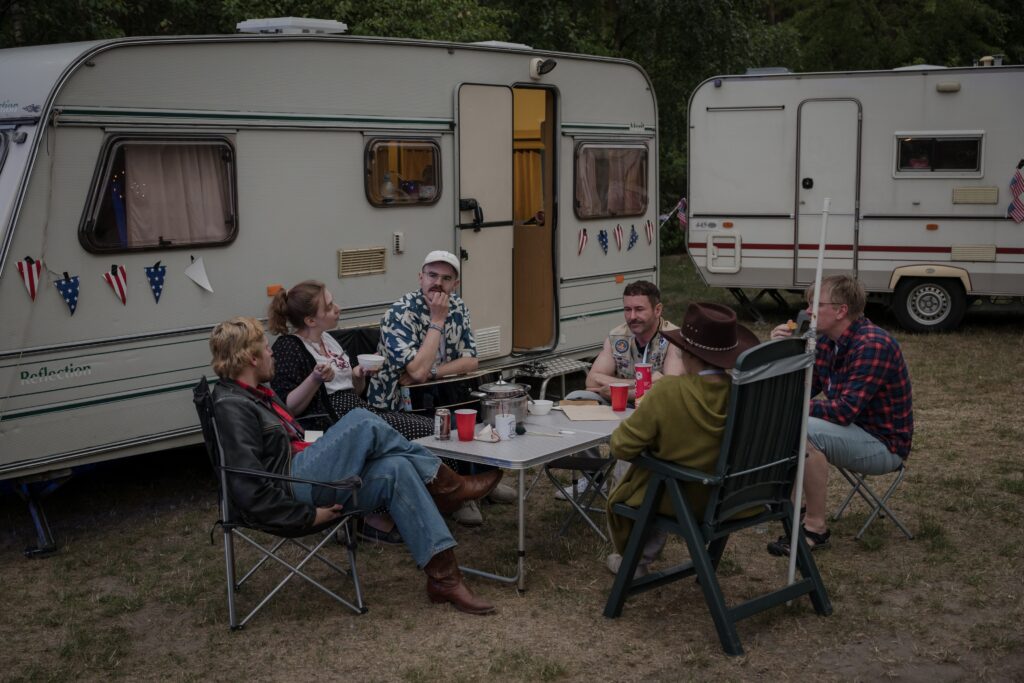
It’s nearly midnight, and we’re eight hours into an elaborate game that almost no one wins. Live-action role-playing more typically deals in history or fantasy — the dramas of Regency debutantes, say, or goblin assassins — but this loose script reflects how its Polish authors view modern American struggles. While the United States was celebrating with flyovers and fireworks, I joined dozens of Europeans acting out a grittier version of the Fourth of July in a pine forest outside Warsaw. For 28 straight hours, we’d pretend to scrape by as dwellers of an Ohio trailer park.
My character, Delilah, evoked Erin Brockovich meets Walter White. Fired from a corporate lab after flagging lethal toxins, the chemist has turned to concocting street drugs with a gangster half her age, which is straining her already wobbly marriage to a garbageman. What Hoyt and I have botched in our makeshift lab is nothing more sinister than blue raspberry rock candy.
“It’s not going to blow,” I say, recalling my temporary alter ego’s chemistry degree. I’m committed to the bit and figure the singed gunk on the stove is still our best shot at what counts here as a Happily Ever After.
Over our weekend together, my 66 fellow LARPers revealed themselves to be a largely studious bunch. They hadn’t come from across Europe — and a few U.S. states — to mock the hardscrabble Midwest. I saw an eagerness to explore the awkward contrast between our vaunted national ideal and the darker stories we broadcast about ourselves. Everyone had thoughts on America, having listened to our pop stars and watched our shows and worked with us in the far less fantastical realms of business, engineering and quantum physics. Now they wanted to know what it felt like to be us, or who they imagined us to be.
We’d fashion mini-quests out of applying for jobs, paying rent, writing scholarship essays and baking apple pie. Our characters were supposed to scream and cry and otherwise geyser emotion, but I’d hear the rawest insights into the American Dream in sideline chats with the humans behind the roles. What would stay with me — and at one point freak me out — were flashes of real in the make-believe.
But first, I’d have to salvage what was left of our blackened Blue Sky.
Safe words and safety nets
Every society has rules. Pristine Park mandated littering.
Trash goes on the ground, our guide told us at orientation. Except for food. That could attract rabid foxes.
“This is a trailer park, so it’s supposed to be sh–ty,” the millennial woman in a “Fourth of July”-branded baseball cap said matter-of-factly.
So speech could be free and offensive here, too.
We learned the safe words (“yellow” to de-escalate, “red” to stop), how to feign intimacy (tickling another player’s arms, with consent, constituted sex) and how to stage an execution (aim a blank-shooting revolver well above your victim’s head). If the action got too intense, a designated “off-game” break room offered loungers and blankets.
Down the stone path, other crew members were transforming a timber-framed pavilion into Joyce’s Diner, stringing up dozens of little American flags. We could order tea there, our guide said, but coffee would be more American.
Coffee more American, I jotted down, straining to keep up with the sensory overload designed by those who know us mainly through screens. At the entrance, I spied a crudely scribbled red, white and blue sign (OHIO BROKEN DREAM). The grass was covered with red Solo cups, paper plates and — was that a ramen sauce packet or a condom wrapper? A portable speaker blared “Battle Hymn of the Republic.” Someone was pumping air into an inflatable pool. Someone else unfurled a rainbow banner from the window of the “hippie trailer.”
Four months earlier, I’d been scrolling Instagram at home in Washington when a blond in jorts — everywhere, jorts! — stared from my feed.
“In Poland, there is a LARP group that roleplays as contemporary Americans,” the photo caption said.
Some light Googling revealed a production studio called LarpVenture had scheduled the next run for the weekend of America 250. I texted a screenshot to my editor.
“Please confirm this is true,” he replied, “so we can book the first flight to Warsaw.”
Soon I was on a video call with one of the creators, who’d never visited the United States.
“When I was a kid, everybody knew that America was the best country in the world with no problems at all,” Bartosz Bruski, 33, told me. New York City looked so cool in every single movie. Harrison Ford, Al Pacino, Batman — his idols were American.
“But then,” Bruski said, “there was a huge clash between that vision of the U.S. and the vision that came to us later through social media.”
His team hadn’t intended to construct downer-ville. Before the pandemic, they’d been scouting locations for a LARP that blended “Stranger Things” with “The X-Files.” “This looks like a trailer park,” one staffer quipped of the vinyl cabins at Resort Iłki, and a new direction bloomed.
“Barely making their ends meet,” the event teaser asserts in slightly stilted English, “they try to be good parents for their families and proud Americans … ”
Years of devouring American pop culture informed the script, Bruski said. LarpVenture’s website named two nonfiction books as key sources: JD Vance’s memoir about his troubled Appalachian upbringing, “Hillbilly Elegy,” and “Nomadland,” a look at would-be retirees chasing seasonal work in RVs.
A native of Indiana, I grew up steeped in the conviction that anyone, no matter where they start, can make it in America. Maybe Hollywood seeded that programming, or a healthy interest in Jay-Z. Journalistic nosiness later led me to where the “American dream” first appeared in print: “The Epic of America,” a 1931 book by historian James Truslow Adams. He defined it as a land where “life should be better and richer and fuller for every man, with opportunity for each according to his ability or achievement.” Dreamers have applied their own meanings ever since.
I asked Bruski if I could observe the Europeans channeling proud Americans. Only LARPers, employees and their friends could enter Pristine Park, he replied.
Well, what if I LARPed?
“Anyone can buy a ticket,” he said. So I did.
We agreed on a plan. I’d document what I witnessed and conduct interviews before or after the game, so as to not interrupt anyone’s creative flow. Interacting with the Washington Post reporter was optional, the organizers would announce. Luckily, everyone I met — dozens of Europeans and those few Americans — wanted to gab. My cultural references were their cultural references. It didn’t always work the other way around.
“Have you heard that song, ‘We’re all living in Amerika?’” Jonatan Kutchinsky, a 54-year-old Danish physicist playing a Marine veteran on the brink of eviction, asked me. He was quoting the German rock band Rammstein’s lyrics about America’s cultural dominance. “I joke that it’s not fair I can’t vote in your elections,” he said.
By the time I signed up, just three roles remained open: a teenage runaway, a 20-something woman in serious debt and 40-something Delilah.
I was 36. Close enough.
The organizers sent me Delilah’s seven-page backstory. Secretly cooking meth was a reprieve from her frosty home life. Following a traumatic childbirth, she’d never managed to connect with her grown daughter, Charlene, and could no longer stand her husband, Roger.
I’d have to ooze standoffish. Not a bad option for a gal who dreads the spotlight. Nailing the meth, however, would take practice, Bruski advised me.
So in late June, the day before flying to Warsaw, I stirred a mix of granulated sugar, water and corn syrup into a pot and watched it boil to 300 degrees Fahrenheit. Then I added blue food dye, poured the glop onto a baking sheet and waited for it to cool into the consistency of a Jolly Rancher.
The instructions included a note of nanny-state caution.
“Take care so that no one gets burned with hot sugar.”
Fear of falling
What was hardening on my stove in Pristine Park looked like chargrilled glass. I smashed it with a meat tenderizer into crispy shards.
We didn’t have time for a redo before the trailer door flung open. In barged Frank, the ruthless head of the mafia, though his neat gray suit suggested he didn’t do his own whacking.
“May I inspect the product?” he asked, as if this late-night surprise was a routine quality-control visit.
“Yes, sir,” Hoyt chirped, grabbing my arm.
Every LARPer had a wordy backstory to lean on as we improvised, but bits of our own personalities tended to melt into our characters. “Ego bleed,” the enthusiasts called it. Trying on someone else’s life can be therapeutic, my more seasoned co-players told me. You may encounter new sensations or unlock hidden parts of yourself or discover how you perform under pressure.
Siiri Talvistu, a 34-year-old aerospace engineer from Estonia, said she signed up to play Delilah’s lab sidekick to work through a nagging worry.
Her character couldn’t afford an out-of-network ambulance bill. She’d come to the LARP to linger in that discomfort, thinking: You are one mishap away from ruin. Getting whacked wasn’t as scary as the crush of medical debt.
In real life, Siiri worked in Switzerland, where, thanks to universal health coverage, the most she’d ever spend on health care per year was $9,000, including her monthly payments for what she called “kinda fancy” private insurance.
That was high for Europe. A Belgian player was in remission for colon cancer. Through a month of chemo, three surgeries and four years of talk therapy, he told us, his biggest bill was 95 cents for a hospital water bottle.
“In here,” he said, gesturing to our phony slice of America, “you get cancer and lose everything.”
Swiss safety nets prevented such collapses, Siiri knew, but since moving to Lausanne five years ago, she had nightmares about some unforeseen calamity draining her savings. It didn’t take a shrink to unmask why. Siiri was fixated on staying ready to rent an apartment with beds for her parents and little sister in case Russia ever attacked their home city, Tallinn.
No one was LARPing a Russian invasion, so she settled for confronting existential threats in a fake Ohio.
“Not bad,” Frank was saying, shockingly, as he bent over our product. Perhaps he couldn’t see the mess clearly in the trailer’s dim light.
“Thank you, sir,” I mumbled.
“I’ll be in touch,” he told me.
That sounded vaguely positive. I glanced down at my phone to see a text from my LARP husband.
Government and other love stories
“Where are you?” Roger asked.
“By the lake,” I lied. “Don’t worry about me.”
“You’re tougher than an old boot,” he wrote back. “I know you can take care of yourself.”
Yuck, I thought, summoning Delilah’s frustration with her marriage. Roger was forever trying to win her back, which just widened the distance.
Clemens Kandler, 35, willed his character to exude a dopey sweetness, which he acknowledged didn’t come naturally. The social security worker in Vienna had what he called a “resting bitch face.” Roger, though, smiled at everyone.
That’s because when Clemens thought of Americans, he thought of optimism. It’s our great asset, or our great delusion (and perhaps the reason I studied newspaper journalism during the Great Recession). Our hustle culture would crumble without it, the Austrian felt.
In his worldview, glorifying individual triumph can hinder collective progress. Not that Austrians were immune to what he saw as the “grindset,” a portmanteau of “grind” and “mindset” popularized by American podcasters. Lifting taxes for the rich is also politically contentious in his nation, he argued, because everyone likes to think they could one day strike it big.
Yet Clemens could appreciate the American Dream’s allure, though he was a bigger fan of state intervention, like the New Deal. What is more motivating than hope? Someone will win the lottery, and that’s the logic behind the catchphrase he devised for his character.
“Well, things ain’t too bad,” Pristine Park’s garbageman said as he cleared the beer cans we chucked on the ground right in front of him. Baked into Roger’s essence, Clemens decided, was “faith in a better future.”
So against the odds, Roger kept trying to engineer a better future for us.
“I’d just feel easier knowin’ what’s goin’ on,” he texted me.
“Let’s talk in the morning,” I replied.
Power play
I didn’t want to talk in the morning. I wanted our meth distributor to cough up the $700 he owed me, or I’d go work for Frank.
The gangster with K-I-N-G tattooed across his fingers didn’t like my tone. He pulled what looked to be a revolver from the waistband of his blue jeans.
Max Wipplinger, the 31-year-old German playing villainous Dwayne, wouldn’t tell me until later, but he felt conflicted about drawing his weapon. A gun can cut a scene short; there’s slim room for debate if your opponent is unarmed. Plus, it disturbed him how much he enjoyed holding even a prop.
A Tom Clancy-inspired video game had stoked his interest in firearms. On a lark, Max and a friend took an all-day training course to fire small-caliber handguns at a shooting range south of Munich. Such controls are standard in Germany, where roughly 2 percent of the population legally owns a gun, compared with nearly a third of Americans.
The power shocked Max. “One twitch of a finger can destroy someone,” the cloud technology engineer told me.
He’d never been to the U.S. but wondered how Americans in open-carry states like Ohio coped with knowing lethal force could be anywhere, even the grocery store. “I would feel incredibly afraid,” Max confessed.
“Do you get used to it?” he asked me.
I’d never actually had a gun that close to my nose. Mercifully, Max kept it pointed at the linoleum floor.
“You either work for me, or you’re not living,” his character growled as he stiffed me.
I backed out of his trailer, thinking it was time for a $1 Taste of Freedom lager at Joyce’s Diner.
Outside, a woman in a taupe cowboy hat smoked a cigarette. I recognized her as a Swedish player. Was she crying? Before I could approach, she headed in the direction of the “off-game” break room.
I made a mental note to check on her later.
‘I’m over it’
Researchers have traced role-playing back to ancient Egypt, but Annika Waern, a LARP scholar at Uppsala University in Sweden, guessed the game was as old as humanity. Children in every culture learn through pretend. Adults compare it to interactive theater on magic mushrooms: You step into someone else’s shoes to expand your perspective. But no one, Waern said, should expect 100 percent authenticity.
Are Vance’s recollections of Ohio representative of the state? Can Poles truly capture American striving? Probably not. We’re all imperfect narrators, seeing the world through the forces that shaped us.
“You are so steeped in your own culture that it could be hard to see what is ingrained there,” Waern told me. Playing someone else’s approximation of an American, she added, could be “a really strong experience, or really frustrating.”
One of the other Americans quit before the game started. A Marylander who’d moved to Germany, Lindsey had come to celebrate America 250.
“I’m over it,” the 47-year-old dance movement therapist told me after the pre-LARP orientation.
Going in, the heavy themes didn’t bug Lindsey, who didn’t want her last name attached to what she described as “bull—t.” Hollywood has long mined poverty, violence, drugs and despair for our entertainment. Those stories can deepen empathy. Or they just trend on Netflix. From a distance, this gamified Fourth of July looked to her like a reflection of what we pump out. Up close in the Polish woods, however, the pop-pop-pop of blank guns made her queasy.
Back in her Baltimore neighborhood, a bullet had killed a 3-year-old girl. Lindsey had also witnessed the tragedy of addiction. And here we were, playmaking another drug that crushed so much potential.
“I love my country,” she said, tearing up, “but we are tired. We are exhausted.”
We were exhausted. I recalled a Gallup poll from February showing optimism in America had slid to a record low. Partisan division was raging. Prices for all kinds of basics were rising. Upward mobility was cratering.
Thus far, I’d been absorbing Pristine Park through the analytical lens of a full-time journalist. When I reported from conflict zones and towns devastated by mass shootings, I tended to suppress my feelings until my next 45-minute therapy session ran me $200.
Now Lindsey was miles from Pristine Park, having rerouted her trip to a chill Polish village.
“If you’re tired and need a break,” she texted me, “you’re welcome to visit.”
I wasn’t ready to tap out. With four hours left in the game, the LARPers were gearing up for their climaxes. How would Europeans playing proud Americans handle their dreams getting broken?
At 6:30 p.m., if we were lucky enough to get the option, we could decide to stay in Pristine Park or catch the bus to the fictional city of Lincoln, ditching all we knew for a quintessentially American fresh start.
Delilah’s endgame was clear. I headed back to my cabin to tell Roger that I’d be moving out.
Not in the script
I opted to break the news on our porch.
“It’s over,” I said, leaning into the crescendo spirit.
Across the street, another couple was loudly splitting. “I really did love you!” a cheating husband yelled. Roger, though, kept his voice low. He didn’t seem to believe his wife was actually leaving.
Up strolled my old friend, Linda, unaware of the moment’s gravity.
“Want to go for a walk?” she asked me.
“Anything to get out of this,” I said, springing up from my foldout chair. That reaction matched Delilah’s checked-out personality, but I hadn’t thought before speaking. My whole body was tense. Even a faux breakup was excruciating.
“You can’t always run away from this!” Roger shouted as we headed into the woods.
“Everything okay?” Linda asked with a tenderness that registered as genuine.
Her actual name was Denise. An American filmmaker in Paris, the 50-something had come to Pristine Park for research. Neither of us, it turned out, were bona fide LARPers.
Guards down, we chatted about how our storylines were wrapping up as we trekked so deep into the forest, we lost cell service. Eventually, the 100-foot pine trees gave way to a pale blue lake.
“Beautiful!” Denise gushed as we snapped photos of each other on the remote shore. It was just us, an overturned rowboat and — what the hell?
There stood Roger, hands in his pockets. How long had he been watching us? Forget “Breaking Bad.” This was a Stephen King jump scare.
“Are you stalking us?” I asked.
“May I talk to my wife?” Roger asked Denise. “Alone?”
A jolt of fear ripped through my chest. What I said next did not appear anywhere in my seven-page backstory.
“The number one cause of murder for women is intimate partner violence,” I blurted out.
Over the preceding four months, I’d written three stories about men killing or trying to kill their partners. The statistics had lodged into my brain: The most dangerous time in a woman’s life is when she is ending her relationship. Homicides overall in the United States were dropping — except for domestic violence killings.
“Delilah,” Roger said, looking hurt, “you know I’d never lay a finger on you.”
My reaction had startled the Austrian behind the persona. Then he thought: She has a point.
Before the game started, I’d quickly assessed Clemens to be a gentleman. He’d offered to bring our groceries and inquired about my comfort level in playing husband and wife. Our characters were supposed to share a twin bed, but respecting my desire for space, he nixed any awkward negotiation by suggesting I bunk with Charlene, our scripted daughter.
A LARP enthusiast, he’d come to “steep in his discomfort,” he’d told me. Following Delilah into the woods reflected a misguided twist on Roger’s optimistic grindset. That’s why I didn’t say “yellow” or “red,” even though, despite this knowledge, despite the fact that we were all pretending, I was rattled and could tell Denise was, too.
“Everything okay?” she asked me again. I nodded, and Denise turned back toward the foliage.
Then Roger plopped onto the rowboat.
“I would have done anything for us,” he said, choking up.
Later, I’d learn that Denise hadn’t actually left us alone. She’d hid behind a tree, she told me, to make sure I was safe.
All played out
The next morning, the game was over, and we were ourselves again. The LARPers gathered for scrambled eggs at what remained of Joyce’s Diner. Down came the American flags. The litter was mostly gone, too. A couple of Germans who’d detested seeing trash on the ground were beating the staffers to the cleanup.
The Swedish player I’d seen smoking through her tears grabbed only a cup of coffee. Wilhemina didn’t have much of an appetite. Her blue eyes were puffy as she sat on a bench and lit another Camel Blue.
Our time as Ohioans had hit too close to home.
“That was hours of constant crying,” she told me.
The 35-year-old graphic artist had been intrigued by the game’s critique of the American Dream, a concept that first enticed and now haunted her. It had been nine months since she returned to Stockholm from Houston, her husband’s hometown.
Both longtime LARPers, the couple met at a Texas vampire masquerade. Pristine Park offended some of their Texan friends, who blasted it as “poverty tourism.” Wilhemina disagreed. To her, this was an exercise in probing what she called the “intense hope” at the core of American identity.
“No other country,” she said, “is marketed as going from nothing to everything as much as the U.S.”
In Houston, the everyday luxuries stunned her. So many families had their own pools and swing sets and air conditioning on full blast. Those amenities tended to be public in Sweden.
For the most part, Wilhemina loved it. She was still working toward her green card when she got pregnant. Suddenly, routinely flying to Stockholm to renew her visitor status was no longer manageable.
Months before the 2024 presidential election, her attorney advised her to overstay her visa as they worked on her case. Wilhemina was married to an American with a baby on the way and no criminal record. What was the worst that could happen?
ICE raids, one of her immigration groups on Facebook soon warned. Others in her position got detained when they showed up to court hearings. Then her daughter was born in Houston, and her husband started thinking every car behind them was a federal agent. A long-distance marriage was safer, they reasoned, while he applied for Swedish residency. (Wilhemina asked me to use just her middle name because she fears retaliation if she ever tries to move back to the U.S.)
Now her 2-year-old girl was in Texas for two weeks, and Wilhemina tried to distract herself with one of her favorite activities. Juicy script, she’d thought. Her character had secretly given up a baby for adoption 15 years ago, and that teenager had materialized to find her in Pristine Park.
The storyline, though, uncorked her agony. This was the longest she’d ever been away from her toddler. She thought of the parents and kids that deportation has separated. Tears kept slicking her cheeks. In her 13 years of LARPing, she told me, “this was the most intense game I’ve ever played.”
The world’s American Dream
Siiri felt the same way, though she was beaming.
In the end, she’d evaded calamity. Hell, she’d reached new heights. She’d faked a religious conversion to avoid jail time and then, in a stroke of classic American reinvention, escaped injury-free onto the imaginary bus to Lincoln.
Players sent her videos they recorded of her inflatable-pool baptism. Siiri laughed and cringed.
“Americans,” she said, “you’ve got to be resourceful.”
No longer Roger, Clemens was back to not freaking me out. As my actual bus departed to Warsaw’s Chopin Airport, he found a sweatshirt I’d accidentally left in our cabin and offered to mail it to Washington.
“Merit doesn’t always equal success,” he texted me a few days later, reflecting on all that had transpired. “Hard work doesn’t equal a comfortable life.”
Clemens was right. The American Dream, after all, was coined during the Great Depression, injecting radical optimism into the historian’s definition. Millions had worked hard only to lose their jobs, life savings and homes. Hunger was rampant. “The Epic of America” still became a mega-bestseller.
“It is a difficult dream for the European upper classes to interpret adequately,” Adams had written, “and too many of ourselves have grown weary and mistrustful of it.”
The historian might have underestimated how closely some of our oldest allies would pay attention. America’s ultimate lore has always been a fantasy or a horror or a romance or an action-adventure or all of the above, depending on the narrator. Like so many before them, the LARPers took what they needed from the American Dream and made it their own.
The post What a fake Ohio trailer park in Poland taught me about the American Dream appeared first on Washington Post.