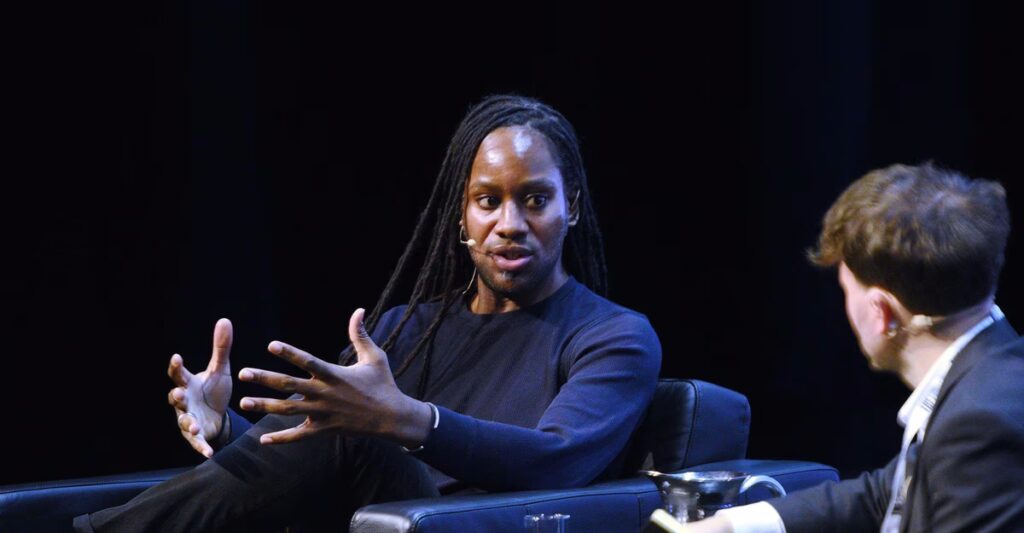
Yesterday in London, Jason Arday, the controversy-plagued British academic and author, was found dead. Made famous as the youngest Black professor in Cambridge’s more than 800-year history, Arday had been dogged by weeks of scrutiny amid accusations of plagiarism, fake qualifications, and a fabricated backstory filled with hard-to-believe details.
He claimed to have been mute until age 11 and illiterate until 18, disadvantages that did not deter him from getting a Ph.D., which he earned by age 30. He claimed, too, that he had suffered from various medical conditions throughout his life, including autism, epilepsy, locked-in syndrome, testicular cancer, and a brain tumor. He was, by his account, a world-class endurance athlete who had racked up a variety of impressive feats, including running 600 miles in six days. Then there were his academic accomplishments: Arday was billed as a once-in-a-generation talent, whose research in his field—the sociology of education—was “the best in the world,” according to Hilary Cremin, the head of Cambridge’s faculty of education. He claimed to have received a book advance of 1.4 million in unspecified currency for his memoir, released this week by Simon & Schuster. It was a meteoric rise, until it wasn’t.
Last month, Nathan Cofnas—a former Cambridge researcher who may politely be described as a philosopher with a special interest in race and IQ, and who may impolitely be described as a professional racist—published in his newsletter what appeared to be significant evidence of Arday’s plagiarism. This month, as it became apparent that much of the Arday legend was most likely just that, the academic became an object of international obsession, especially in British media and on X. He resigned from Cambridge last week, though this did not stem the flood of attention.
The online hive mind, in particular, was brutal until the moment of Arday’s death, at which point the collective swarm did an about-face. The same platform that loosed an algorithmically accelerated torrent of abuse is now dominated by kind remembrances and mawkishness. I find the whole pageantry grotesque.
What I propose is that the public give Arday a courtesy in death that he was often denied in life: Let’s treat him like a person. Not like Cambridge’s magical negro, or like Simon & Schuster’s golden goose, or like the fetish object of internet racists, but like a flawed human being who should still be alive but is not. That requires being honest about who Arday was, not despite his tragic death but because of it. After all, it was systemic, ritualized dishonesty—his own and others’—that undid him.
[Read: Icarus in the faculty lounge]
Here is the truth about Jason Arday: A preponderance of evidence suggests that he was a serial fabulist and unrepentant plagiarist who successfully conned a British academic aristocracy so blinded by do-gooder racial neurosis that it was unable to spot lies that would have been obvious to any Joe Schmo. (Arday denied intentional misconduct and suggested that his apparent plagiarism was a result of his autism, which he said meant that he tended to learn through imitation.) As evidence of those seeming lies mounted, the powerful institutions that had made him continued to back him, doubling down and raising the stakes. Simon & Schuster stood by its author—or perhaps more accurately, stood by its product. Even as the evidence of fraud became all but undeniable, the publisher did not merely declare that it would press forward with Arday’s book; it had the audacity to tout “the professionalism and integrity he has brought to every stage of the publication.”
Then those on the racist right—frothing with glee that they took no trouble to conceal—pressed their advantage, punch-drunk on the double intoxicant of incandescent liberal hypocrisy and a Black man’s failure. The mob swelled, online and in the media. Some people joined out of perfectly legitimate indignation at the apparent obliteration of academic standards that the ordeal attested to. Some joined out of ghoulish pleasure at seeing a beneficiary of DEI, as they cast him, cut down to size.
Everyone following this story would do well to engage in some reflection. I will confess that, until yesterday, I had watched the Arday saga unfold with some combination of amusement and distress. Amusement because of the undeniable comic absurdity to the revelation that the best and brightest minds at Cambridge had been so easily deceived by a man who claimed to have run nine marathons in about as many days on a fractured fibula, and who maintained that his future had been predicted by a Brazilian shaman. Distress because I could relate to some of the things that Arday might have experienced.
[From the September 2026 issue: Why I quit the tenure track]
I have written, in this magazine and elsewhere, about what it is like to be the beneficiary of affirmative action in elite spaces. I have seen, firsthand, the way a specific kind of white progressive treats Black men who have overcome obstacles. They cannot conceal a certain blend of of pity and glee when they learn, for example, that my biological father left before I was old enough to walk, or that I was raised for a time by a single mother. It is a look that says, How far you’ve come, and how kind I am for helping you go further. I have always found such encounters stomach-churning. But I can also imagine—if you came up hard and are unaccustomed to kindness—how good it might feel, and how tempting it might be, to do and say things that make people give you that look again and again, whether or not the things you’re saying are strictly true.
Two images have rattled around in my head since the news of Arday’s death. The first is from a 2023 BBC clip celebrating his hiring at Cambridge. Cremin, Arday’s Cambridge colleague, clasps both of his hands in the manner of a cherished loved one as they stare into each other’s eyes. The camera zooms in on their white and Black hands interlocked and lingers there. The second image was posted on X last night: a screenshot of a list of article headlines about the Arday scandal, stretching to several pages, published by one British outlet alone. It represents but a few watts of the international spotlight that had been trained on the academic.
I have been dwelling on these two images—the theatrical interracial handclasp; the pages and pages of monomaniacal media coverage of what was ultimately a niche academic scandal—because together they speak to a terrible reality. Arday was fetishized in his ascendancy by white liberals, for whom he served as a mirror in which they could see their own goodness. And he was fetishized in his downfall by white conservatives who saw him as a test case for their own obsessions with an academic apparatus that they believe is not meritocratic enough—which is to say, not white enough.
The right would have us believe that the Arday scandal is a story of affirmative action taken to its most caricaturish conclusion. Many progressives see it as something else: a racist witch hunt in which self-righteous zealots with suspect motives hounded a man to death. The problem with these narratives—and it is a sticky problem—is that they are both right.
To be a Black person in elite institutions, and particularly in elite academia, is to have the standards simultaneously set too low and too high: too low because only a Black person with Arday’s dubious qualifications and seemingly invented biography could have been elevated to the top of the mountain in academia and publishing; and too high because only a Black person could have been pushed off that mountain with such nakedly racist enthusiasm, his tumbling fall so ruthlessly documented, analyzed, and cheered. When a famous white man errs, people tend to rightly understand his mistakes or transgressions as an individual’s missteps. When a famous Black man does, the errors are typically turned into spectacle, characterized as proof of the inferiority, suspected all along, of his race.
Around the same time yesterday afternoon that I learned of Arday’s fate, I came across another piece of news: an announcement that Ross Barkan, a white novelist and journalist, had just been dropped by New York magazine after the publication—having investigated allegations regarding dozens of instances of plagiarism in Barkan’s writing—concluded that his work “did not live up to our editorial standards.” Swiftly afterward, Barkan announced that he would now focus on writing a new column at The Nation, another venerable outlet, where he will get a very public second chance.
It is impossible to know what is in someone’s head or heart in their final moments. I have to imagine, though, that Arday understood well enough the world he had entered and how its rules tend to work: When you are Black, some people will open the door for you far wider than they should. And when that door abruptly comes swinging shut, you will be offered no second chances.
The post The Truths That Failed Jason Arday appeared first on The Atlantic.