DAYS OF MIRACLE AND WONDER: Paul Simon and the Trials and Triumphs of “Graceland,” by Ashley Kahn
Lovin’ eyes can never see, says Percy Sledge. For me, it’s “Graceland.” No other cultural object have I loved so long, so deeply, so blindly. Why do these few dozen minutes of dancing brass and gliding bass and snaky poetry hit me so much harder than almost anything else I’ve ever heard?
True romance always takes place somewhere beyond the realm of the rational. I’ve been happy to leave the mystery of “Graceland” unexplained.
What a welcome surprise, then, to read the music historian Ashley Kahn’s careful look at Paul Simon’s 1986 masterpiece and find that by bringing both its beauty and its uglier aspects into the light, Kahn, far from ruining its strange magic, has only made me appreciate the album’s intricacies and paradoxes all the more.
Like “Graceland” itself, “Days of Miracle and Wonder” starts with a bootlegged cassette. Summer, 1984. A friend passes Simon “Gumboots,” an album of mbaqanga music, “township jive,” the driving beat of Soweto, which reminds him of early rock ’n’ roll, “very up, very happy music — familiar and foreign-sounding at the same time,” as Simon put it. (“Gumboots” for the rubber boots worn by laborers working the gold mines around Johannesburg, to whom the album was originally marketed.) Something about listening to “Gumboots” on long drives between New York and Montauk galvanized Simon, guiding him through a dark period marked by the impending dissolution of his marriage to Carrie Fisher and dissatisfaction with his recent work.
What does it mean for a white man with a beach house and a movie-star wife to find inspiration in Black working people’s music from an ocean away, produced under a hateful regime? Kahn, who was a member of the “Graceland” tour production team, tackles the question throughout. He presents Simon’s argument: that music is by nature a fluid, unsteady thing, to be shared and misheard and re-evaluated by anyone and everyone, thriving through cross-pollination. Kahn quotes the South African trumpeter Hugh Masekela, who said about America: “I heard Louis Armstrong, I heard Charlie Parker, and I said I got to go there. So I can identify with Paul Simon going to South Africa, the music pulling him.” Kahn also outlines the opposing view, that “Graceland” constitutes an act of violation. He quotes the producer Mark C. Batson, then a freshman at Howard, who during a campus talk by Simon asked: “How can you justify taking over this music? For too long, artists have stolen African music. It happened with jazz. You’re telling me the Gershwin story of Africa.”
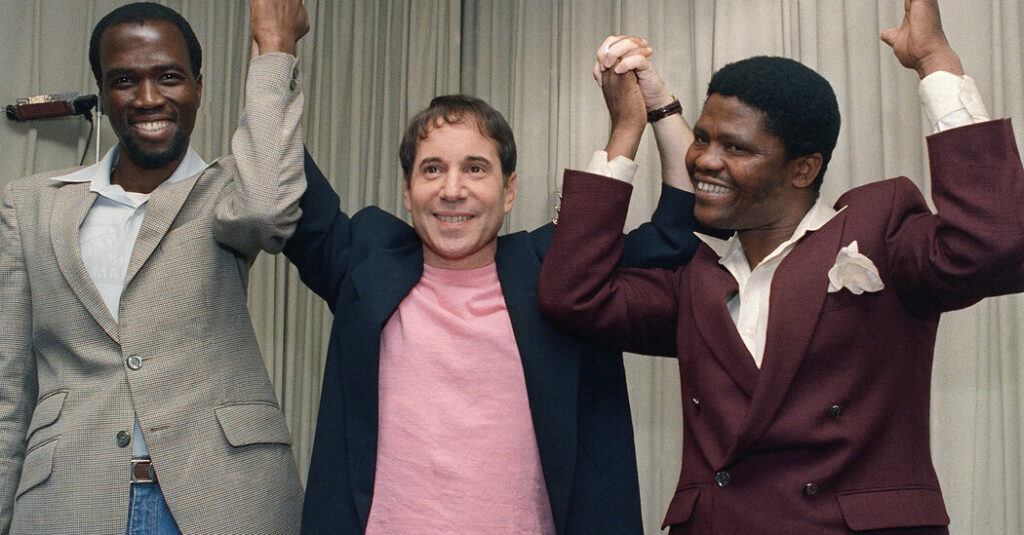
Kahn lets his historical actors speak for themselves as often as possible, collecting a remarkably wide array of voices for so short a book. So while this is the story of Paul Simon and his genius, Simon rarely appears alone on a page. He’s always bouncing off some other talent. The album altered many lives. Especially fascinating are the respective creative journeys of the bassist Bakithi Kumalo, the guitarist Ray Phiri, and Ladysmith Black Mambazo and its brilliant leader, Joseph Shabalala. Cameos come from Harry Belafonte, David Byrne, Miriam Makeba and Youssou N’Dour, among others.
While tracing the evolution of “Graceland,” Kahn considers broader political conflicts at play. The vexed debates about Simon’s breaking with the boycott of apartheid South Africa are as old as the album, and Kahn illuminates those debates by paying attention to the particular, considering individual intentions, seeking nuance and avoiding sanctimony.
His sympathies ultimately lie with Simon, shown as someone working in good faith, however naïvely, who certainly could have done better, but who acted openly and honestly throughout, listening more than he spoke. Still, there’s ample evidence here to satisfy anyone looking to see Simon as a villain, a musical thief, foolish from the start.
There is plenty of myopia and ill will in the tale of “Graceland”’s creation. But Kahn’s book, echoing the album, is concerned above all with the beauty of human connection forged through music, across space and, 40 years later, over time.
Having reached the age Simon was when he and his collaborators told these stories, I wonder at their wisdom and their prescience. It’s all come true. The breakdowns and heartbreaks, the shortening attention spans and softening middles. Also the unquenchable desire to carry on through all of it, forever on the lookout for moments of grace.
What I’m saying is the book made me nostalgic. Meaning that this ends with me watching old music videos on YouTube. And far more gripping than the clips themselves were the comments below: testimonies from all over the world of people finding communion through these songs. I read of “Graceland” played as the background to a memorable one-night stand; to soothe unsleeping babies; to communicate with a partner with dementia; to elicit a final smile from a dying man; to remember lost parents. And to that I say Amen and Hallelujah.
DAYS OF MIRACLE AND WONDER: Paul Simon and the Trials and Triumphs of “Graceland” | By Ashley Kahn | Atria | 310 pp. | $30
The post The Album That Sparked a Thousand Debates Is About to Turn 40 appeared first on New York Times.