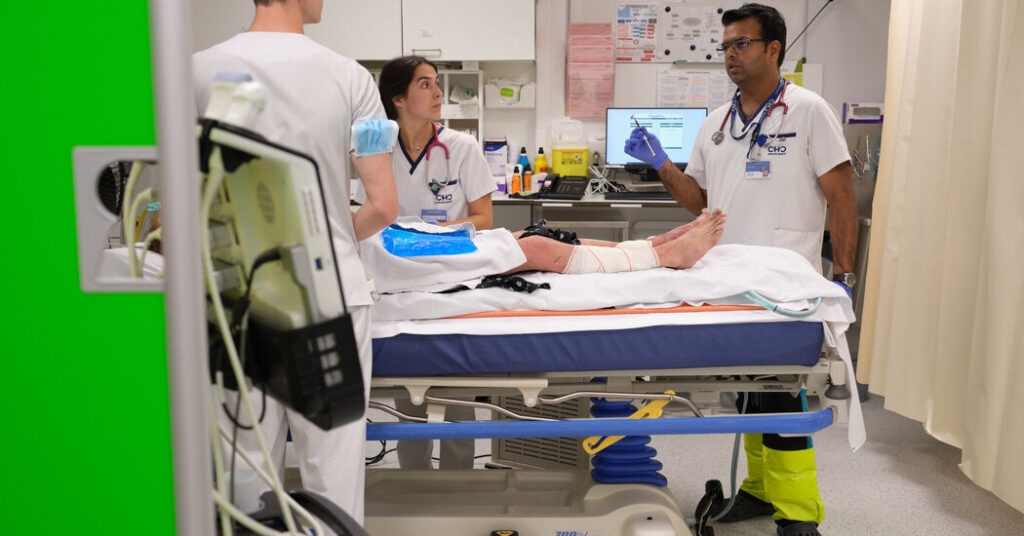
Seniors died in stifling apartments. Emergency calls were left on hold. Doctors treated an onslaught of people sick from heat, sometimes in wards without air-conditioning.
These are scenes that played out in Belgium, one of the world’s wealthiest nations, on a recent summer weekend. They are also a warning to Europe.
Europe is the fastest-warming continent, yet large parts remain ill prepared. As heat waves scorch its nations this summer, they are killing thousands in countries with strong health systems. In just one week in late June, there were around 16,000 excess deaths, or more people who died than usual, in Europe. Belgium, France and Germany were the worst affected, based on data collected by the European Mortality Monitoring Network.
Belgium, known for cold and damp, not searing heat, had the highest excess deaths in Europe, making it a case study into what went wrong. In Wallonia, the region that makes up the country’s south, the death rate was 77 percent higher than what would be expected between mid-June and early July. Some hospitals were overrun, with gurneys and patients lining the hallways and medical staff working without breaks in the unrelenting heat.
“Each crisis is becoming increasingly severe,” said Yves Coppieters, the health minister for Wallonia. “That’s what we’re failing to anticipate.”
Climate change means that the issue is most likely here to stay. Across Europe, “we think the summers are hot now,” said Joan Ballester Claramunt, a research professor at the Barcelona Institute for Global Health who focuses on climate change and health. “The future that we’re seeing, it could be much worse.”
Belgium is a stark example of why heat waves can become deadly in countries more accustomed to cool weather. Emergency systems in some cases buckled under the pressure, and structural challenges left the most vulnerable to suffer.
The federal health ministry defended elements of the response and noted that hospital capacity had been scaled up during the crisis, but it acknowledged that some change was needed. “I believe we must indeed learn lessons quickly,” Frank Vandenbroucke, the Belgian minister of social affairs and public health, told lawmakers early last month.
During the late June wave, MontLégia hospital, in the Belgian city of Liège, experienced a rush of patients so intense that in the emergency room healthier people were temporarily lined up in hallways so that those past the point of saving could have privacy while they died.
Dr. Arnaud Detroz, who was working that weekend, said his team was confronted with overheating cases that they had seen mostly in textbooks. “In our countries, at our latitudes, these cases are relatively rare,” he said.
‘Very Crushing’
Belgium is not accustomed to taking heat so seriously.
At the start of the June heat wave, Theo Francken, the defense minister, posted an image on Instagram of himself smiling in the sun with the caption, “It’s warm for two days and we’re all going to die again apparently.” He criticized the press.
“Enjoy the beautiful weather,” he added. “And LIVE!”
The weather quickly turned into a matter of life or death.
Temperatures shot up between mid-June and early July, surpassing 100 degrees in parts of Wallonia. The fact that it was early in the summer, before people had a chance to acclimatize, worsened the danger, experts said.
In the last weekend of June, the Belgian emergency call line was severely overwhelmed, according to medical groups whose representatives signed an open letter protesting the meltdown. In some cases, they said, it took 10 minutes just to get through to an operator. (Bernard Quintin, the Belgian interior minister, told lawmakers that average waits were much shorter and noted that extra staff members were brought in.)
“If you have to wait for 10 minutes if you have a stroke or heart attack, it’s quite a big problem,” said Dr. Pierre-Louis Deudon, a general practitioner in the Brussels region who signed the letter.
Emergency rooms were also overrun in parts of Wallonia. During the peak of the heat wave, the number of emergency vehicles arriving at Grand Hôpital de Charleroi, about an hour’s drive west of Liège, rose from an average of 60 to up to 110 per day, said Dr. Laurent Peyskens, deputy head of the emergency department.
“It was very crushing,” Dr. Peyskens said.
Half of all emergency rooms in Wallonia lacked air-conditioning, said Dr. Phillippe Devos, director general at Unessa, a federation of Belgian health care providers in Brussels and Wallonia.
For Belgium, June 27 appears to have been the second-deadliest day of the 21st century, after a day early in the coronavirus crisis. In Wallonia, June 28 was deadlier than the depths of the pandemic in 2020.
“We should definitely be afraid of a repeat,” said Loïc Gillerot, a climate-health expert at CERAC, an independent Belgian research center that studies climate risk. “The question is: Are we talking about a repeat this summer?”
Pre-existing Conditions
In Belgium, as elsewhere, extreme heat hit the vulnerable the hardest.
The region of Wallonia had more than twice as much excess mortality as the northern region of Flanders.
Part of the problem, experts said, is that people in Wallonia have lower incomes on average. Poor people are more likely to have pre-existing health conditions, and they often lack access to well-ventilated housing.
About 85 percent of the more than 900 excess deaths in Wallonia between mid-June and July 1 were of people 65 or older, according to figures from Sciensano, the Belgian health data institute. Low-income seniors who lived alone were particularly at risk, health care professionals said, as their houses or attic apartments became baking death traps.
“You have people who are isolated, old,” Dr. Devos said. “We saw in the emergency rooms: When people came to the E.R., it was impossible to save them.”
Wallonia’s housing was part of the challenge. Many residential buildings are aging and were constructed to hold in heat, not to keep it out.
“It’s a country that is considered cold, culturally,” said Gilles Vanvolsem, managing director of the Belgian Green Building Council. “People think more about heating their house than cooling their house.”
Nor did behaviors adjust. Belgians, including those with medical conditions and their caregivers, at times appeared unaware of how to handle the heat.
Dr. Deudon in Brussels noted, for instance, that people on antidepressants and other mental health drugs often are not made aware that they are at higher risk, and so they continued to go to work as normal.
Dr. Toon Ceyssens, a general practitioner in Flanders, echoed that concern, noting that blood pressure medications also increase the danger.
During the worst of the heat wave, he was alarmed to see residents at a care institution where he works still taking excursions. “The caretakers and the patients didn’t take the heat wave that seriously,” he said.
Cold Country No More
To limit heat risk, countries like Belgium will need to shake their cold-country mentality, experts said.
Dr. Ceyssens said patients were often hesitant to install air-conditioning, worried that it would make them sick, spread germs and harm the environment.
Belgians do not “want to be Americans,” with the indoor temperature set to 65 degrees, he said, but he saw a middle ground in which vulnerable people would have access.
“The mentality on air-conditioning has to change,” he said.
Others disagree. Even some Belgian officials are wary of relying too much on climate control, concerned that adding it could overwhelm the power grid and leave cities even hotter by pumping hot air into the streets.
“Air-conditioning can be appropriate in specific situations, particularly for vulnerable people or certain buildings,” said Simon Souris, a spokesman for Wallonia’s housing and energy minister. “However, our long-term strategy is not based on its widespread deployment.”
Since June, Belgian experts have issued recommendations for more cooling spaces and resources for the vulnerable. Federal authorities are working toward handling emergency calls differently, doctors said. The housing authorities in Wallonia are instituting policies to encourage housing renovation.
Yet medical workers and public health experts fear that the kind of changes that are needed — like housing and infrastructure improvements — will take more time than Belgium has. At MontLégia, doctors remain concerned that officials will not dedicate enough resources to the ongoing threat of heat.
Late last month, as emergency doctors recalled losing patients in June, another arrived.
A 77-year-old woman was wheeled in with heat stroke, her frail chest heaving, her temperature near the point of organ failure. Doctors cut off her blouse and covered her in ice packs.
They are bracing for more. A supply closet on the emergency-room floor is stocked with fans. Nearby, a refrigerator is filled with cooling IV drips.
“As emergency-room doctors, we can come to terms with fatality, but it’s not the same when you know it’s due to a systemic failure,” said Dr. Michèle Yerna, who runs the MontLégia emergency unit. That, she added, is “much harder to bear.”
The post Heat Deaths in a ‘Cold’ Country Are a Warning to the Rest of Europe appeared first on New York Times.