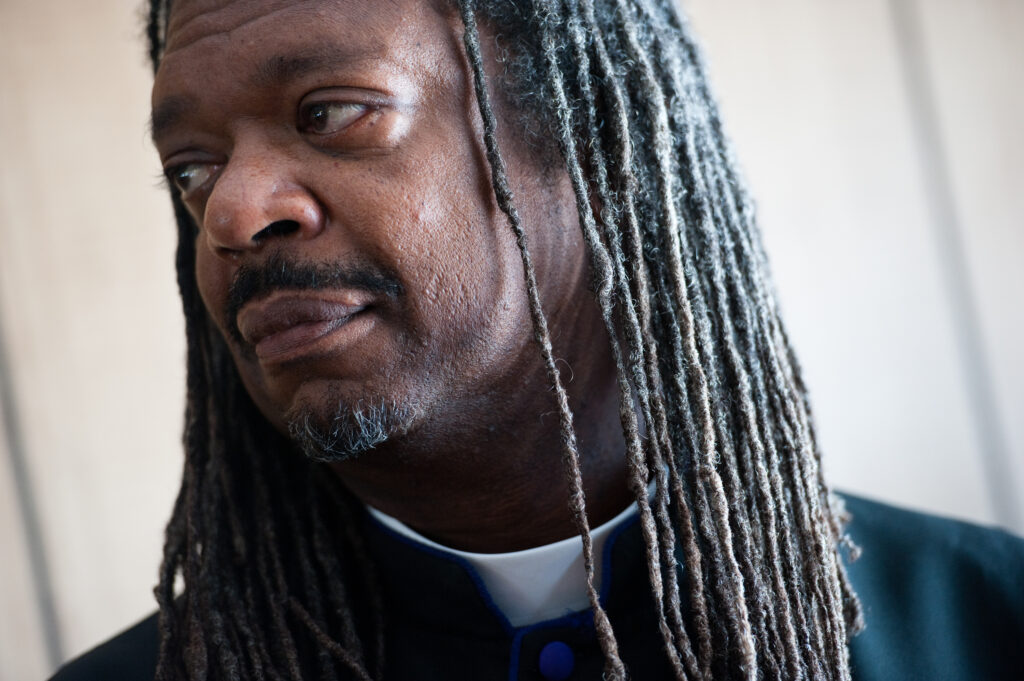
Before he became a ninth-degree black belt and a grandmaster of taekwondo, Bishop Rainey Cheeks learned to adopt the principles of Bushido, the way of the warrior. It was a mindset and moral code that went far beyond martial arts.
“People misunderstand that term, because the way of the warrior is the person who respects life and honor, who respects fellow man as a human being,” he once told The Washington Post. “You can cause no harm to him. At the same time, you must stand up for what you believe.”
Bishop Cheeks, who died Aug. 11 at 74, was an uncommon warrior, even among the elite group of martial artists who earn the title grandmaster. He fought before cheering crowds at Madison Square Garden, won a bronze medal at the inaugural World Taekwondo Championships in Seoul, and was ranked one of America’s Top 10 fighters by Black Belt magazine. When he wasn’t leading classes or charging opponents with a jumping back kick, he was spreading a message of radical love and acceptance, establishing himself as a linchpin of Washington’s LGBTQ+ community.
As the manager of the ClubHouse, a storied Petworth nightclub that opened in 1975, he safeguarded a dance-filled sanctuary for Black gay men and their allies. During the AIDS epidemic, he formed an advocacy and support group that grew into a region-wide health organization called Us Helping Us, People Into Living. And in 1993, more than a decade after he was ordained as a minister, he founded what is now Inner Light Ministries United Church of Christ, becoming one of the city’s first Black faith leaders to welcome LGBTQ+ members into his congregation.
A Notable Life
This article is part of A Notable Life, an obituary feature telling the stories of remarkable people every Saturday. Read more from the series here:
Exploring queer themes and Chicano life, he became a bard of the U.S.-Mexico border
Preserving and exposing the human form, he courted controversy with ‘Body Worlds’
Mathematician Gladys West, a hidden figure behind GPS, dies at 95
“Almost every affirming ministry in this city owes Inner Light Ministries something,” the Rev. Christine Wiley said in 2012, honoring Bishop Cheeks in a guest sermon at the church.
At a time when Black churches “acted like the LGBT community was invisible,” she added, Bishop Cheeks offered a different path, saying “we don’t have to hide, we don’t need to be afraid.”
His death, at a hospital in Washington, was caused by complications from a kidney transplant, said the Rev. Wallace R. Henry III, his successor at Inner Light. Bishop Cheeks, who had cancer, served in recent years as the church’s pastor emeritus.
“He helped anyone who would need help, even to his own detriment,” Henry said. “Our affirmation for our church is, ‘I see the God in you.’ He helped individuals see that for themselves.”
Bishop Cheeks had been leading street outreach programs, ministering to the poor and to people living with HIV, when he founded Inner Light with encouragement from Carl Bean, a minister, AIDS activist and singer who had recorded the gay pride anthem “I Was Born This Way.”
His first service, held at First Congregational Church in downtown Washington, drew 10 people. By 2012, he was preaching to nearly 100 congregants, most of whom were gay or lesbian. Some had felt shunned or ostracized by mainstream faith leaders and had joined Inner Light after slipping away from their home church, attending Bishop Cheeks’s services in secret.
“For years, I’ve dealt with ministers who want to dump guilt on people” who are gay, Bishop Cheeks told The Post. “I ask them, ‘Really?’ If you have the ability to send me to hell, let me see you walk on water — what’s holding you back?”
In a city where HIV/AIDS disproportionately affects Black residents, he and his church served as a resource and refuge, offering free condoms and HIV testing to combat the disease’s spread. Bishop Cheeks was open about his own HIV diagnosis — once, during his sermon, he realized he had forgotten to take his medication and paused to wash down the pills with water — and spent decades working to reduce the stigma around AIDS, which he described as “the pink elephant that nobody wants to talk about.”
“When you deal with AIDS, you have to deal with all of the issues, all of the isms of our community,” he told the New York Times in 1998. “You can’t touch AIDS and not deal with homophobia, drug abuse, homelessness. It touches all of the things that people don’t want to talk about.”
Early on, he said, the illness was considered “a gay White man’s disease,” one that he and other African Americans didn’t pay much attention to. That began to change in the mid-1980s, as the ClubHouse’s membership plummeted.
“I remember going through the book and scratching out the names of people who died of AIDS,” he said. “When we got to 300, we were so numb we couldn’t continue. Half our staff was gone.”
In 1984, Bishop Cheeks lost his partner to the disease. After testing positive for HIV the next year, he was told he had six to 18 months to live. He defied that prognosis while helping to launch Us Helping Us, which taught participants about holistic health techniques, espoused a philosophy of independence and resilience (“I have it,” Bishop Cheeks would say; “it doesn’t have me”), and aimed to ease the pain and isolation experienced by patients struggling to navigate the health care system.
The group met at the ClubHouse and, after the venue closed, convened in Bishop Cheeks’s living room. It became a lifeline for men such as Ron Simmons, who went on to serve as the organization’s president and chief executive.
“I walked into Rainey Cheeks’s one-bedroom apartment on E Street in Southeast D.C. and saw 22 other HIV-positive African American men. I felt at home,” Simmons told Washingtonian magazine in 2011. “They taught me I could live with this disease, and no other Black organization was saying that.”
‘Dancing away the frustration’
A native Washingtonian, Albert Rainier Cheeks — he later gave himself two traditional West African first names, Yao and Kwabena — was born on March 20, 1952. His father worked on passenger trains and could be physically abusive, Bishop Cheeks said. His mother had a desk job for the D.C. government and encouraged him to stand up for himself. He was about 16 when he came out to her as gay.
“What is the issue?” he recalled her saying. “You’re my child, I love you. Don’t do anything crazy.”
“I walked away from her totally perplexed, going, ‘What the hell just happened?’” Bishop Cheeks told MetroWeekly in 2008. “But after that point, I could care less who knew. Once I was cool with my mother, the rest of the world could jump. It gave me my strength to take on all kind of fights and battles.”
Beginning at age 14, Bishop Cheeks trained under Korean-born taekwondo instructor Ki Whang Kim, working out at the 12th Street YMCA. He medaled at the world championships at 21, in 1973, and in 2007 was inducted into the Taekwondo Hall of Fame, which called him “one of the greatest Taekwondo players in U.S. history.”
Grieving a loved one? Tell us what made them special.
The Post is publishing reader-submitted obituaries as part of a new series, What We Remember, about everyday but extraordinary people.
Our first installment included a poetry-loving lawyer and a mom who had all the time in the world.
While training in taekwondo, Bishop Cheeks supported himself with jobs as a steamfitter, working in construction and occasionally taking evenings off to visit nightclubs like the Third World, a discotheque near Fort Totten that advertised itself as the home of “Washington’s finest quadraphonic system.”
At the time, he said, the venue was among the only gay-friendly clubs accessible to Black customers, who were often hassled at White-run bars and clubs. Bishop Cheeks joined the Third World’s owners in helping to open a new venue, the ClubHouse, at a former garage and warehouse. He helped build the place himself, joining a small work crew in gutting the building, laying the floors and hanging the speakers before the grand opening on Mother’s Day in 1975.
As manager, he instituted an informal screening system, handing out membership cards to family and friends. (The venue’s motto: “You would know if you belong.”) The club lacked a liquor license and, because it was in a residential neighborhood, served fruit punch, water, cookies and candy.
Balloons hung from the ceiling. As many as 1,000 people visited on Saturday nights. Nona Hendryx performed, and ballet dancer Rudolf Nureyev once stopped by to join the party.
The line sometimes stretched out the door, drawing the attention of police who raided the venue but “never found anything,” Bishop Cheeks recalled in an interview for TheBody, an online HIV/AIDS resource.
“This policeman looked at me and said, ‘You’ve got to be doing something illegal for people to come line up outside like this when you don’t have any alcohol.’ I said, ‘We’re dancing away the frustration of people like you who mess with us all week long.’”
As disco, house and gospel music boomed on the dance floor, Bishop Cheeks decamped to a back office to study for his ordination. He graduated in 1982 from the National Spiritual Science Center and went on to blend African spiritual traditions and holistic healing practices in his ministry, while also presiding over funerals for friends and loved ones. During the AIDS crisis, he led 17 in a single month.
Bishop Cheeks is survived by two brothers and a sister. He sometimes marveled at the fact that he ended up in the ministry, though in some ways it seemed preordained. He had been raised Catholic, he told MetroWeekly, and as a boy he had been told by a pastor, “One day, you’ll be a priest.”
“I almost fell out laughing,” Bishop Cheeks said. “I was like, ‘Oh, God would never put up with that.’”
The post Bishop Rainey Cheeks, a taekwondo master who took on the AIDS crisis, dies at 74 appeared first on Washington Post.