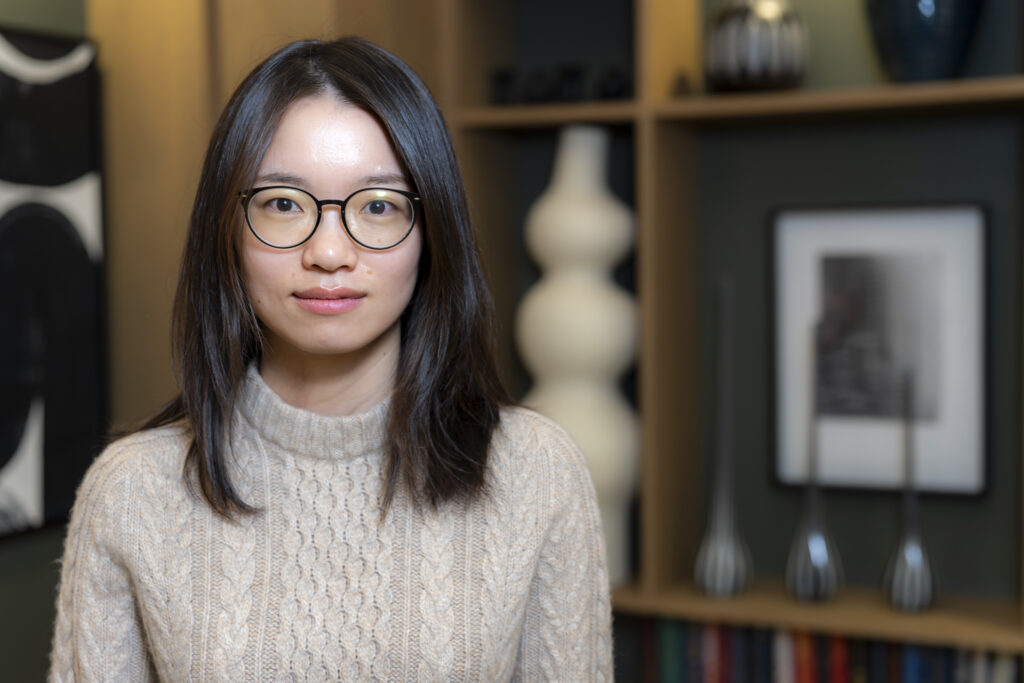
Winning one of the world’s most prestigious math prizes has made Hong Wang a household name in her native China.
The fact she was awarded the 2026 Fields Medal for work she did in the United States has sparked discussion about China’s rigid education system, the pressure it’s said to foster and the challenges it poses for women.
“We are trying to cultivate talent while also being highly selective,” said New York University Shanghai sociologist Yi-Lin Chiang, the author of “Study Gods,” a book on China’s elite institutions. “It becomes very difficult for students to enjoy studying and acquiring knowledge without constantly thinking about test scores.”
Since winning the medal at the International Congress of Mathematicians in Philadelphia last month, Wang has spoken publicly of her frustrations with the system.
“When I went to college, suddenly mathematics became difficult,” Wang, 35, told the École Polytechnique in Paris. “It took effort and discipline to actually learn it, and it took me many years. I felt a little discouraged.”
That word has gone viral on Chinese social media.
“If Hong Wang was only a little discouraged,” a fellow Peking University graduate mused on RedNote, “then ordinary students must be super, super discouraged.”
The prize, named for the Canadian mathematician John Charles Fields, is awarded by the Berlin-based International Mathematical Union every four years to up to four people under 40 for outstanding achievement.
Wang, a professor at New York University and the Institute of Advanced Scientific Studies in France, is the third woman and first Chinese woman to win the medal. Also honored this year was her onetime Peking University classmate Yu Deng, who transferred to MIT, earned a doctorate at Princeton and is now a professor at the University of Chicago. Neither Wang nor Deng responded to requests for interviews.
Chinese state media have celebrated their successes as proof of the country’s rising prowess in the field. But academicians and analysts say it would have been difficult for them to win such recognition if they had stayed at home. The West, they say, offers more time and freedom for scholars to explore. In China, those who go a full year without publishing research, as Wang did, probably would be dismissed.
“The Fields Medals won by Wang and Deng are not a win for China,” said Zhao Yongsheng, a professor of European Studies at the University of International Business and Economics in Beijing, “but rather a reminder that the country’s education system and academia need to do serious self-reflection.”
Wang, a math prodigy, entered top-ranked Peking University at 16 with plans to deepen her understanding of the subject. But the top-ranked institution offered only one slot for a mathematical sciences major from her province of 50 million, and her test score was deemed insufficient.
After Wang earned her bachelor’s degree, she left China for graduate study in France and a doctorate from MIT, postdoctoral work at the Institute for Advanced study at Princeton and a professorship at UCLA.
Deng, interviewed recently by Peking University, encouraged students to have “at least one relatively complete experience abroad” during their academic careers. (The remark was later excised from the university’s WeChat account but remains accessible on other platforms.)
Wang’s reflection has resonated with Chinese students. Social media users have described experiencing high pressure and hyper-competition in their own academic careers. In a culture that favors innate genius, some say, they’ve feared asking questions that might be perceived as “stupid” or “simple.”
For women, students and academics say, the challenges are compounded. Women made up 63 percent of new university students in 2022, but men continue to dominate elite institutions and STEM majors, the examination, enrollment and data website China Education Online reported last year.
“When it came to intelligence itself, they thought girls were not as capable as boys,” said Shang Li, 26, a Chinese doctoral student studying mathematical cognition at Vanderbilt University.
As one of the few girls who competed in high school math Olympiads in China, she said, she endured gender stereotyping from some of her teachers, who believed “girls achieved better grades because they mature earlier and are better at sitting still.”
The news website Women of China, run by the All-China Women’s Federation, invoked Wang’s success last month in calling for an end to the biased view that “women are not good at math.”
Some RedNote users have encouraged Wang to stay abroad, where she has been able to flourish.
Zhao said China’s policymakers fail to encourage innovation or independent thinking but focus instead on excessive politicization, administrative control and rigid restrictions on teaching methods.
“We had talents like [Wang and Deng] all along,” he said. “Why did we almost end up burying their potential?”
The post Would Hong Wang have won her historic math prize if she had stayed in China? appeared first on Washington Post.