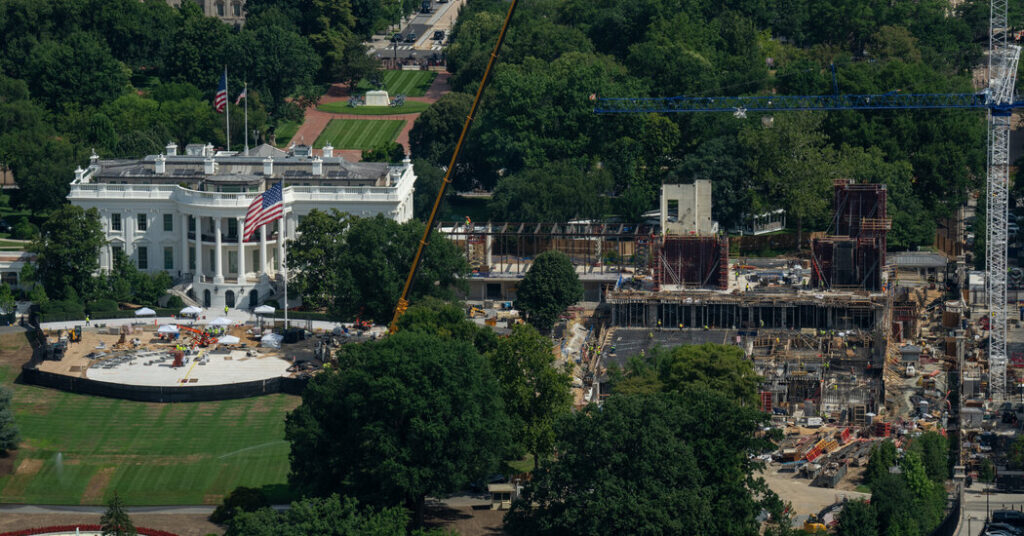
The Trump administration on Friday asked the Supreme Court to bless the construction of President Trump’s White House ballroom to replace the demolished East Wing.
The planned 90,000-square-foot ballroom has been mired in litigation ever since the president tore down the East Wing last October as part of his plan to dramatically remake the White House campus. But the courts have let Mr. Trump continue building even while questioning the project’s legality, allowing the ballroom to steadily rise in recent months.
The administration’s request for intervention from the nation’s highest court comes after an appeals court on Aug. 7 said the president most likely exceeded his authority by moving ahead with the privately financed project without approval from Congress. The case presents a test of the limits of executive authority for a Supreme Court that has embraced some, but not all of the president’s agenda, and it presents the justices with yet another challenge to one of Mr. Trump’s signature initiatives.
In a 2-to-1 ruling, the U.S. Court of Appeals for the District of Columbia Circuit said the Constitution gives Congress — not the president — the responsibility to decide when proposed changes to the White House may move ahead.
“Congress has not ceded unfettered authority to the Executive Branch to dramatically redesign, reshape, and reconstruct the White House — the People’s House — to fit a particular President’s desires,” the appeals court ruled.
The appeals court paused its own ruling for two weeks to give Mr. Trump time to appeal to the Supreme Court. His petition landed a week later. In the interim, work on the project has continued.
Construction of the ballroom, estimated to cost $400 million, is part of Mr. Trump’s second-term effort to reshape Washington in his style.
The National Trust for Historic Preservation, a nonprofit chartered by Congress to guard America’s historic buildings, sued to try to stop its construction, asserting that the president had resisted oversight in violation of federal law.
Mr. Trump has defended the project, insisting that congressional approval is not necessary and that his plans are no different than previous, more modest renovation projects completed at the White House without consultation with lawmakers. He has said the White House is in need of a large event facility; state dinners and other large events have long been held in tents outdoors due to the lack of such a space.
The president’s legal team has shifted its claims about the project since the litigation began, asserting in recent months that its primary purpose is to add a sprawling underground military complex below ground to improve White House security.
After the appeals court ruling, Mr. Trump posted on social media saying “this unjust decision must be overturned by the Supreme Court in its entirety.” He emphasized that the project is vital for national security and military operations.
In April, Judge Richard J. Leon of the U.S. District Court for the District of Columbia ruled that the project exceeded the scale of the kind of minor changes presidents have traditionally made to the White House grounds and required approval from Congress. The judge, however, deferred to the president’s claims about the critical need for an upgrade of the military bunker below the White House. His ruling, upheld by the appeals court, would halt construction of the ballroom, but allow renovations below ground to continue, including construction of bunkers, bomb shelters, and military and medical infrastructure.
Despite that ruling, Judge Leon permitted construction to continue temporarily both above and below ground while the litigation played out.
The National Capital Planning Commission, which reviews plans for major projects and renovations, voted to approve the project in April. The president had installed allies on the commission before announcing a design for the ballroom.
The project is being funded by private donations. Democrats and public interest groups have raised conflict-of-interest concerns about the financing because many corporate donors engage in business with the federal government.
Mr. Trump has said that the private funds give him the flexibility to pursue the project at no expense to taxpayers, and that he does not need Congressional approval for the overhaul of the White House when taxpayer money is not involved.
But in June, the administration transferred roughly $350 million from the Secret Service to cover security upgrades at the White House, which appeared to be destined for the combined East Wing project.
Seven Republican senators joined Democrats in June in voting to block the construction on the project until Congress had formally authorized it, but the measure failed to secure the 60 votes needed to pass.
The post Trump Administration Asks Supreme Court to Greenlight White House Ballroom appeared first on New York Times.