“In brightest day, in blackest night.” The Green Lantern oath allows for both, but HBO’s new series “Lanterns” is almost entirely about the dark night of the superhero’s soul.
A couple things to know about Green Lantern, one of the foundational heroes of what would become the DC Comics roster (the character dates to 1940): There are many Green Lanterns, and they are all intergalactic cops, members of a corps that keeps the peace in the 3,600 sectors of the universe.
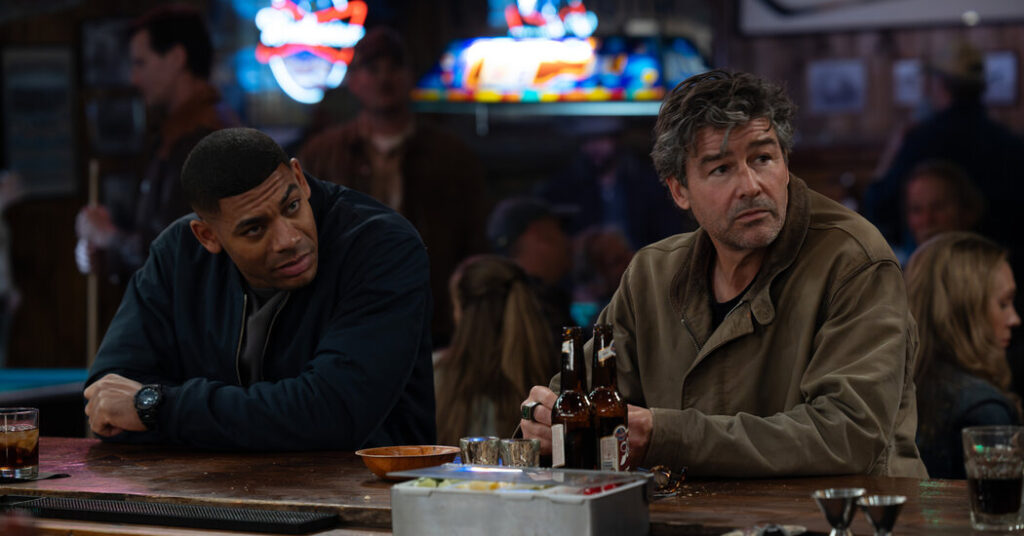
“Lanterns,” which premieres its eight-episode first season on Sunday, leans on these facets of the character. It’s essentially a buddy-cop story, putting two of the best-known Lanterns — Hal Jordan (Kyle Chandler) and John Stewart (Aaron Pierre) — on a case together. Both are summoned to rural Nebraska, where an investigation of shootings at a high school football game leads to a mysterious, existential menace with a past connection to Jordan.
Jordan, a former fighter pilot, distrusts Stewart, his trainee, who is being groomed as Jordan’s replacement. Stewart, a former Marine sniper, loathes Jordan, who stands in the way of what Stewart sees as his birthright. The air is thick with anger, ill will, resentment and Freudian angst. (Both men have daddy issues, and Stewart has mommy issues as well.)
What the show does not lean into, until late in the season (seven of eight episodes were available for review), are the simple, fantastical pleasures that the Green Lantern mythos offers.
The ring that provides a Lantern’s power, by physically manifesting anything he or she is able to imagine, is woefully underutilized; Jordan and Stewart are too busy fighting over possession of Jordan’s ring to spend much time making cool things with it. (Even so, it keeps running out of juice, and Jordan is constantly looking for his lantern to recharge it, like a forgetful iPhone owner.) And for much of the season, the show is not just earthbound but confined to a small stretch of the Midwest, artfully presented but not as diverting as the alien planets that are within the Lanterns’ reach.
“Lanterns” was created and overseen by a team that includes the peak-TV machers Damon Lindelof (“Lost,” “The Leftovers,” “Watchmen”) and Chris Mundy (“Ozark,” “True Detective”) and the award-winning comics writer Tom King (“Batman,” “The Vision”). It is meticulously assembled and peopled with actors you’re happy to see (Kelly Macdonald as the sheriff, Garret Dillahunt as a rancher with secrets, Nathan Fillion in a brief appearance as a third Lantern). It is also overstuffed with contemporary platitudes on themes like race, parenting and immigration, and it is more often dour than fun.
It continues HBO’s practice of putting a coat of prestige paint on genre properties like “Game of Thrones,” “True Detective,” “Mare of Easttown” and “The Last of Us” — dressing them up for the network’s Sunday night drama slot, just about the last corner of the TV business where time and place matter. And “Lanterns” is certainly not alone in focusing on superhero angst — it’s heavy going everywhere you look, from the grief-ridden Scarlet Witch of “WandaVision” to the self-pitying Spider-Man of “Spider-Noir” to the power-denying hero of “Wonder Man.”
The gap between the idealistic, fanciful source and the somber, psychology-heavy adaptation is particularly acute with “Lanterns,” though. There are long stretches that don’t connect to superheros or comic books in any essential way; when a character refers to events in far-off Gotham or Metropolis, it sounds like a mistake. The show seems to have adopted a defensive crouch with regard to its origins. The drumbeat focus on the wages of power is a drag, and it doesn’t ring true. Where’s the exhilaration?
The one place it shows up, occasionally, is in the sly performance of Chandler as the cynical flyboy, Jordan, who gets at least a little joy from both the exercise of his ring’s powers and from the violent pranks he plays on Stewart. (Pierre has presence as the glowering Stewart, but the piousness of the role locks him down.) Even an actor as accomplished as Chandler, though, can’t do much with a line like Jordan’s proclamation, referring back to the death of his father, that “I’m not fearless because I’m brave, I’m fearless because I’m broken.” It would take more than Green Lantern’s light to fix that.
The post ‘Lanterns’ Review: It’s Not Easy Being Green appeared first on New York Times.