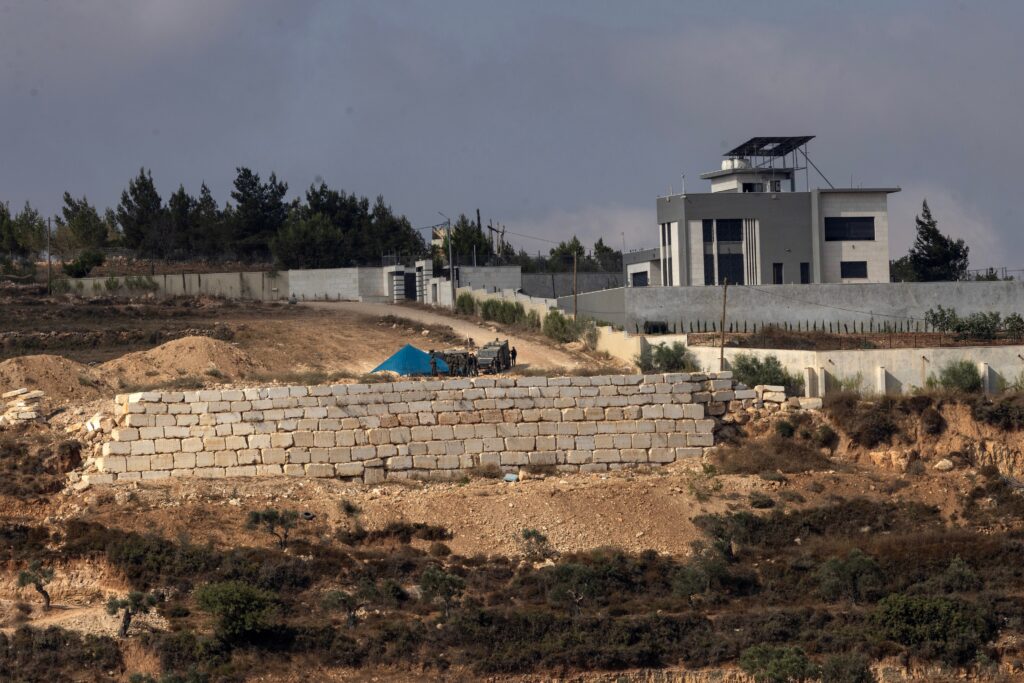
QUSRA, West Bank — When Israeli extremists arrived here this week seeking to evict Palestinians from their hilltop homes, Qusay Abu Raida and other besieged residents, huddling indoors and running short on food and water, hoped the Israel Defense Forces would come to their aid.
Instead, the soldiers drank coffee and prayed with the assailants.
When the Israeli general in charge of the occupied West Bank, Lt. Gen. Avi Bluth, came Wednesday and promised to protect residents, they allowed themselves to feel a glimmer of relief.
But IDF troops evicted other Palestinians from their homes and declared the area a military operation zone. They drove away some settlers — but allowed others to continue their siege.
At a time when settler attacks in the West Bank have become a daily occurrence, the effort this week to oust the Palestinians by cutting off their food, water and electricity has stood out not just for its aggression, but for the response of the Israeli military, which appeared incapable of confronting extremists — or complicit in their attempt.
The incident, which has received an unusual amount of coverage in Israeli media, has drawn condemnation from some Israelis. Opposition leader Gadi Eisenkot, currently leading Prime Minister Benjamin Netanyahu in polls before Israel’s October election, said it revealed a breakdown within Israel’s political and military leadership.
It was not clear why the army did not immediately drive the settlers off. But Bluth, a West Bank settler himself known for his tough stance toward Palestinians, had been lambasted in recent weeks by radical Israeli leaders, including Defense Minister Israel Katz, for attempting to detain an Israeli Jew accused of attacking Palestinians in the West Bank.
For Palestinians, long accustomed to Israeli soldiers accompanying and protecting settlers raiding their villages instead of trying to stop them, the episode was another example of the army and settlers working together to drive them from their land.
“The army is not interested in evicting the settlers. If they wanted to do it, they would have done it in less than an hour,” said Abu Raida, who remained trapped in the house owned by his Palestinian-American brother late Friday.
“It is unbelievable that an army that is fighting on different fronts cannot enforce order over 10 young men. It’s a staged play,” he said.
The IDF did not immediately respond to a request for comment Friday. In a statement Thursday, it said soldiers had “dismantled two illegal outposts” near Qusra and detained one Israeli. It didn’t address why it was continuing to allow settlers to roam the village.
“The soldiers will carry out defensive missions and patrols in the area to maintain security and protect the area,” the IDF said. It called the siege “illegal, reprehensible, and unacceptable activity that harms the residents of the areas and disrupts their daily lives.”
Late Friday, six days into the siege, the settlers vanished, apparently of their own accord. It was unclear whether or when they might return.
Twenty to 30 Israeli men and teenagers arrived in Qusra on Sunday. Since then, nine Palestinians from three families have holed up inside their homes, fearful of losing them if they leave.
The settlers pitched a tent, erected a barricade with large rocks, cut off the residents’ water and electricity, and threw stones at the houses.
Far-right Israeli activists have blocked aid trucks entering Gaza. Israeli hard-liners have argued for severing food, electricity and water to force Hamas to surrender or Palestinians to leave Gaza.
The siege in Qusra, a village perched among steep terraces of olive in the central West Bank Hills, was a repeat of an assault last month in neighboring Jaloud, where Israeli extremists drove the family of Mahmoud Tubasi from their two homes.
“When I saw the images, the videos from Qusra, I felt their pain, their suffering, the same strategy,” Tubasi said. “It’s not easy to watch them in the house that you spent all your money and savings to build for your future.”
Tubasi’s family held out for 10 days without water or electricity before fleeing on July 22. Their homes have since been taken over by Israeli settlers and soldiers.
Since 2023, the Israeli nonprofit Peace Now says, more than 115 square miles of the West Bank have been seized by settlers or reclassified as state land by the Israeli government.
Tubasi, Qusra Mayor Abdel Azim Wadi and others said they recognized men besieging Qusra from the attack on Jaloud. In July, assailants burned cars and a mosque in Qusra, they said. In March, settlers killed a 28-year-old Qusra man. No one was charged.
“There is no police, no law, no order here,” Tubasi said. “It is a settler state. They decide what will happen, with the army protecting them.”
Residents believe Qusra has attracted more attention than Jaloud in part because one of the homes was owned by a U.S. citizen. Mike Huckabee, the U.S. ambassador to Israel, said Thursday he had asked the IDF and Israeli police to remove the “Israeli terrorists.”
“The actions of those doing this to this family’s home is criminal,” Huckabee wrote on X. “Actions by those who carried out this horrific act of terror meant to intimidate and harass this family are disgusting. No excuse for such thuggish behavior.”
Bluth, the head of the IDF’s Central Command, visited the families on Wednesday morning and pledged to remove the settlers and discipline soldiers who joined them. But after he departed, some settlers remained on the property under the gaze of IDF soldiers — drawing speculation in Israel about who was giving orders.
The Commanders for Israel’s Security, a group of retired Israeli officials, expressed shock that “settler militias” were able to exert influence over the army.
“When the military command turns a blind eye, and at times is complicit in these grave acts, and when the political leadership supports, funds, and incites them, it is the State of Israel and the Jewish people, both in Israel and throughout the diaspora, who pay the price,” wrote retired Maj. Gen. Jacob Or, a former senior West Bank administrator.
Israel Ziv, another influential former two-star general, disputed that the army was abetting the settlers. The former IDF operations chief blamed far-right politicians in Netanyahu’s cabinet, including National Security Minister Itamar Ben Gvir and Finance Minister Bezalel Smotrich, for preventing arrests.
“It’s absolutely political,” Ziv said. “Those Jewish terrorists are running the show, and the military cannot control them because they can lean on the government and the policies of Ben Gvir and Smotrich and feel like they can do anything want. It is the beginning of chaos.”
Bluth, considered by peers to be one of the most pro-settler Central Command chiefs in IDF history, is often publicly lauded by settler leaders. But in recent weeks, he has drawn the ire of a more extreme faction in Israel’s growing far-right movement.
In June, when Bluth recommended extending the detention of an Israeli accused of stripping a Palestinian man naked, tying him by the genitals and parading him around his West Bank village, groups of young settlers held sit-ins in Jerusalem in protest. Katz, the defense minister, called for his dismissal. Ben Gvir followed suit.
Ziv, who knows Bluth, said the commander’s hands were tied. “There is a very big difference between his personal views and the way he conducts things,” Ziv said. “He is a professional. Sadly, the military is caught in the middle.”
Katz said Friday he would transfer security oversight in West Bank settlements from the army under Bluth’s command to the Israeli police, which is led by Ben Gvir.
The Palestinian families, meanwhile, mostly remained in their homes. One mother, Rukaya Hassan, and her two daughters, one of whom was vomiting with fever, were evacuated by ambulance. Other residents received food, medicine and tools to repair their water supply from activists.
While soldiers turned journalists and activists away Friday morning, more settlers arrived by car. Some settler youth played soccer and sat on the Palestinians’ property while Israeli soldiers stood by and watched.
Lior Soroka in Tel Aviv contributed to this report.
The post IDF troops stood by as West Bank settlers besieged Palestinian homes appeared first on Washington Post.