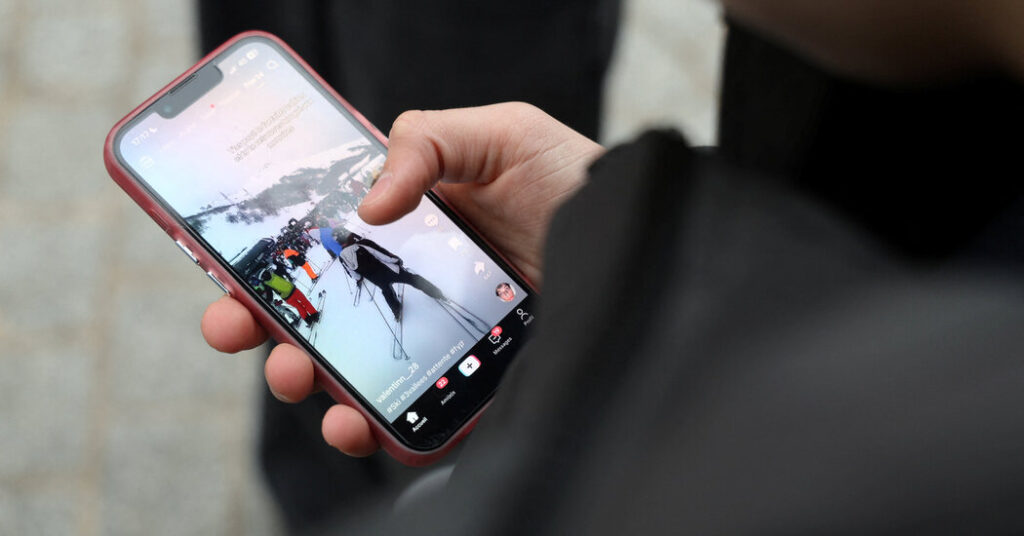
France’s highest court on Friday rejected the government’s move to ban people under 15 from using social media, a stinging setback to President Emmanuel Macron, who has made the measure a centerpiece of his legislative agenda in his final year in office.
The Constitutional Council, France’s closest equivalent to the Supreme Court, said that, although such a ban could be justified, its current provisions constituted a “disproportionate infringement on freedom of expression and communication,” according to a statement released on Friday.
The council said the ban, which lawmakers passed in July, was too wide-ranging — it could apply to platforms that did not necessarily pose risks to children’s health and safety — and that it did not take into account the age, maturity or family situation of children. The council also found that the ban would infringe on privacy, because it would require everyone to prove their age on social media platforms.
France was the first European country to pass a law restricting young people’s access to social media, following in the footsteps of Australia, which passed a similar law in December. Denmark and Spain are preparing similar legislation, but the court’s decision underscores the legal and practical hurdles to these efforts. Critics say they are ineffective and can have unintended consequences.
Left-wing lawmakers, who had opposed the law and petitioned the council to weigh in on its legality, praised the decision. Arthur Delaporte, a socialist lawmaker in the National Assembly, said in a statement that the Council’s verdict had proven their arguments valid and that the law had been “drafted in haste,” and was “too vague, too broad.”
Mr. Macron still hopes to enact a law before he leaves office next spring. His office said in a statement that Prime Minister Sébastien Lecornu would develop a “legally sound” version of the law that would also align with new European Union-wide regulations that are being drafted in Brussels.
The statement added that Mr. Macron remained committed to protecting “the best interests and health of our children.”
But legal experts said European countries were limited in their ability to go after foreign technology companies because of jurisdictional issues. And the European Union already does much of what France could legally do through the bloc’s Digital Services Act, a law enacted in 2022 that seeks to protect children from harmful effects of social media, among other goals.
“The protection of minors with regard to social networks is no longer really a national issue on which the government and candidates can commit,” Benjamin Morel, a constitutional scholar at Panthéon-Assas University in Paris, said on social media.
The post France’s Top Court Strikes Down Ban on Social Media for Children appeared first on New York Times.