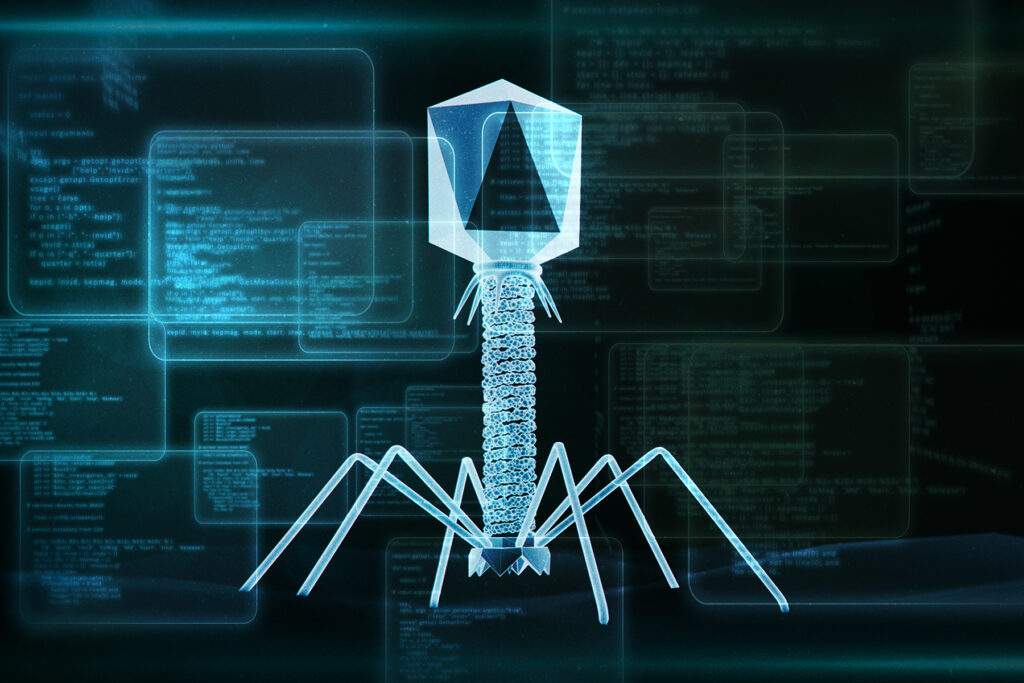
There is perhaps no clearer illustration of the promise and perils of artificial intelligence than its ability to design new viruses. In the right hands, this advancement could lead to innovations that ward off pathogens and save countless lives. In the wrong hands, it could unleash biological warfare and the next pandemic.
Fortunately, some modest steps can mitigate the downside risk.
A paper published last week in the journal Science detailed how researchers at Stanford University and the Arc Institute used AI to create 16 functional viruses that have never been seen in nature. This is being likened to a “Wright Brothers moment” for pharmaceutical research. The authors believe their work could lead to new treatments against pathogens, especially superbugs that have developed resistance to existing treatments.
Synthesizing novel viruses isn’t new. Researchers have been doing it for years, but previously they needed the blueprints of known microorganisms to serve as templates for their genetic designs. These AI-generated viruses, by contrast, created novel viruses from scratch.
The Stanford-led team fed millions of DNA sequences into an AI model and asked it to predict genomes that could produce a virus capable of infecting E. coli bacteria. Such viruses, known as bacteriophages, are incapable of infecting human cells and therefore harmless.
The researchers tested nearly 300 new viruses created by the model. Most of them could not replicate themselves once introduced to bacteria. The 16 that could, however, featured genes entirely different from naturally occurring viruses, allowing them to overcome bacterial resistance.
That alone could prove transformational. In 2021, the Centers for Disease Control and Prevention estimated that antimicrobial-resistant infections kill more than 35,000 people in the United States each year and contribute to more than $4.6 billion in annual health care costs.
That might just be the beginning. AI’s ability to synthesize genetic sequences could unlock an era of vaccines and genetic therapies.
Unsurprisingly, the Science paper generated warnings that the new technology could be used for evil purposes. It’s important not to overstate such a threat, however, since synthesizing new viruses costs hundreds of thousands of dollars. And while AI can create genomes, it cannot synthesize viruses in a lab on its own.
The U.S. government will never be able to prevent every AI model from distributing existing human knowledge about biology. Much easier and more effective would be to focus on the physical choke points of gene synthesis. That’s how policymakers can prevent bad actors from abusing the breakthrough.
The federal government should mandate that all laboratories capable of gene synthesis screen for potentially harmful biological agents. Many large biotech companies already have such measures, but not all do. Uniform federal standards would help.
Such an approach would be more effective than trying to censor what information AI models can share with users, especially since the genomes of some of the world’s most dangerous pathogens are already easy to obtain on the internet. And the U.S. government will not be able to control open-weight models used overseas.
A bipartisan bill with lab-focused reforms has made headway in the Senate. It has been attached to the National Defense Authorization Act, now stalled by partisan squabbling over Iran. Getting the provision over the finish line would ensure that the extraordinary promise of this technology is not undermined by reasonable fears of its misuse.
The post AI can design new viruses. That’s not as scary as it sounds. appeared first on Washington Post.