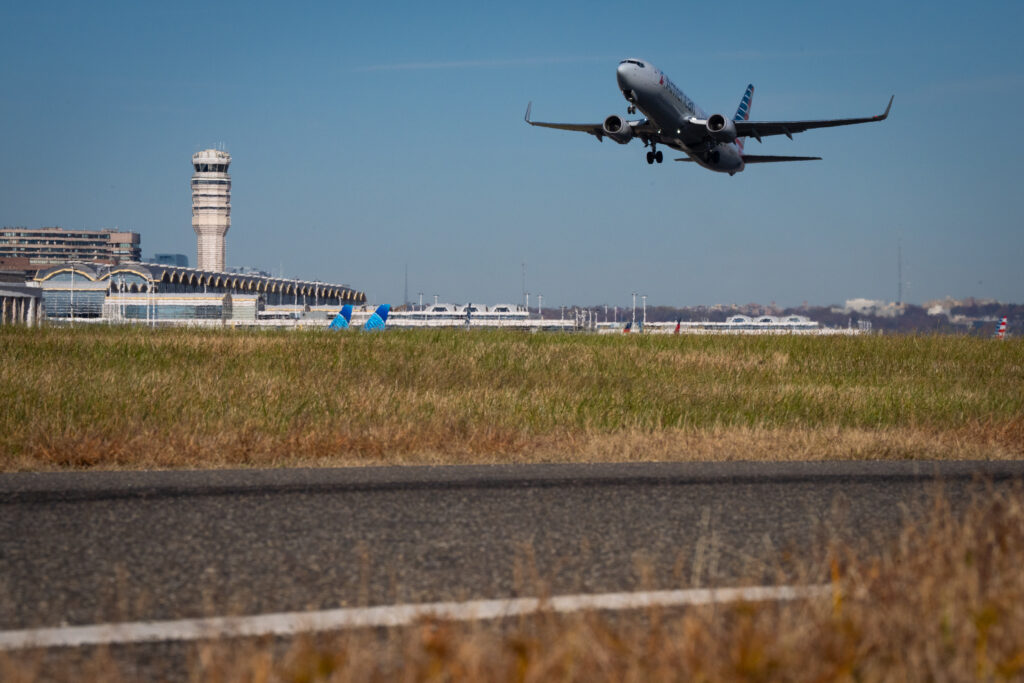
Six months have passed since the National Transportation Safety Board issued its final recommendations aimed at making aviation safer following a deadly crash at Reagan National Airport.
Of the NTSB’s 52 recommendations, 51 remain open.
“We are no closer today to addressing many of the serious safety gaps that contributed to this terrible tragedy,” chairwoman Jennifer Homendy said in a recent statement.
In January 2025, an Army helicopter collided with an American Airlines plane over the Potomac River, killing 67 people in what was the deadliest domestic plane crash in over two decades.
The NTSB concluded that the largest factor in the crash was the Federal Aviation Administration’s placement of a helicopter route directly in the path of Runway 33 at the airport. The board issued two urgent recommendations in March 2025 before releasing its full list of recommendations in January, covering everything from mandating advanced-location receiving equipment for aircraft to developing a new visual-separation training.
Tim Lilley, whose son Sam was the first officer on the American Airlines flight, said he wants the FAA and military to be more transparent about what actions they’ve already taken and what work remains.
“No one should have to guess where these critical safety recommendations stand, especially families like ours who are fighting to ensure the loss of their loved ones actually results in changes that prevent another tragedy,” Lilley, a pilot himself, told The Washington Post.
Multiple aviation safety experts said that the timeline for implementing the recommendations hasn’t been out of the ordinary. Enacting these sorts of changes — which aren’t mandatory — can take years, they said.
“I’ve never seen such an aggressive approach on recommendations with the NTSB,” said Jeff Guzzetti, a former accident investigator at the FAA and the NTSB. “They need time to consider these recommendations. They need time to think about potential unintended consequences that could be more hazardous, and they need to get everybody on board.”
Ella Atkins, an aerospace engineering professor at Virginia Tech, said she thought the process could go faster.
“The regulatory process is extremely slow, and I don’t like that it’s slow. I appreciate the need to be careful with each new regulation,” Atkins said. “But I often feel that because of economics and pilot and air traffic controller preference to not change, that the speed is far slower than it needs to be to actually improve safety.”
After the 2025 collision, the NTSB determined 15,214 “near-miss events” occurred at National Airport between 2021 and 2024, where aircraft were within one nautical mile of each other, with a vertical separation of less than 400 feet. During the same period, there were 85 times when aircraft were less than 1,500 feet apart, and within 200 feet of altitude.
Problems have also been documented after the crash.
In March 2025, a Delta Air Lines passenger flight departing National was diverted to avoid a potential collision with a group of Air Force jets flying to Arlington National Cemetery. Two months later, air traffic controllers ordered two flights to abandon landings at National to avoid collisions with an Army helicopter en route to the Pentagon. That same month, the FAA confirmed that a hotline between National Airport air traffic controllers and their Pentagon counterparts had not worked since 2022.
The NTSB has marked one recommendation as “closed.” That one, an urgent recommendation issued to the FAA in March 2025, pertained to prohibiting helicopters from the stretch between Hains Point and the Woodrow Wilson Bridge when airport runways are being used. The FAA promptly implemented the recommendation and also prohibited commercial operations during “specific, limited helicopter operations” in the vicinity of National Airport.
“That was a fairly quick and easy low-hanging fruit,” said Michael McCormick, coordinator of the Air Traffic Management program at Embry-Riddle Aeronautical University. He said that considering the chronic congestion of D.C. airspace, plus the high rate of near misses at National Airport, it was crucial for the FAA to restrict helicopters around the airport.
But earlier this month, commercial traffic continued at National Airport as President Donald Trump took off from the White House in Marine One, even though the airport is supposed to pause commercial operations while Marine One flies by.
Although the FAA said the president was never in danger, the agency said it is investigating the incident, which featured a “momentary loss of separation” between Marine One and a passenger plane. Audio recordings indicate the air traffic controller couldn’t hear Marine One’s three-minute takeoff warning, reigniting safety concerns surrounding the congested D.C. airport. The NTSB is also investigating the incident.
Guzzetti said the incident wasn’t very serious, but still warrants examination.
“This needs to be investigated to find out why the communication wasn’t clear and how to mitigate this in the future, so it never happens again,” he said.
During a Tuesday news briefing at Newark Liberty International Airport in New Jersey, Transportation Secretary Sean P. Duffy acknowledged that the incident featured communication issues. “We’ve found at a staff level between the Marine One team and the FAA, there had been some telecom issues. That’s been now elevated,” he said.
After the incident, the FAA convened a safety review panel, and agency leadership met with the White House Military Office helicopter unit, an FAA spokesperson said. The group will enhance coordination on three-minute lift notifications and boost signal frequencies, the spokesperson said.
The FAA has already moved an antenna for the helicopter frequency at National Airport to improve communications, according to two people familiar with the matter, who spoke on the condition of anonymity because they weren’t authorized to comment.
The Marine One incident’s communication issues echo the 2025 crash, when the helicopter and commercial jet were communicating with air traffic control on different radio channels and were unable to communicate with each other. In similar situations in the future, air traffic controllers should instruct helicopters to switch to the same channel as the commercial aircraft, Atkins said.
“That is a very logical, common-sense fix that doesn’t require new technology,” Atkins said.
Politics also play a role in the lagging implementation of the NTSB’s recommendations. For months, the Senate and House of Representatives have been in a stalemate over two bills — the Rotor Act and the Alert Act, respectively — which aim to improve aviation safety in different ways.
“There’s still some confusion legislative-wise, and that’s part of what is slowing the process down,” McCormick said.
The Rotor Act, which unanimously passed the Senate but failed in the House by one vote, mandates advanced-location receiving equipment for all aircraft, including military aircraft. That technology, known as Automatic Dependent Surveillance-Broadcast, or ADS-B, allows planes to receive information from other aircraft to identify their locations in the sky.
The Rotor Act failed in the House after the Pentagon pulled its support, citing national security concerns, according to House Armed Services Committee Chairman Mike Rogers (R-Alabama).
Sen. Ted Cruz (R-Texas), who chairs the Senate Commerce Committee and sponsored the Rotor Act, continues to believe that the ADS-B In safety measures in the bill are the most effective way to prevent an accident like the National Airport crash from happening again, according to a committee spokesperson.
“Holding the Department of Defense accountable and requiring all operators to play by the same rules is critical to ensuring any safety improvements are lasting. Congress and partners in industry, the FAA, and DOD should not let this opportunity to make meaningful safety reforms slip away,” the spokesperson said.
Atkins said she had safety concerns if military aircraft in the U.S. weren’t equipped with ADS-B In and Out technology. “I don’t see there being a strong argument for any aircraft carrying a person to not have both,” she said. “If you don’t have that, then the pilots have to look out the window.”
The Alert Act, which passed the House and was referred to the Senate Commerce Committee, has more lax requirements for advanced-location receiving equipment. Still, the NTSB said the bill addresses all of its recommendations.
“The ALERT Act and ROTOR Act were advanced with the same goal in mind: to improve aviation safety for all travelers and flight crews,” Rep. Rick Larsen (Washington), the top Democrat on the House Transportation Committee, said in a statement.
But Homendy chided Congress for not yet passing a bill: “Congress left for August recess without action on a final bill, and we urge they work through differences during this recess so that a final package can be voted on when Congress returns in September.”
“We owe it to the victims, to the families who continue to grieve their loss, and to the millions of people who rely on the safety of our aviation system every day,” she said.
The House Transportation Committee is continuing to have “good conversations” with the Senate and “is working towards an agreement on this important safety legislation,” a committee spokesperson said. The Senate Commerce Committee spokesperson said work to conference the two bills continues. A person familiar with the negotiations, who spoke on the condition of anonymity to discuss private conversations, said the goal is to put forward a bill that combines the best parts of the Rotor Act and Alert Act.
For Tom Lilley and his wife, the measure of progress isn’t whether recommendations have been issued or legislation has been introduced. “It is whether the changes needed to prevent another tragedy are actually put in place,” said Lilley, whose son was 28 and about to get married.
“We appreciate the progress so far, but there is still a lot to do,” he said. “We owe it to Sam, the 66 others who should have made it home that night but didn’t, and to every pilot and passenger in our nation’s airspace.”
The post After deadly DCA crash, changes have been slow to come, official says appeared first on Washington Post.