Americans do not know enough about the Cold War, and much of what they think they know is wrong. After the fall of the Soviet Union in 1991, Republicans took a victory lap, rightly noting that the Soviet collapse was unimaginable when President Ronald Reagan first took office. Liberal critics, however, argued—also rightly—that the Soviet Union was a decaying, economically crippled giant by the time Reagan was inaugurated. In the years since, explanations of the ending of that great conflict have been reduced to the equivalent of partisan bumper stickers: We crushed the Kremlin in the arms race, or The U.S.S.R. imploded without any pressure from the West.
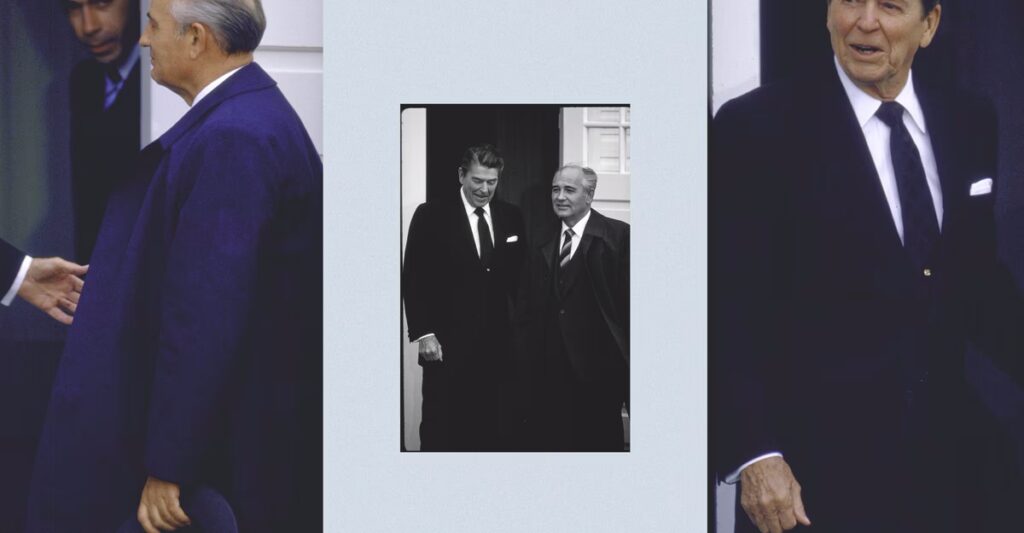
In October 1986, Reagan and Soviet General Secretary Mikhail Gorbachev met to discuss nuclear-arms control in Reykjavik, Iceland. At the time, I was a young scholar in Washington, training in Soviet affairs and international relations at Georgetown University and working at the Center for Strategic and International Studies. (I was also a two-time Reagan voter.) When the Reykjavik meeting took place, no one was looking ahead to the collapse of the Soviet Union; Kremlin watchers were, mostly, relieved to see a Soviet general secretary and an American president talking with each other.
The Brink of War, a new film released nationwide today, tries to bring texture and detail to those two days in Iceland. The movie relies on transcripts and other documents from the time, along with interviews with a former secretary of state, the late George Shultz (to whom the movie is dedicated). The film is a welcome corrective to the liberal orthodoxy about Reagan—specifically, that he was a disconnected simpleton who didn’t understand the complexities of the arms race. But it leans too much in the opposite direction: It is too kind to the Gipper, and takes too many liberties with the historical record.
As a viewing experience, The Brink of War is a better film than the only other movie about the summit, a 1987 British production titled Breakthrough at Reykjavik. But that’s because the earlier movie (now no longer available, as far as I can tell) was more accurate—and perhaps, for some viewers, more boring. The diplomats who met in the middle of the night thought they were ridding the world of nuclear arms, and that story has plenty of drama, but The Brink of War forgoes those details in favor of needless melodrama and a focus on fewer personalities.
[Read: The thin line between biopic and propaganda]
The title itself is misleading. The world was not on the brink of war in late 1986. Soviet-American tensions were much higher, and the risk of war much greater, during Reagan’s first term, which were perhaps the most dangerous years of the Cold War since the Cuban missile crisis. In the early ’80s, the Soviet Union was led by Yuri Andropov, a former KGB chief. In 1983 alone, Reagan gave his “Evil Empire” speech and announced the start of his missile-defense plan, the Strategic Defense Initiative; the Soviets shot down a civilian Korean airliner (killing a U.S. congressman); and the Americans overthrew a Marxist regime in Grenada. Andropov died in 1984, and Gorbachev took more than a year to gain power while the Kremlin stumbled along under the caretaker regime of the grievously ill Konstantin Chernenko.
Gorbachev’s arrival cooled some of these tensions. Almost a year before Reykjavik, Reagan and Gorbachev met in Geneva, where they issued a joint announcement that “a nuclear war cannot be won and must never be fought.” This was an important moment: Gorbachev, still consolidating power, was taking a risk by bucking anti-American hawks back in Moscow and standing with Reagan to join him in officially ruling out nuclear war as a rational instrument of policy.
By the time the two men met in Iceland, they were both determined to reduce their nations’ stockpiles of nuclear weapons. For Gorbachev, this reflected both a sincere belief and an economic imperative. The Soviet Union was struggling with the costs of boneheaded decisions such as the invasion of Afghanistan and the deployment of new and extremely threatening Soviet nuclear weapons in Europe. Reagan, despite his reputation among his critics as a warmonger, was actually an abolitionist when it came to nuclear weapons, and on this, he and Gorbachev were of one mind.
Both men had earlier made dramatic proposals to rid the world of nuclear arms. These were roundly dismissed in each other’s capitals as propaganda, but as it turned out, Reagan and Gorbachev were completely serious. The meeting foundered because of Reagan’s commitment to SDI, but the Reykjavik summit, despite its failure to reach any agreements, nevertheless suggested to the two leaders that they agreed about important things.
The Brink of War gets much of this right, but it portrays Reagan as highly prepared and Gorbachev as somewhat nervous. In reality, Reagan was concerned about the meeting, and at the start he relied on notes and cards he had in front of him. One of Gorbachev’s first observations when they met was about all the paper in front of his American counterpart; Reagan at one point dropped all of his notes and had to shuffle through them to get back on track. The film also shows Reagan confidently teasing his negotiating team about being Democrats, which was probably done so that the movie could make the summit seem like a bipartisan effort. It’s true that a few Reaganites were once Democrats, such as the negotiator Richard Perle, but this was not a team of liberals and conservatives. Perle was so distrustful of arms control with the Soviets that his nickname in Washington in the ’80s was the “Prince of Darkness.”
Soon the two leaders took up the proposal first discussed in Geneva for a 50 percent cut in Soviet- and American-weapons stockpiles. Reagan and Gorbachev, in the course of their discussion, agreed to eliminate all nuclear weapons, a move that surprised both delegations. The idea of full abolition—beloved by both leaders but not part of the Reykjavik agenda—was an improvised moment, almost an accident, and not some premeditated masterstroke (as the movie implies) by Reagan. This sudden change drove hours of unexpected negotiations. Both sides, in a very short time, got remarkably close to a major nuclear deal, because their bosses, both Soviet and American, wanted one.
These American negotiators do not get much attention in the film; likewise, the Soviets, starting with Gorbachev himself, get unfair treatment in The Brink of War. The Soviet boss huddles in the bathroom with his wife, hiding from the KGB, as if he were doing something illegal and not presenting positions he’d already raised among Soviet leaders. The film also depicts Gorbachev as something of a drama queen during the meetings, slamming the table and raising his voice. At one point, when Reagan suggests sharing missile-defense technology, Gorbachev stands up and whines about how America will not even share dairy technology so that the Soviets can provide milk to their children.
Reagan did make that missile-defense technology offer, and Gorbachev did in fact dismiss it. What Gorbachev actually said, however, according to records from the meeting, was more restrained: “Excuse me, Mr. President, but I do not take your idea of sharing SDI seriously. You don’t want to share even petroleum equipment, automatic machine tools or equipment for dairies.” This was a kind of sarcastic zinger from the real Gorbachev. But in any case, no Soviet leader would complain to an American president about hungry Soviet kids. It would have been especially out of character for Gorbachev, who Shultz later recalled was not whiny but rather “brisk, impatient, and confident, with the air of a man who is setting the agenda and taking charge of the meeting.”
Other Soviets appear as central-casting scary Communists. The Soviet Foreign Minister Eduard Shevardnadze is played as a glowering, skeptical presence by a darkly handsome English actor. The real Shevardnadze looked more like a white-haired professor, and he supported Gorbachev’s proposals. Likewise, Marshal Sergei Akhromeyev, the senior military officer who led the Soviet negotiators, is portrayed as a difficult, stiff military man, but American negotiators, especially Paul Nitze, later spoke of him with great admiration as smart, flexible, and someone the Americans could trust.
The Brink of War also presents Reykjavik as something of a guy’s poker party. Men conduct the work in the movie, but in real life, some of the important negotiations with the Soviets were led by the veteran diplomat Rozanne Ridgway, who does not appear in the film. The two most important women in the film are the wives, Raisa Gorbacheva and Nancy Reagan. Raisa is presented as a chic, smart adviser to her husband. Nancy, who stayed in Washington, is Ronnie’s faithful booster, but she also unfairly comes across as a catty flake, envying Raisa and telling the president that the stars are aligned for a successful summit.
Nancy Reagan, fearful of losing her husband, did indeed consult an astrologer after Reagan was shot. But Karen Tumulty, The Washington Post’s chief political correspondent and the author of a definitive biography of Nancy, told me that Nancy was angry in October 1986 not because she felt upstaged, but because her husband’s advisers had told her that Iceland was not a “summit” and therefore that Raisa would not be there. A scene where Nancy tells Ron about the position of Mars, Tumulty added, “strikes me as preposterous.”
The supreme error in The Brink of War, however, is that it wanders too far from the history of the event in order to depict a successful summit. In life, the two leaders agreed about ridding the world of nuclear weapons, but they both left Iceland full of gloom and bitterness. A deal to eliminate nuclear arms dissolved when Reagan insisted that testing for SDI had to continue. Gorbachev, hamstrung by demands from hard-liners back in Moscow, was equally intransigent that no deal could be made so long as SDI was in the works. The summit-that-was-not-a-summit failed.
As the Reagan biographer Max Boot told me, both Reagan and Gorbachev left “furious and disappointed.” Tumulty cites Nancy Reagan as saying later that it was clear to her, watching from afar, that her husband, “pale” and with his “teeth clenched,” was extremely angry as he said goodbye to Gorbachev. According to declassified Soviet transcripts released years later, as the two leaders stood outside waiting to leave, Reagan accused Gorbachev of not wanting a deal in the first place, adding that he didn’t know when they would meet again. (“I don’t either,” Gorbachev said.) Ken Adelman, one of Reagan’s aides at the meeting, later wrote that Reagan, during that final conversation, recalled Gorbachev saying, “I don’t know what else I could have done.” Reagan answered: “I do. You could have said yes.”
None of this makes its way into The Brink of War. Instead, the film makes much of Reagan trying to get a visa for the sister of Mstislav Rostropovich, a Soviet musical maestro who had defected to the United States. Reagan did raise this issue, and the Soviets relented, but The Brink of War makes it seem as if reaching agreement on this opened the way to more deals later. The movie ends with Reagan doubling back to try one more time on the Rostropovich issue. Gorbachev agrees, the men shake hands, and the last word of the movie is deal.
This is not remotely what happened. According to Adelman, it was Gorbachev, not Reagan, who tried one more time to engage—and not on Rostropovich’s sister but on a nuclear deal. “Can’t we do something about this?” the Soviet leader asked as Reagan got ready to leave. “It’s too late,” Reagan said, and walked out.
[Read: How Hollywood taught a generation to fear the bomb]
In the movie, this coldly enraged Reagan is replaced by a smiling dealmaker who is deeply introspective. In a private moment, he stares at the scar from the 1981 attempt on his life; that night he has a fit of PTSD about the shooting as he tosses and turns. The next day, Reagan emphasizes to Gorbachev that he felt that God had spared his life for a great purpose.
Whether Reagan had PTSD from nearly being murdered is a matter of speculation, but he said no such thing to Gorbachev. The movie is full of lines that sound good from Reagan but that he never said. At one point, he invites Gorbachev to “tear down this wall between us,” as if he were already thinking of the line he would use in front of the Berlin Wall a year later. Nor did he say to Gorbachev that the Soviet people were “pissed off” at their government, a line that rings especially false from Reagan, who did not approve of any kind of swearing. As Boot noted to me, the president would not even spell out the word hell in his own diaries.
All of this is unfortunate, because Reykjavik was a crucial step in ending the Cold War, and The Brink of War could have captured Reagan’s admirable toughness and confidence without exaggerating either the president’s abilities or what happened in Iceland. Reagan deserves great credit for making the end of the Cold War possible not only by holding fast to his belief in the superiority of the American system but also by having the vision to see that the Cold War and its endless nuclear tensions did not need to be accepted by either side as an immutable fact of life. He came into office excoriating the Soviets, and learned—almost too late—that he had succeeded too well in scaring the Kremlin and had brought the world closer to war. Encouraged by Shultz and Nancy, he changed course during his first term, and he found a courageous partner in Gorbachev.
Yet Reagan, especially at Reykjavik, was hobbled at times by rigidity and tunnel vision. At the summit, he tried to lecture Gorbachev on the bankruptcy of Marxism-Leninism—this did not go over well—and the president’s obsession with SDI tanked what might have been the most dramatic arms agreement in history. Gorbachev, too, was intransigent, but by Soviet standards he was practically a radical. Fortunately, Gorbachev would drop his objections to SDI in time for both men to sign a landmark treaty in 1987 that abolished all intermediate range nuclear arms in Europe and made the entire world safer. (Donald Trump foolishly withdrew from this treaty in 2019.)
Reagan did not win the Cold War alone, but he and Gorbachev made the end of the conflict and a more secure world possible. The Brink of War, whatever dramatic license it takes, underscores that Reykjavik was part of that story. The summit itself turned out to be a failure, but Washington and Moscow later climbed over its wreckage to reach new agreements. Reykjavik did not end the Cold War, but the Cold War could not have moved toward its peaceful ending without Reykjavik and the spirit of discussion it fostered.
The post A Cold War Movie That Gives Too Much Credit to Ronald Reagan appeared first on The Atlantic.