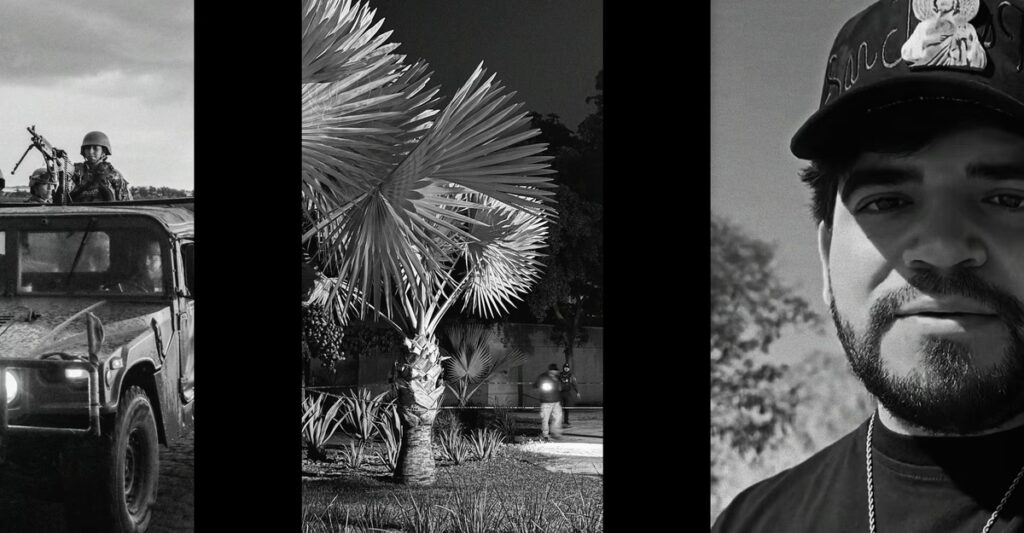
Last Tuesday night, I was eating sushi with a Mexican police chief in downtown Culiacán, a city that had momentarily flickered back to life amid a bloody cartel turf war. At the table next to us was a birthday party. The police chief ordered a salmon roll. Through the window, I could see groups of families and friends walking on the sidewalk, past car dealerships and strip malls, after months of self-imposed lockdown.
Among them were three influencers who pulled up to a KFC down the street. They were dressed as food-delivery workers, carrying insulated bags on their backs, joking with one another and livestreaming everything with their phones. César Gastélum, the group’s front man, had become famous for such innocuous pranks. Even as thousands were murdered by the cartels, Gastélum, a stocky, bearded 24-year-old, posted videos of himself dancing in pajamas, dressing as a priest, sipping iced coffee. He had more than 700,000 followers on TikTok.
It was this kind of incongruity that had drawn me to Culiacán, the capital of Sinaloa. The city is the center of the fiercest and most consequential battle between armed groups in Mexico, and I wanted to untangle what was behind the surge of violence. From afar, it was difficult to tell whether someone like Gastélum was proof that the mundane and the horrific could coexist here, as they have for decades across Mexico, or whether he was a symbol of something else—the way drug cartels had quietly co-opted even the city’s least likely protagonists.
At about 8 o’clock, Gastélum and his friends were recording themselves waiting for their fried-chicken orders when two men on a motorcycle drove past. “Those guys scare me,” Gastélum said. He then seemed to regain his calm, joking about his skinny jeans in front of the camera when the motorcycle returned. It stopped momentarily in front of the three young men. The driver, wearing a black helmet with a face shield, raised a gun about two feet from Gastélum’s head and fired. The livestream captured the moment of the bullet’s impact and then went dark.
Someone on the city’s ambulance team texted me when the 911 call came in, and I ran across the street to the KFC. I got to the scene as police were arriving. Gastélum’s body lay at the drive-through’s exit, a ribbon of blood streaming toward the sidewalk. A cluster of soldiers gathered nearby, some of them scrolling through Gastélum’s TikTok feed. A small group of crime photographers were taking photos and uploading videos.
“As you can see, they have killed another influencer here in Culiacán,” José Ángel Beltrán of Luz Noticias said, narrating on Facebook Live.
Culiacán, for years the axis of Mexico’s drug wars, is now the focus of a U.S. effort to demolish drug cartels—something President Trump has said he’s willing to use military force to achieve. It is in many ways an understandable target: The Sinaloa cartel, which has administered the state for decades, is responsible for trafficking millions of kilos of fentanyl, meth, and cocaine into the United States. The Justice Department has indicted both the Sinaloa governor and the Culiacán mayor for cooperating with the cartel. Several of its leaders are serving life sentences in the U.S., and others have been targeted by Mexican security forces using intelligence from the United States.
[Read: Fentanyl doesn’t come through the Caribbean]
And yet, so far, these actions have only deepened the civil war between two Sinaloa-cartel factions, one run by the children and supporters of Joaquín “El Chapo” Guzmán (the Chapitos), and the other run by allies of Ismael “El Mayo” Zambada García (the Mayos). In 2022, there were 476 homicides in Sinaloa. In 2025, it had 1,657. Government action against organized-crime groups in Mexico has almost always had such an effect—increasing violence without significantly altering the flow of drugs into the United States. But the current Sinaloa turf war—la narcopandemia, locals call it—has created new categories of victims, far from the foot soldiers and hit men targeted in previous spasms of violence. Now influencers and content creators are recruited by cartels to distribute their messages online. And university and vocational students have been kidnapped, presumably because their skills are needed by criminal groups. Each time a young person here is killed or vanishes, there are immediate questions about whom he or she might have been working for. When drug traffickers allegedly subsidize TikTok dances, a victim’s innocence can be almost impossible to discern.
As forensic police arrived at the KFC, Beltrán told me that another TikToker had been killed a few blocks away months earlier. A fitness influencer, El Tata, was murdered while leaving a shopping center. The body of a YouTuber, El Pinky, was found showing signs that he had been gagged and bound. About a dozen other influencers in Sinaloa have been killed, kidnapped, or attacked. Each time, the Mexican government investigated whether the influencers had somehow been linked to one group and targeted by the other. Last year, an unidentified plane dropped thousands of flyers over Culiacán that accused a number of influencers and musicians of having ties to the Chapitos (Gastélum was not on the list).
Standing in front of the crime scene as the forensic police hovered around Gastélum’s body with flashlights, I asked Beltrán why he thought a goofy livestreamer would be a target in a cartel turf war.
“Did you see that he was wearing a cowboy hat?” Beltrán asked me.
Cowboy hats have become a symbol of the Mayos faction of the cartel. The implication was that Gastélum, while performing juvenile pranks, had been making a subtle nod to one group’s power. Online commenters rushed to make the same point.
Beltrán filmed one last video of Gastélum’s body as it was taken away, and then he tapped me on the shoulder. Another victim had been found half a mile away: a man shot in the city’s botanical garden after a screening of a Lady Gaga documentary. I went with him to cover it. When we got there, it was dark, and the body was lit by a streetlight. Beltrán took his phone out again and started streaming.
“Hello again, everyone,” he said. “It’s another rough night in Culiacán.”
The next day, I drove 30 minutes from downtown Culiacán to a neighborhood called Costa Rica, on the outskirts of the city. I passed several motorcyclists who had their face covered by a ski mask. These punteros, as they’re called, have for years worked as low-level informants for the cartel. Even before the fracture of Sinaloa, the cartel was famous for its capacity to monitor every inch of Culiacán. In addition to deploying the punteros, it placed hundreds of cameras across the city and set up surveillance teams in residential neighborhoods.
[Read: A planeload of informants]
The Mexican government has surged hundreds of soldiers and national guardsmen across the city, ostensibly to disrupt the criminal groups who have terrorized it. But the military presence is overwhelmingly performative. On the road to Costa Rica, I watched as punteros and soldiers nonchalantly drove past one another.
I pulled up to the squat house of Marta Pérez Guzman, whose son, David Antonio Ruelas Pérez, had been kidnapped by armed men along with his classmate José Isaías Ibarra Duarte. There were 2,154 disappearances in Sinaloa last year, but the kidnapping of Ruelas, 22, and Ibarra, 23, had received more attention than most. The men were students at an aviation school in Culiacán, and many here suspected that they had been abducted to work on cartel aircraft. There was another notable fact: Ibarra is a U.S. citizen, born in Los Angeles.
His mother, Graciela Duarte Valdez, had wondered whether that would be enough to nudge the U.S. government to act. After all, Trump had articulated in Truth Social posts and Fox News interviews his desire to intervene in Mexico. She had traveled to the closest U.S. consulate, in the neighboring state of Sonora, and made her case. Not only was her son still missing, but the Mexican attorney general’s office had obtained surveillance footage of the kidnapping and showed it to her. Through tears, Duarte described seeing footage of four men who wore ski masks and carried rifles getting out of a minivan and forcing her son and Ruelas into a second car. It all took only a few seconds.
She felt abandoned by the Mexican government’s investigators, who asked questions suggesting that the boys had been working for a cartel faction before the kidnapping. When she went to the U.S. consulate, officials took notes and thanked her for coming (when I asked the State Department about the case, a spokesperson told me in a statement that it was “aware of reports of the kidnapping of a U.S. citizen in Mexico” but did not elaborate). Duarte was despairing; she knew that just a small fraction of disappeared people were later found alive in Sinaloa. One day last year, she heard that Governor Rubén Rocha Moya was visiting her neighborhood. She ran to meet him.
“Please help,” she told the governor, as she held a missing-person poster with her son’s photo and name on it. Rocha told her he would try.
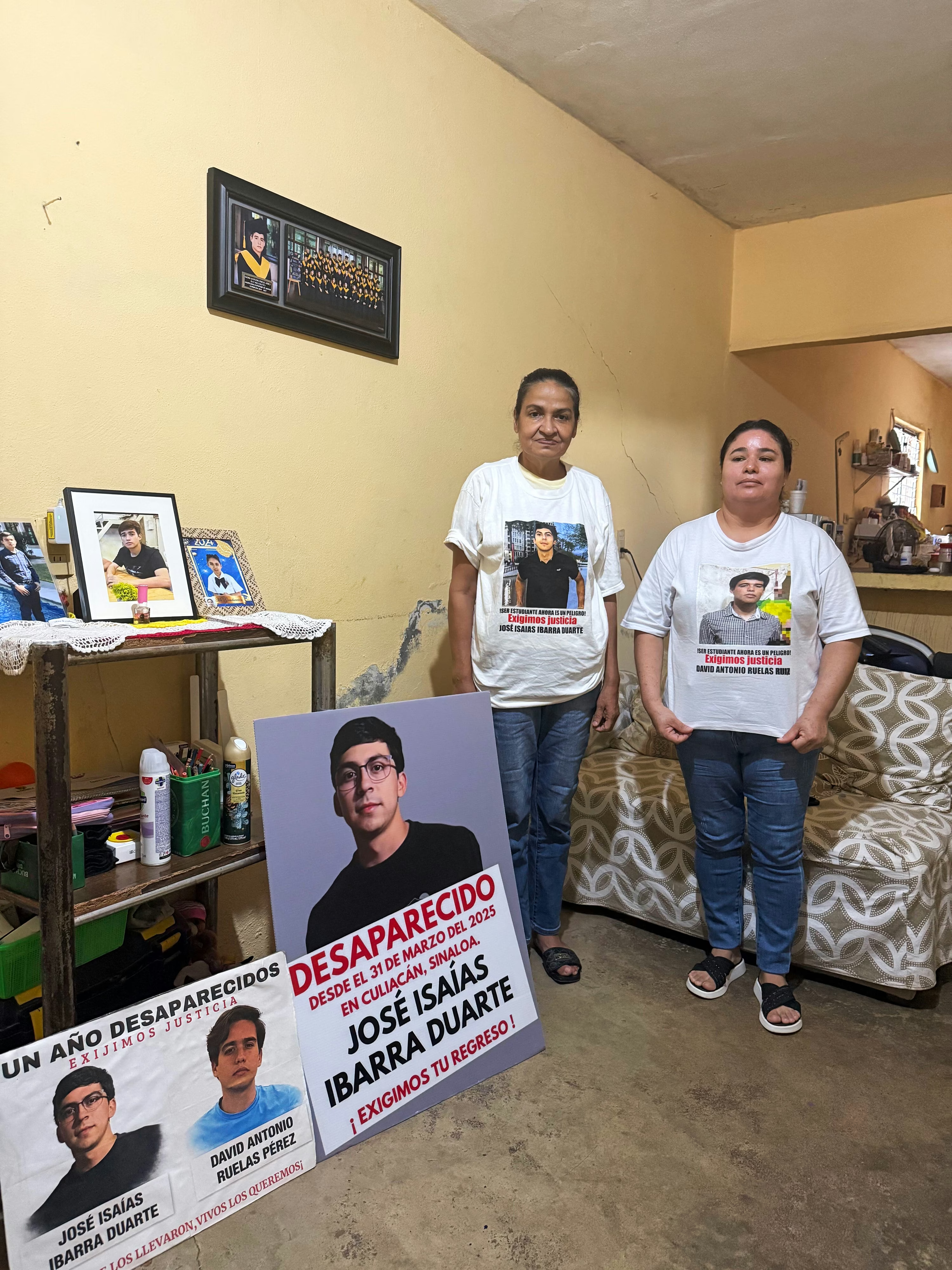
A few months later, Duarte was skimming her Facebook feed for information about missing people and recovered bodies when she saw a news story that said Rocha had been indicted by the United States for colluding with the cartel. The U.S. government had acted, but she could not bring herself to see the move as productive or helpful. Rocha temporarily resigned and fled Culiacán. The Mexican government announced that it would support him until the U.S. showed more evidence of his collusion.
“All I could think was that I had begged that man for help,” Duarte said. “But of course, he did nothing. He had been working for the cartel the whole time.”
About a third of Mexico is controlled by organized criminal groups, according to a U.S.-government analysis. Culiacán—even during its most peaceful stretches—has been a prime example. The cartel presence here has never been subtle. One man in his early 20s told me that his childhood friends had been recruited to work in fentanyl labs and would return smelling like chemicals for weeks. The children of cartel kingpins enrolled in the city’s top prep schools. In one cemetery, families of deceased cartel operatives erected graves the size of suburban homes. Each time the cartel’s fractures sent the city into spirals of violence—in 2010 and 2017—they ended the same way: not with the disintegration of organized crime but with one faction emerging as the victor.
The Trump administration believes that it can avoid repeating this pattern, partially by going after Mexican politicians who support the cartel—“all the government officials that are part of the ‘Culiacán clan,’” Sara Carter, the director of the White House’s Office of National Drug Control Policy, told a journalist earlier this year. The U.S. has also continued its decades-long strategy of targeting top cartel operatives, largely by funneling intelligence to elite Mexican-military units who have conducted a number of successful operations. That partnership is deeper than it has been in years. But I didn’t meet anyone in Culiacán who believes that the strategy will reduce violence here. So far, it hasn’t reduced drug flows, either. Even officials in the Mexican government who are in favor of attacking criminal groups privately dismiss the Trump administration’s absolutist goal of eliminating cartels, given the enormous demand for drugs in the United States.
[Read: Claudia Sheinbaum’s impossible dilemma]
“On Day one, President Trump designated major cartels—including Sinaloa—as Foreign Terrorist Organizations, unlocking powerful sanctions, asset seizures, and enhanced prosecutorial tools to crush their operations. We will not allow cartels to profit off of poisoning our children and grandchildren,” Lauren Bis, a White House spokesperson, told me in a statement.
As César Gastélum’s body was buried last week, some of the city’s influencers posted tributes to him, as if describing a fallen comrade. “We need to take care of ourselves,” one wrote to his 2.3 million followers. Even Mexico’s president weighed in, promising to find the assailants. Duarte had followed the news. Gastélum was just a year older than her son.
But she was following another story more closely. The government had detained a dozen young alleged cartel operatives in a rural area outside Culiacán. It published photos of the boys and men, their faces blurred. Many of their T-shirts were off, revealing skinny frames. Duarte zoomed in on one of them. It was hard to tell, but he looked at least a little bit like her son.
The post What I Saw In Sinaloa appeared first on The Atlantic.