In today’s edition … Trump gets a big warning on gas prices … We ask for your song of the summer … but first …
What Democrats can take from a departing ‘boring’ Tony Evers
Tony Evers is an oddity in Democratic politics right now.
The two-term governor of Wisconsin has backed progressive policies but is not part of the party’s far left. At 74, he is older and choosing to retire, a rarity in this moment of gerontocracy. He has managed to stay popular after eight years of running a divided battleground state. He is not a social media maven — the most viral thing about him is probably his love of ice cream. And he is, to put it mildly, a bit boring — more of a deliberate leader than a passionate firebrand.
Yet, Evers proved himself prophetic Wednesday morning in Wisconsin. When the Democrat won his second term in office in 2022, he embraced people calling him boring. “As it turns out,” he quipped, “boring wins.”
And Evers, even on his way out, has won again.
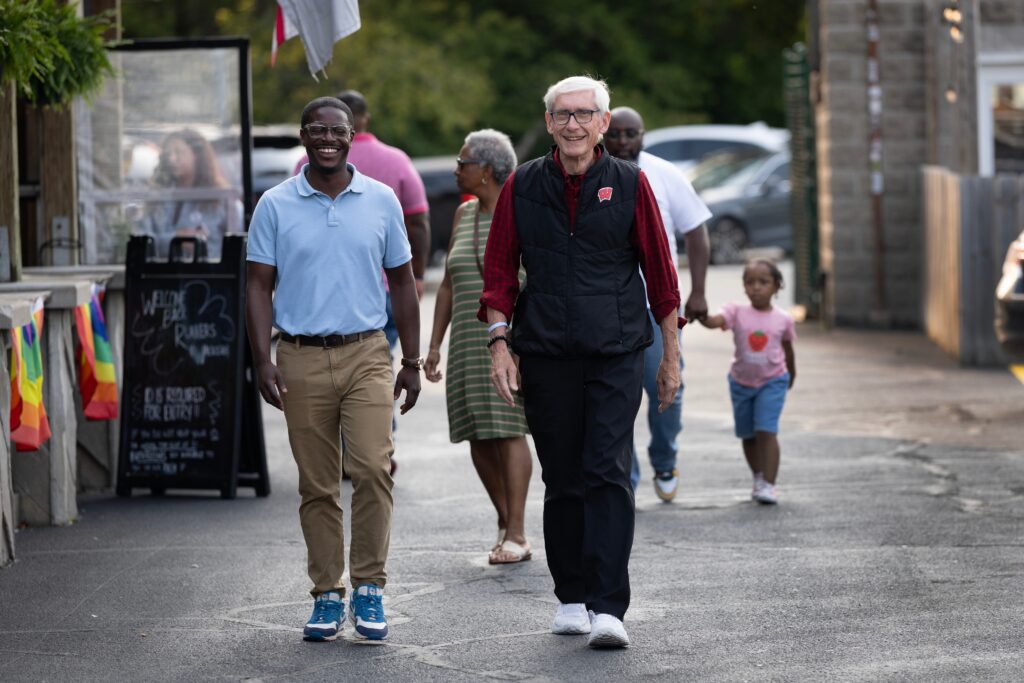
Milwaukee County Executive David Crowley, after polling in the low single digits, had already dropped out of the race to replace Evers when the sitting governor decided to endorse him. With Evers’s backing, Crowley jumped back into the crowded field, and the two began barnstorming the state, hoping that with Evers’s popularity and the chaotic nature of the contest they could pull off the unthinkable.
And they did.
In the early morning hours on Wednesday, Crowley defeated Francesca Hong, a State Assembly member and democratic socialist, in the Democratic primary, a massive upset given a string of polls that showed Hong with a large lead.
Evers was roundly mocked for his decision to resuscitate Crowley’s campaign. The left lambasted him for attempting to thwart Hong’s rise. Many questioned why he was getting involved at all, given that it looked like Crowley and Mandela Barnes, Evers’s former lieutenant governor, would split the anti-Hong vote. But Barnes got out shortly after Crowley got back in, and Evers, acting basically as Crowley’s shadow for the final weeks of the campaign, all but dragged the Democrat across the finish line.
“Even his closest allies didn’t think he could pull this off,” a Wisconsin Democratic operative told me, speaking on the condition of anonymity to talk openly about private conversations. “There are a lot of people applauding him who were shaming him in private conversations.”
Sure, Crowley deserves credit, despite bowing out of a race he eventually won. And Hong did herself no favors by closing the campaign defending a string of controversial social media posts, including one where she raised the idea of canceling Thanksgiving.
But when the dust settles on this contest, it will probably be the man who critics said was too boring to win statewide in Wisconsin, Evers, who deserves most of the plaudits.
“He is not a flashy guy. He has never been someone who constantly wants attention,” said Alex Floyd, an aide on Evers’s 2018 campaign.
But Floyd recalled that lack of flashiness helped because it was “very authentically him.” “The ice cream thing is no joke. He loves McDonald’s ice cream, and he is an incredible euchre player,” Floyd said, noting that Evers played the card game on local news while running in 2018. “That is not a vibe you can fake.”
American politics is currently in a moment where the ability to get attention is prized over nearly anything else. It’s why President Donald Trump has been so successful for a decade, why more people know about Congress’s bombasts than they do the body’s quiet workhorses, and why the thing that fires up Democrats the most right now is the candidate who is best able to attack Trump in any way possible.
But maybe Crowley’s win — and Evers’s role in it — should serve as a reminder for Democrats that winning is not one-size-fits-all.
“You have to just be who you are and have voters believe you and trust you. But that can look many different ways,” said Sam Lau, a former Evers aide who compared his one-time boss to Fred Rogers, aka Mr. Rogers, the iconic children’s television host. “The voters of Wisconsin have just trusted that authenticity for a long time.”
Evers’s primary attack on Hong reflected this lesson. Evers regularly took issue with the fact that she “spends a lot of time … talking on Twitter and all these other extraneous issues.”
Evers pointed to the reality that the job Hong and Crowley were running for involved life-and-death issues, like natural disasters destroying communities, and “we’re going to spend time on that bulls— that others are talking about on Twitter. Please.”
The question now is whether Evers uses this power again. “If Crowley becomes the next governor, he has one person to thank for that, and that is Tony Evers,” said Corey Platt, the political director at the Democratic Governors Association in 2018, when Evers was first elected. “When Crowley becomes governor, Evers will have as much a role as the kingmaker or de facto leader as he wants to have.”
Years ago, I wrote a piece about former Democratic senator Bob Casey, whom a columnist famously compared to oatmeal early in his political career. Casey was so aware of the joke that years later he remembered the name of the columnist who wrote it and where he was when he read it the first time. And yet, Casey wore it as a badge of honor.
At a time when voters are looking for the eggs benedict or blueberry pancakes of political candidates, it wouldn’t be a stretch to make the same comparison with Evers.
But that comparison deserves an addendum: Oatmeal may be a little dull, but it often gets the job done.
Want this in your inbox?
Start your day with The Washington Post’s flagship political newsletter. Sign up here.
Our picks
- Record El Niño to give Earth a preview of its warmer future, from Ben Noll.
- This national youth sports organization is failing to protect kids from sexual abuse, from Molly Hensley-Clancy.
- White House press secretary Karoline Leavitt to leave administration, from Cat Zakrzewski.
- Record-breaking $12.5 billion deal for Lakers comes just months after previous sale, from Les Carpenter.
- Trump administration set to spend at least $900 million on White House construction, from Jonathan O’Connell and Sarah Blaskey.
What we’re watching
We could probably write about gas prices in this section of the newsletter for the next three months.
Don’t worry, we won’t.
But today there is real news.
According to Patrick De Haan, head of petroleum analysis at GasBuddy, the national average of gas prices is “now at its highest ever level this late in the calendar year, according to GasBuddy data.”
“Meaning the national average has never been above $4/gal after Aug. 12 in any previous year- ever,” De Haan wrote on Twitter. He later said that their data goes back to 2000, but gas prices never were over $2 before 2000, according to other data.
This is a big political problem for Republicans.
There is a credible argument to be made that Republicans’ fortunes at the ballot box in November are directly correlated to the size of the numbers at the gas pump over the next few months. We have written about how gas prices are embedded in the American psyche more than any other cost, in part because they are advertised in big, block numbers on countless street corners.
Republican operatives are clearly worried about the high prices, and a few argued that if they don’t fall by Labor Day in September, the party could be in for massive losses two months later.
Gas prices spiked because of the war Trump started with Iran, a by-product of the critical Strait of Hormuz being largely closed during the conflict. There is little indication that the shipping channel will open any time soon, and De Haan and others have said that even if it were to reopen, it would take weeks to see a dramatic impact on prices.
But also consider this: Trump has pulled oil from the nation’s Strategic Petroleum Reserve to tamp down gas price shocks. That, according to CNBC, has left the reserves below 300 million barrels, the lowest since 1983. The lower those strategic reserves fall, the less power Trump has to impact national gas prices ahead of an election.
In your local paper
North Dakota Monitor: Thousands of North Dakotans are losing their food assistance benefits because of changes to federal priorities. Many in that group are refugees, who are losing out in part because of work and citizenship requirements put in the federal food assistance program.
Stateline: Schools are spending billions on AI tools for students. The problem? They can’t really figure out what is worth buying.
Send a reply
Our colleagues Ela Jalil, Ethan Beck and Klara Auerbach posited that they can tell you where you are from based on what “song of the summer” you pick, and we shared that story in yesterday’s intro. Simple question: What is your song of the summer? And why? Let me and your fellow Early Brief readers know at [email protected].
Thanks for reading. You can follow Dan and Matthew on X: @merica and @matthewichoi.
The post What Democrats can learn from Wisconsin’s ‘oatmeal’ win appeared first on Washington Post.