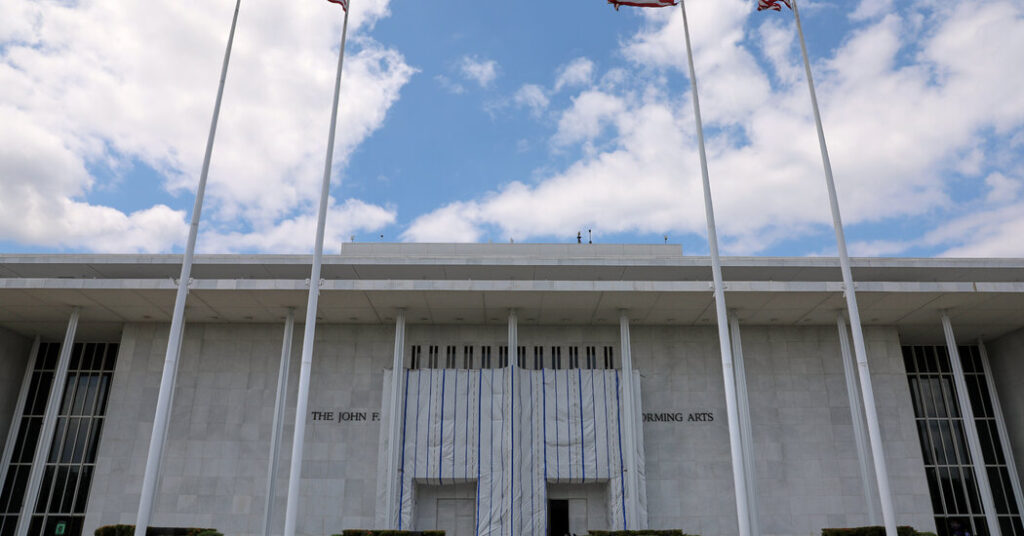
The board of the John F. Kennedy Center for the Performing Arts voted on Thursday to inscribe President Trump’s name on the building beneath the main signage, according to two people with direct knowledge of the proceedings, aggressively testing a federal judge’s order.
According to the resolution approved by the Trump-allied board, the inscription underneath the institution’s name would read: “Restored and Renovated by President Donald J. Trump.” The board’s decision, which directs officials to act by “all legal means,” came shortly after it voted to move forward with Mr. Trump’s plan to shutter the building for renovations.
The president’s name was added to the building last year, but the judge ordered the letters taken down, finding that only Congress had the authority to change the institution’s name. The center removed Mr. Trump’s name in June but is appealing the ruling.
The move appeared to be a creative workaround to a provision in the federal law governing the Kennedy Center that says “no additional memorials or plaques in the nature of memorials shall be designated or installed in the public areas.”
In Thursday’s resolution, the board directed officials to honor Mr. Trump for bringing the center back “from the brink of disaster,” presenting a series of possibilities that include naming the center’s grounds the “President Donald J. Trump Plaza.”
“It is hereby resolved,” the measure said, “that the center desires to recognize and honor President Trump’s existential and unprecedented contributions to the survival of the center by all legal means.”
Both decisions will be subject to the scrutiny of the judge who found that the board had been “derelict” in considering the closure plan ahead of its original vote. Mr. Trump announced in February that the center would close for two years, with the objective of transforming what he called a “tired, broken and dilapidated” institution.
The board voted on Thursday to close the Kennedy Center’s main building, while keeping a newer addition to the campus, known as the Reach, open for limited programming and to operate as an active memorial to John F. Kennedy.
Ahead of the meeting, the board was presented with a 163-page plan for a $250 million “renewal” project that includes structural repair work, new marble floors, $11.8 million in “acoustical improvements” and a plan to temporarily move the famous 3,000-pound bronze bust of Kennedy to another building on campus.
The approved resolution notes that the decision to close was made based on an “independent and objective analysis” of possible options by an outside consulting firm, which determined that keeping the main building open during renovations would be significantly more costly. It notes that the board is “fully committed” to continue arts and educational programming during the closure and maintain the “historic and architecturally significant nature of the center’s main building.”
After Mr. Trump announced the closure plan this year, the board — led by the president and composed largely of his allies — quickly agreed. But a Democratic lawmaker who sits on the board sued over the decision and a federal judge temporarily blocked the closure, ruling that the original vote had been “ill-informed and seemingly preordained.”
In his order in May, Judge Christopher R. Cooper of Federal District Court in Washington wrote that if the center continued to pursue a closure, its trustees had a legal obligation to seriously consider the potential consequences of shuttering Washington’s pre-eminent performing arts venue.
Mr. Trump lashed out at the judge following his decision and said it would be “dangerous” to keep the center open. Center officials later assured the judge that they were following his order and further scrutinizing the decision, culminating in the meeting on Thursday morning.
Judge Cooper will soon review the decision to consider whether the trustees, in his view, performed enough due diligence ahead of the vote.
“The board will be expected to prepare itself with sufficient information to make a considered, independent decision,” the judge wrote in the May order, “taking account of its obligation to both maintain and operate a premiere arts venue and its solemn duty to memorialize a fallen president.”
For weeks, the future of the Kennedy Center has been in limbo, with a largely bare performance calendar.
Broadway touring shows, typically a major source of ticket revenue for the center, have gone elsewhere for the coming season. The National Symphony Orchestra, the center’s resident ensemble, has yet to announce a season that typically opens in late September. And employees at the center, which already executed rounds of layoffs in anticipation of a full closure, remain unsure about their futures.
Ahead of the meeting, board members were provided with a comparison of two scenarios for renovations by an outside consultant. Both the consultant and the construction management firm, JLL, raised safety and cost concerns that they say would arise from keeping the building open during a phased renovation.
The proposal by JLL says the project would address chronic leaks, replace outdated equipment and redesign parts of the interior. Changes include new furniture, a new coffee shop, electronic ticketing kiosks and $7 million in public restroom renovations. The target for reopening would be summer of 2028.
Judge Cooper said in his order that the board had a legal obligation to maintain the facility as a memorial to President Kennedy. Under the plan, memorial materials would be moved to the building known as the Reach during the closure.
It was unclear immediately after the meeting, which was held virtually and was not public, whether the center intends to pursue the exact construction plan laid out in the report following the judge’s review.
Over the past year and a half, the Trump-led Kennedy Center has struggled with an exodus of audience members, employees and artists unwilling to be involved with what they now view as a political arm of the White House. The backlash was particularly strong late last year, when the board voted to change the institution’s name to the Trump-Kennedy Center. New letters were added to the building’s marble facade the next day.
Judge Cooper rejected that decision as well, ruling that only Congress — which dedicated the institution to President Kennedy in 1964, shortly after he was assassinated — had the power to change the center’s name. The center is appealing, but in the interim has followed the judge’s order to remove “Trump” from the building, website and other official materials. It also installed a towering matrix of scaffolding, covered in tarps, that obscures much of the current signage.
The legal challenge has been waged by Representative Joyce Beatty, a Democrat of Ohio who holds an ex officio seat on the board. Her lawsuit questioned the true reasoning for the closure plans, arguing that it may be an effort to mask a financial downturn precipitated by slumping ticket sales and fleeing artists.
Many other members of the board are staunch Trump allies, such as Susie Wiles, the White House chief of staff; Dan Scavino, a Trump adviser; and Allison Lutnick, a former lawyer who is married to Commerce Secretary Howard Lutnick.
In recent months, Mr. Lutnick has stepped in as something of a surrogate for Mr. Trump in matters involving the Kennedy Center.
In an interview in June at a Kennedy Center event to honor the comedian Bill Maher, Mr. Lutnick said Mr. Trump asked him to get involved to make sure the board’s processes were in line with the court’s expectations.
“He asked me to help him make sure everything is organized,” Mr. Lutnick said, “so that when judges consider what the board is doing, that it’s done perfectly.”
Matt Floca, the center’s executive director, has argued in recent months that a full closure would be the most efficient and responsible way to execute sorely needed renovations using the $257 million allotted by Congress last year. In a report for the board, Delta Consulting Group, which was hired to compare different scenarios for renovations, said that if the center pursued a phased construction process over four years, the congressional appropriation would cover less than half of the estimated costs.
Outside arts administrators have suggested the financial realities for cultural organizations are far different from what the board is projecting, saying institutions typically do anything possible to avoid closure so they do not lose ticket revenue and donors.
The Kennedy Center has until next week to share its plan with Judge Cooper.
The post Kennedy Center Board Decides to Inscribe Trump’s Name on Building appeared first on New York Times.