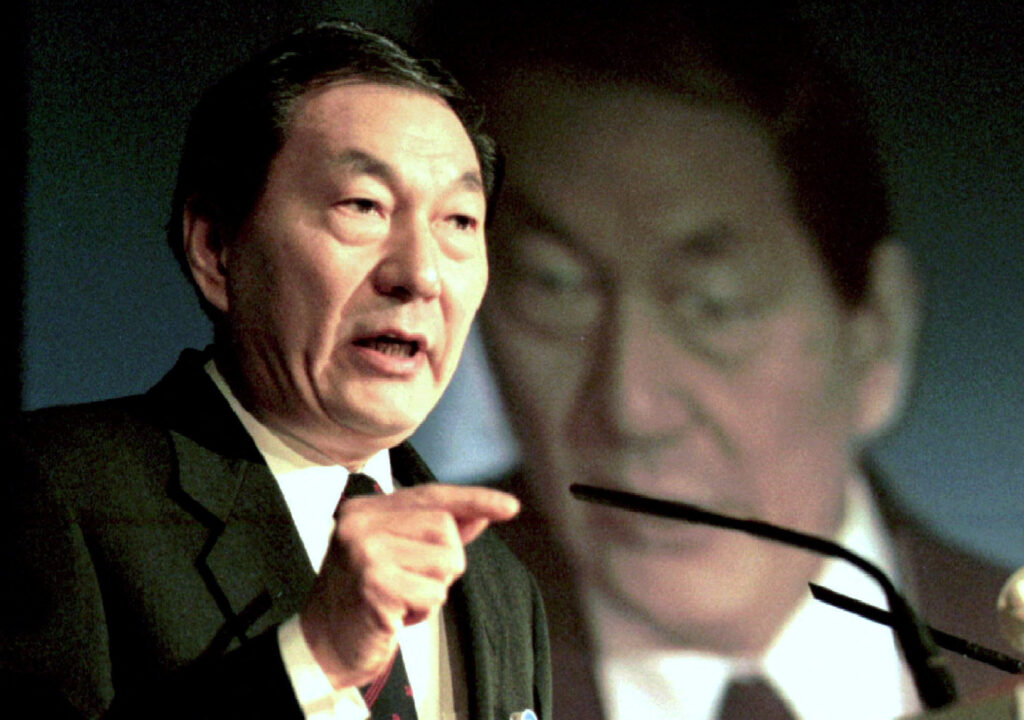
BEIJING – Zhu Rongji, a brilliant economic policymaker and a driving force behind China’s economic opening to the world, died Aug. 12 in Beijing. He was 97.
State news agency Xinhua reported the cause as illness, citing an obituary issued by China’s Communist Party.
Mr. Zhu spent a decade as China’s “economic czar,” including five years as premier under President Jiang Zemin, from 1998 to 2003. He negotiated his country’s entry into the World Trade Organization, pushed through reforms that breathed new life into China’s state-directed economy and set the stage for another decade or more of rapid economic growth.
Known for his frankness and sardonic humor, his impatience with banquets and protocol and his intolerance of lazy and corrupt colleagues, Mr. Zhu was something of a maverick within China’s stifling one-party system. He was widely admired in Western capitals, but less popular within the corridors of power at home.
Mr. Zhu was intellectually curious and pragmatic. Above all, he was a risk-taker. He unleashed new dynamism in China’s economy by exposing it to competition and market forces. In the process, he threw tens of millions of employees of state-owned companies out of work, but he also cut through a web of patronage and corruption that had threatened to swamp China’s economic rise.
Mr. Zhu’s approach made many enemies within the system but ultimately renewed the Communist Party’s hold on power. Succeeding the conservative Li Peng, who played a key role in the violent suppression of the Tiananmen Square demonstrations in 1989, Mr. Zhu, as premier, breathed new life into his country’s economy and helped rebuild the Communist Party’s image in foreign capitals.
Economic architect
“He was one of the most important economic architects China has had in the post-1949 period,” said Nicholas Lardy, a senior fellow at the Peterson Institute for International Economics, who met Mr. Zhu on many occasions. “He did more to integrate China into the global economy than anyone, and led a major effort to reform weak state-owned enterprises and the weak banking system.”
As mayor and then mayor and party boss of Shanghai, from 1988 to 1991, Mr. Zhu laid the foundations for that city’s stunning modernization. He wooed foreign investors and cut red tape, he also opened up the Pudong district on the east bank of the Huangpu River and kick-started its transformation from sleepy backwater to the financial hub of modern China.
Promising to do away with the scores of rubber stamps — or chops — needed to approve investment projects, he promised a one-stop shop. That earned him his first nickname, “one-chop Zhu.”
He was known for publicly berating officials who failed to measure up to his standards, and his subordinates often referred to him simply as Zhu Laoban, or “Boss Zhu.” Later, his uncompromising approach brought him the nickname Zhu Fengzhi, or “Madman Zhu.”
As vice premier, his tours around the country sparked trepidation.
In 1994, he clashed with a provincial party boss in the northeastern province of Heilongjiang — and fired him on the spot. On another occasion, a local official is said to have showed off an expensive cigarette lighter – beyond what someone on his salary would normally afford — and Mr. Zhu sacked him on the spot for corruption.
His influence on Chinese economic policy — as vice premier, central bank chief and ultimately as premier — formed his most enduring legacy. He was a protégé of paramount leader Deng Xiaoping, who brought Mr. Zhu to Beijing in 1991 and described him as someone who “gets economics,” a vital attribute in rapidly changing China.
Two years later, he was given overall control of economic policy, at a time when inflation was a runway 25 percent. He soon repaid Deng’s faith, engineering a soft landing, bringing greater discipline to banks that had been lending to money-losing state-owned enterprises, slashing government spending and curbing money-supply growth.
Temporary price controls on staple foods helped break inflationary expectations, index-linked savings schemes offered protection against inflation and encouraged people to bank rather than immediately spend their wages, and a currency devaluation stimulated exports.
Then, he moved on to the sclerosis that threatened to strangle China’s economic rise. Mr. Zhu’s overhaul of state-owned enterprises ultimately caused more than 30 million employees to lose their jobs, although many found work in the private sector.
About 1.5 million officials also found themselves out of work as Mr. Zhu tried, with limited success, to trim a bloated bureaucracy. With the support of President Jiang, who tried to staunch rampant corruption in the military, he made an effort to push the armed forced out of their commercial ventures and boosted the flow of tax revenue to the central government.
His most lasting achievement may have been China’s entry into the WTO in 2001. There were years of tough negotiations with the United States, during which he was often accused at home of selling out to the Americans.But ultimately Mr. Zhu negotiated terms that laid the foundation for years of export-led growth.
Still, Mr. Zhu acknowledged that his work was incomplete when he retired in 2003, at 75, and said he had failed to address a growing divide between the booming cities of China’s east coast and its much poorer rural hinterland.
Dynastic antecedents
Mr. Zhu’s family were said to be descendants of Zhu Yuanzhang, the first emperor of the Ming dynasty, founded in the 14th century, and they were large landowners around Changsha in Hunan province.
Mr. Zhu’s father died before he was born in Changsha on Oct. 1, 1928, and he was an adolescent when his mother died. He was raised by an uncle who had three daughters and a son. The uncle was supposedly so poor that they could afford to send only the two boys to school.
Mr. Zhu made the most of his opportunity. He was at the top of his class and went on to study electrical engineering at the prestigious Tsinghua University in Beijing. In 1949, the year the People’s Republic of China was born, he joined the ruling Communist Party.
At Tsinghua, he was elected class president and chairman of the student government committee. He also met his future wife, Lao An, with whom he shared a passion for Peking opera. They married in 1956 and later had a son and a daughter, who were both educated in the United States and rose to prominence in the financial industry in China.
In 1957, Mr. Zhu was caught up in one of Chinese Communist Party Chairman Mao Zedong’s purges. Mr. Zhu reportedly had made a short speech criticizing the party leadership and praising reforms taking place in Communist-controlled Hungary and Yugoslavia. He was branded a “rightist,” interrogated for months, kicked out of the Communist Party and sent to a reeducation camp in the countryside (to do menial labor or clerical work).
During the bloody Cultural Revolution, Mr. Zhu was banished again to the countryside in 1970. He raised pigs and planted wheat but also found time to continue learning English.
Dr. Zhu’s career took an upswing after Mao’s death in 1976. He was rehabilitated by Deng, who had suffered a similar fall from grace under Mao. Under Deng’s wing, Mr. Zhu rose rapidly through party ranks on his way to running Shanghai.
There, one of his first actions was to berate local tourism officials over the state of the city’s public toilets. “How is Shanghai expected to attract 900,000 foreign tourists if they can’t find a clean restroom?” he asked the officials, before ordering them to scrub every one clean.
He faced a greater challenge in June 1989, after the violent suppression of the Tiananmen Square protests in Beijing. Thousands of students were blocking roads in Shanghai, and workers were not showing up at factories. Instead of ordering a crackdown, he made a televised speech that defused tensions, calling the students patriots rather than “counterrevolutionaries,” as protesters had been branded in Beijing. He pledged not to dispatch armed police and appealed to protesters to “preserve Shanghai’s livelihood and production” by going home.
“Historical facts cannot be covered up by anybody,” Mr. Zhu said. “The truth will always come out.” The anger dissipated, and the demonstrators dispersed.
In 1990, on an American tour, Mr. Zhu was dubbed “China’s Gorbachev” by a New York Times reporter, referring to the reform-minded Soviet leader Mikhail Gorbachev. But it was an honor that brought him considerable heat at home and one that he angrily rejected. Mr. Zhu never indicated a desire to replace Communist Party rule with Western-style democracy, but he appeared genuinely frustrated by officials who illegally enriched themselves, and he told journalists to be true to their professions and to expose “the dark side of society.”
In retirement, Mr. Zhu wrote several best-selling books, played a traditional stringed instrument called the huqin, and gained a reputation as one of China’s most generous philanthropists, donating millions of dollars’ worth of book royalties to a foundation dedicated to improving education in poor rural areas.
The post Zhu Rongji, China premier crucial to economic transformation, dies at 97 appeared first on Washington Post.