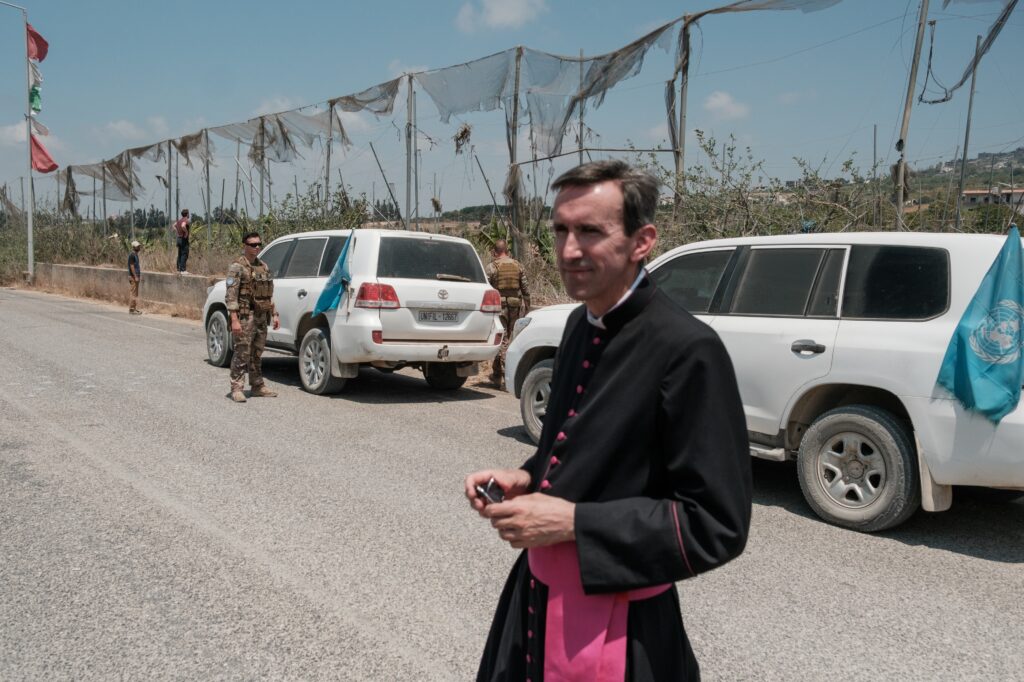
NAQOURA, Lebanon — As the cars advanced down the coastal road here at the southwestern tip of Lebanon, the flags came into view. The yellow and green banner of Hezbollah. The red, white and green tricolor of Iran. Finally, a few miles from the border, the blue and white standard of Israel.
“Turn back,” an Israeli soldier warned, in English, through a megaphone. “You don’t have authorization.”
The convoy of church officials and humanitarian workers, approved by United Nations peacekeepers to visit three towns inside Israeli-occupied Lebanon, retreated to seek new authorization.
For the few inhabitants who have remained in southern Lebanon since Hezbollah and Israel renewed fighting in March, such incidents have become common. Israeli officials say they need to occupy the 75-mile-long, 6-mile-wide buffer zone to dismantle Hezbollah’s infrastructure and prevent the group from launching drone and missile attacks into northern Israel.
The announcement by Secretary of State Marco Rubio in June of a preliminary deal in which Lebanon would disarm Hezbollah and the Israel Defense Forces would gradually withdraw from the country has had little impact on daily life here. Instead, residents are seeing parallels to the Israeli security protocols that vex Palestinians in the occupied West Bank.
“We are trapped in a prison,” said Ayoub Khreish, mayor of Ain Ebel, a predominantly Christian town an hour east of Naqoura. Even ambulances need permission to enter and leave, he said. “We drive and we pray.”
President Donald Trump is attempting to keep the peace here in part to advance talks with Iran. Tehran has repeatedly tied a ceasefire with the United States and Israel to an Israeli withdrawal from Lebanon. Israeli strikes on Beirut in June almost derailed a deal, and Iran signaled over the weekend that it would not reopen the Strait of Hormuz unless attacks in Lebanon stopped.
Trump, hosting Lebanese President Joseph Aoun in the Oval Office last month, pledged support for the war-torn country, including an easing of flight restrictions. When asked about the withdrawal of Israeli troops from Lebanon, he said, they were “in the process of redeployment.”
Under a U.S.-brokered deal, Israel has carried out a small phased withdrawal in areas known as “pilot zones” and handed over control to the Lebanese Army. But there have been no indications of a more substantial redeployment after another round Lebanon-Israel talks last week at the U.S. Embassy in Rome.
The IDF has increased strikes elsewhere in southern Lebanon in response to what it says are ceasefire violations by Hezbollah, and has erected earthen barriers in places where the Lebanese Army is already deployed, raising fears of a long-term occupation.
Israeli Prime Minister Benjamin Netanyahu told Fox News last month that some Lebanese Christian towns had “asked to be annexed to Israel” for protection against Hezbollah militants. He did not name the towns or provide evidence. Last week, a map published by the Israeli Foreign Ministry appeared to incorporate southern Lebanon into Israeli territory. (It was later deleted.)
Officials in several Christian towns quickly refuted Netanyahu’s claim. “We do not want to be part of Israel,” Sandy Diab, a native of Ain Ebel, told The Washington Post. “We are very proud to be Lebanese.”
Sam Heller, a Beirut-based fellow with the Century Foundation, doesn’t see clear indication that Washington will force Israel to leave Lebanon, and so doesn’t expect a withdrawal anytime soon.
For now, he predicted, Israel will continue to restrict access to southern Lebanon because it’s “not interested in outside scrutiny that isn’t coordinated.”
The aid convoy was organized by L’Oeuvre d’Orient, a Catholic nonprofit based in Paris, which coordinated with U.N. peacemakers and the U.S.-led mechanism monitoring the ceasefire between Hezbollah and Israel.
Most of the 15 convoys the group has sent here since the fighting resumed in March have reached their destination uninterrupted, its director said, but conditions on the ground are fluid. The Christians who have remained in southern Lebanon, the Rev. Hugues de Woillemont said, ”are showing remarkable courage and determination.”
Like many in southern Lebanon, Christians have been caught in a war they did not choose. The conflict has cut them off from the rest of the country; at its height in March and April, fuel and internet interruptions left many dependent on outside aid.
The continuing scarcity of basic goods in Ain Ebel is driving up prices, Khreish said. “Everything here is 25 percent more expensive than Beirut.”
Farmers leaving their homes to tend to their crops in the countryside need prior approval, the mayor said, and ongoing airstrikes by both sides have scared away the honeybees that produced honey.
The aid convoys have been escorted by U.N. peacekeepers. Their term expires at the end of the year; who will take over their role is unclear.
“What [the people here are] saying, and you don’t need a diploma to understand, is that they want to live, live in peace” said Col. Maxime Laudet, an officer with the French contingent to the decades-old U.N. Interim Force in Lebanon (UNIFIL).
Laudet’s troops helped to renovate a sports facility here to give local youth more recreational opportunities and to prevent a further decline in the population. “They’re a bit upset because ties with the north are complicated.”
Only a few towns in the buffer zone remain inhabited. Israeli Defense Minister Israel Katz has said the IDF had destroyed 24 Lebanese villages and currently occupies 270 square miles of Lebanese territory.
The majority Shia population, which Hezbollah claims to represent, has mostly fled.
The people who remain, De Woillemont said, are “exhausted and anxious.”
“Their request is very simple,” he said. “To be able to live safely and with dignity on their own land, without being forced to leave.”
Lior Soroka in Tel Aviv contributed to this report.
The post Trump says ceasefire in Lebanon is working. For residents, it’s a ‘prison.’ appeared first on Washington Post.