Bill Hansen served as U.S. deputy secretary of education from 2001 to 2003 and as vice president of the Virginia Board of Education from 2022 to 2026.
The U.S. economy added over 400,000 jobs in the past year. Unsurprisingly, many of the fastest-growing roles do not require a four-year degree, but instead ask for the sort of industry-recognized credentials that can be earned in months, not years — and increasingly, while students are still in high school.
In 2010, employers posted more jobs requiring a college degree than jobs that didn’t. By 2020, not only had that flipped — online postings open to workers without a degree outnumbered those requiring one by nearly 2-to-1.
Washington is responding. As of July 1, for the first time in the history of federal student aid, students can use Pell Grants not only for a college degree but for short-term workforce credentials — as short as eight weeks. That opens the door to fields where demand is already acute, such as health care and construction, and in trades such as electrical work, HVAC and fiber-optic installation. These occupations will only grow more essential as the country builds the data centers and infrastructure needed to power a modern economy. The message from Republicans and Democrats is clear: Federal policy should promote multiple tracks to economic mobility.
There’s a corresponding shift in how families think about the journey from high school to career. Enrollment in trade-focused and certificate programs has surged nearly 20 percent since 2020. The share of parents who view career and technical education (CTE) as a path for high-achievers, not just a fallback, has nearly tripled since 2019. More high school students are asking not just “Where will I go to college?” but “What will I be able to do when I leave school?”
But while parents and policymakers may be wising up to an evolving landscape, too many schools remain trapped in a different era. The average U.S. public K-12 school is roughly 50 years old. Over decades, as the focus shifted toward college readiness, schools across the country deprioritized the vocational spaces that once connected students to careers. Districts fell $56 billion a year behind on capital investment, with equipment-heavy spaces such as shops and labs often bearing the brunt. Today, nearly half of CTE educators say additional facilities and equipment are needed to improve their programs. The shortfalls are not random budget decisions; they reflect an outdated consensus that the four-year college path was the only one worth designing schools around.
Where students learn matters almost as much as what students learn. Education researchers call the physical environment the “third teacher,” after classroom instructors and peers. A growing body of research points to the benefits of thoughtful school design on student focus, collaboration and academic outcomes.
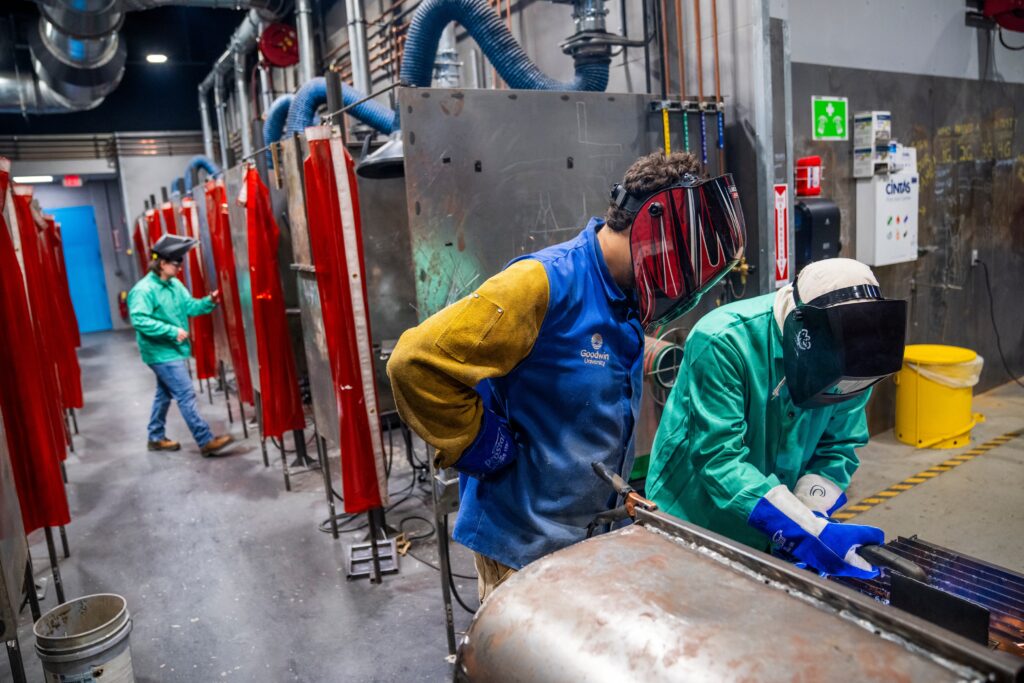
Consider what is possible when school systems invest in their facilities. When the Utica Shale Academy of Ohio launched a skills-based “dropout recovery” program in a single classroom, few expected it to become a national model. Today it serves about 170 students across six campuses with state-of-the-art welding facilities, robotics labs, and training bays for industrial maintenance and heavy equipment. The program was built on a simple idea: If you ask students to learn industry-level skills, the room should look and feel like the industry.
Demand for this kind of learning isn’t just growing from parents. In a U.S. Chamber of Commerce survey last year, 80 percent of hiring managers said today’s high school graduates are less prepared for work than previous generations. In contrast, those with industry-recognized credentials were seen as workforce-ready at a much higher rate than those without.
Students, parents and employers want the same thing: the knowledge, skills and experience to enter a changing world of work. Unfortunately, too many of our nation’s high schools weren’t built to provide it.
Changing the physical environment in which learning occurs is among the most vexing challenges in an already politically charged and fragmented landscape. Districts face millions, even billions, of dollars in deferred maintenance costs, and funding is uneven and under-resourced. And, as I witnessed during my time as U.S. deputy secretary of education in the George W. Bush administration, federal policy plays only a limited role.
The good news is that some states are stepping up. In Idaho, the West Ada School District acquired a 70,000-square-foot warehouse last year with plans to convert it into a workforce-ready campus. The $12.9 million acquisition was made possible by a 2024 law that created a framework for the state to invest roughly $2 billion in school facility modernization. A year earlier, the legislature created the Idaho Career Ready Students program to fund construction and capital projects — and awarded over $64 million in grants to districts across the state by the end of 2025.
More states should follow Idaho’s lead. Because while the condition of individual school buildings is often a local concern, developing a skilled workforce is a national priority.
Today’s students are eager to explore career paths earlier than the generations before them. They want to graduate with options. They will not get those options in a building designed in the 1970s for an economy that no longer exists.
The post Students want to learn trades. They need a ‘third teacher.’ appeared first on Washington Post.