Ever since he launched the all-out invasion of Ukraine in February 2022, Russian dictator Vladimir Putin has been claiming that his “special military operation,” as the Kremlin propaganda euphemistically calls it, enjoys overwhelming support among Russian citizens — going as far as to say that “the entire nation” is united behind his war.
This claim has always been dubious. How do you truthfully measure public opinion in a country that imprisons people for expressing opinions — in the case of anti-war speech, for seven, 12 or (as with me) 25 years? Puzzlingly, some commentators in the West, including harsh Putin critics, have accepted the Kremlin narrative at face value, buying into — and repeating — the idea that most Russians support the war.
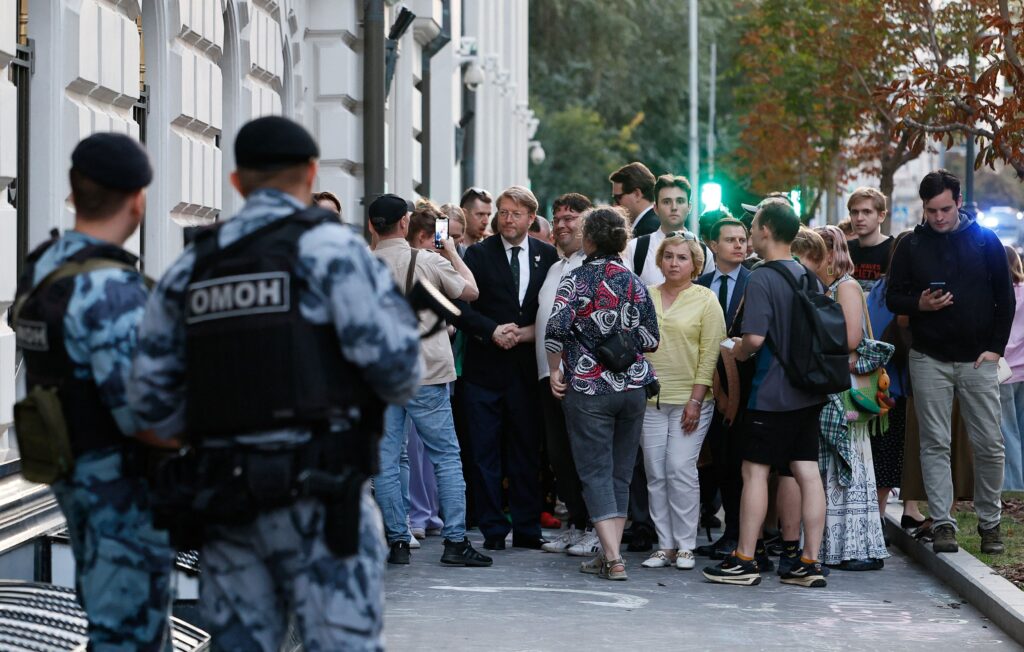
But actions speak louder than words. And, as often happens with dictatorships, the most stunning act of self-exposure came from the regime itself. On Monday, after a single day’s hearing, Russia’s Supreme Court annulled the electoral registration of Yabloko — the only party in the country that opposes the war in Ukraine and calls for an immediate ceasefire — barring it from the September parliamentary election.
“What election?” the reader may justifiably ask, because Putin’s Russia is a dictatorship. The same question could be posed in 2020 about the presidential election in neighboring Belarus, where long-ruling dictator Alexander Lukashenko had decided to allow pro-democracy candidate Svetlana Tikhanovskaya — a “housewife,” as he condescendingly dismissed her — on the ballot to present a democratic facade and showcase his supposed popularity.
But the plan didn’t work: According to independent analysts, Tikhanovskaya overwhelmingly defeated the dictator in the first round of voting, prompting mass demonstrations and forcing the regime to resort to a brutal crackdown to stay in power. For now, it has. But the whole world saw that Lukashenko no longer had any claim to either popular support or political legitimacy.
When Russian authorities registered Yabloko for the parliamentary ballot in late July, the Kremlin’s thinking was not hard to read. After all, it had everything under control: the media, the electoral commissions, the repressive apparatus of the state. Why not allow an anti-war party on the ballot, announce its official result at 2 percent, and show to the world that — as Putin had said so many times — the Russian people overwhelmingly back his war in Ukraine?
But things began to go wrong. What the regime failed to grasp was that Yabloko was no longer just a small liberal party, a leftover from Russia’s brief experiment with democracy in the 1990s. It was now the only avenue for Russian citizens to express opposition to the war.
They seized on it. Yabloko exploded on social media, overtaking pro-Kremlin parties in the number of subscribers. TikTok videos in support of the party — made by young people who have no memory of the 1990s and who had probably never heard of Yabloko before — suddenly got millions of views. In residential-building online group chats across Russia, including in the provinces, Yabloko surged ahead of Putin’s United Russia. Leaked results from closed polling showed the party well above the threshold required for parliamentary representation — and near double-digit figures in public support.
Yabloko’s anti-war campaign has received backing from the leading figures of Russia’s diverse and famously fragmented opposition, who urged their supporters to vote for the party in September and show the strength of anti-war sentiment. This was the widest coalition of opposition groups since at least the 2011-2012 anti-Putin protests — if not since the early 1990s, the time of the Soviet collapse.
And Putin panicked. However adept the Kremlin had become at rigging elections and falsifying vote tallies, it is difficult to hide the scale of opposition support once it reaches into the millions of votes and double-digit figures (just ask Lukashenko). A repeat of the “Tikhanovskaya effect” in Russia was very real — and the Kremlin went into emergency crisis management.
The court filing hastily cobbled together by Rodina (Motherland), a puppet pro-Kremlin ultranationalist party, listed several reasons for barring Yabloko from the election — some of them patently absurd, such as the claim that, by posting a photo of the Hiroshima bombing, the party violated the U.S. Army’s intellectual property rights. The filing also accused Yabloko of “extremism” for advocating an immediate ceasefire in Ukraine and thus “violating the territorial integrity of the Russian Federation” — because a ceasefire would mean abandoning attempts to conquer Ukrainian territories that Putin had declared to be “Russian.” Rodina’s leader, State Duma member Alexei Zhuravlev, has called Yabloko a party of “national traitors” who “work for the West.”
With only pro-war parties left on the September ballot, the Kremlin will once again claim that it has full public support for its attack on Ukraine. But this time, after Monday’s unmistakable show of fear, few will believe it. Yabloko may have been removed from the ballot, but the millions of Russians who oppose the war remain — and it is only a matter of time before Putin’s regime will be confronted again with this reality.
Watching the videos from outside the Supreme Court in Moscow on Monday, where hundreds of young people demonstrated in support of Yabloko, chanting, singing, laughing in the face of police, I couldn’t help thinking that these kids in their late teens and early twenties, the age of my children, are the future of Russia — and the septuagenarian dictator in the Kremlin is not.
The post Putin just showed the world how afraid he is of his own people appeared first on Washington Post.