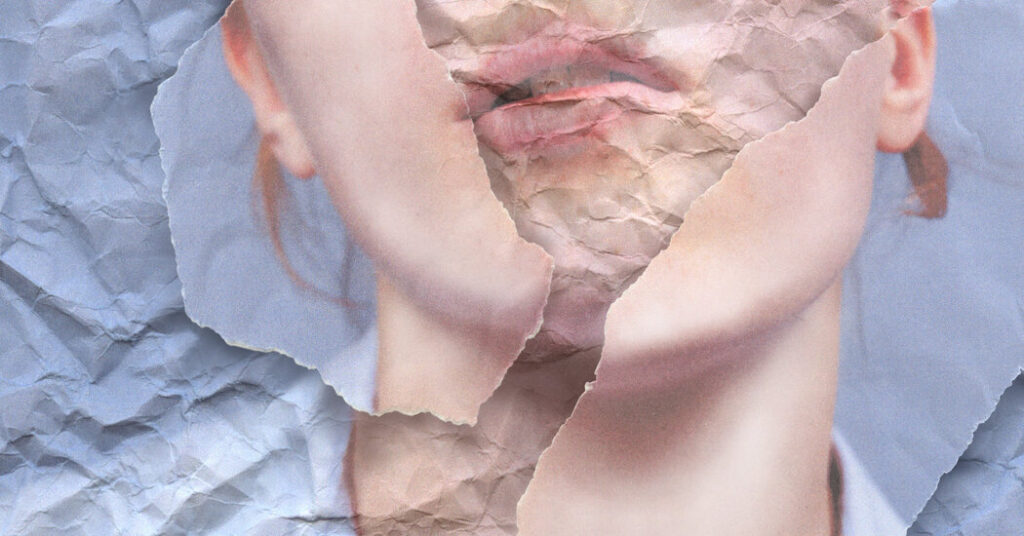
Just after my 47th birthday, a disarmingly young-looking plastic surgeon told me, “The bottom half of your face looks older than the top half of your face.” He wasn’t wrong; my neck rippled like that of a Shar-Pei. When he pushed my jowls back into place, looking in the mirror was jarring. All of a sudden, I saw a younger — but somewhat more attractive — version of myself. A few months later, I was rolled into an operating room for a deep plane face- and neck-lift.
The plastic surgeon pulled my skin taut and gave me cheekbones where I had never had them before. He made me better looking, and I don’t regret it. So I’m not going to perpetuate the lie that my new face came from drinking a lot of water or getting a lot of sleep. I’m going to talk about it — because it’s not fair that women are confronted with both unrealistic beauty standards and lies about how they’ve been achieved.
I, like many a young woman, was once wildly judgmental about plastic surgery. I grew up in the 1990s at the bizarre, lonely intersection of second-wave feminism and Manhattan privilege. Many of the girls in my private high school had their breasts enlarged and their noses shrunk. I congratulated myself for not following suit, even though I didn’t have a bump on my nose and I wasn’t flat chested.
My mother, the writer Erica Jong, had a whole gestalt back then: pro-sex feminism, which of course meant keeping herself appealing enough for men to want to have sex with her. She worried about her own weight and beauty constantly. Julia Phillips, a successful film producer and writer, once compared her to “Miss Piggy when her face is in repose,” which was not exactly a compliment. My mom was the concubine of more than a few powerful men. To preserve that status, she had a face-lift in her 50s.
Many of the feminists who populated my mother’s narrow townhouse — Andrea Dworkin, Betty Friedan and Phyllis Chesler among them — did not believe in molding themselves into something different for men’s delectation. These women rejected the beauty-obsessed power structure that my mother embraced. Instead, they hoped to change that culture by refusing to comply with it.
Our looks shape our livelihoods, our romantic prospects and our visibility in the world. In response to that, my mother and these women were each forced to make a choice: Should they try to keep up or opt out? We ask ourselves this question with the full understanding that plastic surgery perpetuates beauty standards that are rooted in misogyny. Which gets to the bigger question: Does trying to keep up make me a bad feminist?
I don’t think so. I never quite bought into the idea that the best response to a culture that would exclude women from public view if they didn’t look young or pretty enough was to spurn it. My face, for instance, is directly connected to my livelihood; I talk about politics on TV for a living. Eventually, I, too, had to make the choice: Conform to the standards of beauty and hopefully prolong that part of my career, or reject those standards and resign myself to aging. I’ve always believed (perhaps self-servingly) that it’s more important to be in the arena, to share my ideas, than to allow myself to be forced out. So I had the surgery.
What I did to my face isn’t that unusual; I’d argue that it’s actually the norm for women on TV these days. We’re all on screens more and more, whether we’re grown-ups taking Zoom meetings or young influencers who have to feed the TikTok beast. Many cosmetic treatments once given only to Hollywood stars and socialites are now available at strip malls. We might expect this country’s growing embrace of plastic surgery to lead to a culture where we celebrate women’s bodily autonomy and cast off the shame that follows those who change their faces or bodies. Instead, stigma about plastic surgery (especially the schadenfreude around bad plastic surgery) has continued to dominate our discourse.
The most unobtrusive plastic surgery, the face-lifts we don’t really notice, the ones that lead to total transformation, are still prohibitively expensive and reserved for the rich and famous. In the 16th-century “Book of the Courtier,” Baldassare Castiglione writes about “sprezzatura,” the idea that a real courtier should make things look easy. It’s trying that’s the offense. You can be born beautiful, or you can be young, but these days, trying to be something you aren’t — and being convincing at it — feels like cheating the system. The fact that a certain class of women can make themselves into something that used to be possible only with lucky genes is what truly infuriates people. It’s not the surgery; it’s the inequality.
This is most visible in the way so many of us treat celebrities who are open about their plastic surgery. People online and in the press frothed over the transformative face-lift Kris Jenner got before her 70th birthday, but soon, their obsession morphed into watching for whether the lift slipped or fell. The internet was flooded with unretouched photos of her, asking: Was the procedure that good or was it just lighting? The schadenfreude was simple. The momager had tried to cheat — she works in an industry that absolutely punishes visible aging — but had been slapped back by time, the way the rest of us inevitably are. The underlying sentiment was clear: It wasn’t fair that she was 70 and looked 40. It’s one thing to fly private; it’s another to cheat time.
Plastic surgery isn’t going away. My daughter will have to make this choice one day, too. She may decide to cater to the male gaze, as my mother and I did, or she may decide to spurn it. But the worst thing that I could do for her, that any of us could do for our daughters, is to pretend that some of us naturally are not graying, not aging, not wrinkling, because of good genes or some other magic excuse. We must be transparent about the treatments we receive and stop shaming others about their choices. All this starts with honesty: about the lasers, the peels, the red light masks, the surgeons, the Botox and the filler — put anywhere but the top lip, because we still want to be able to drink from a straw.
Nora Ephron, who is like Jesus to bourgeois Gen X women like me, once wrote: “Our faces are lies, and our necks are the truth. You have to cut open a redwood tree to see how old it is, but you wouldn’t have to if it had a neck.” Now my neck lies. But I won’t.
Molly Jong-Fast is the host of the “Fast Politics” podcast and the author of “How to Lose Your Mother: A Daughter’s Memoir.”
The Times is committed to publishing a diversity of letters to the editor. We’d like to hear what you think about this or any of our articles. Here are some tips. And here’s our email: [email protected].
Follow the New York Times Opinion section on Facebook, Instagram, TikTok, Bluesky, WhatsApp and Threads.
The post I’m Not Going to Lie About My Neck appeared first on New York Times.