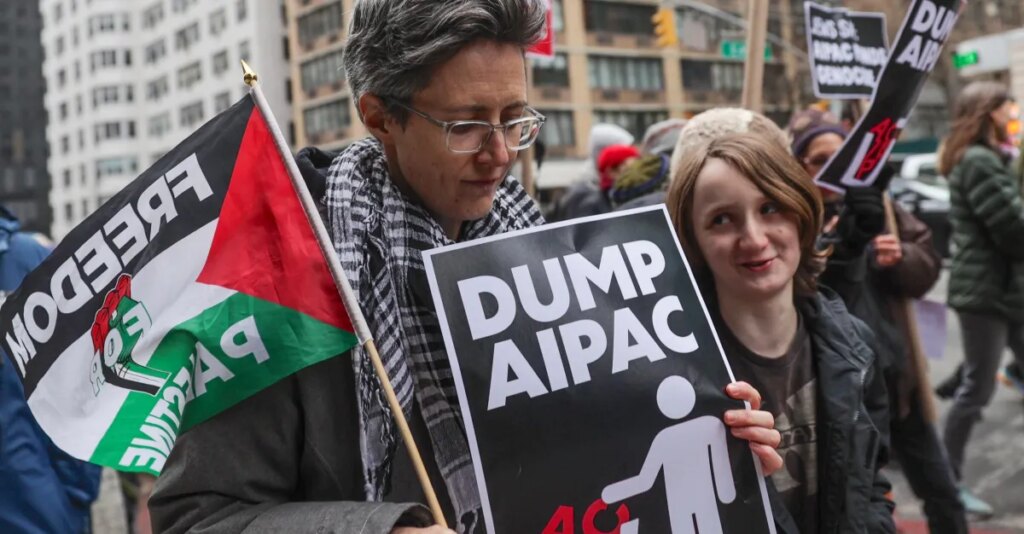
The American Israel Public Affairs Committee — better known by its short name, AIPAC — bills itself as a bipartisan advocate “for policies that strengthen the US-Israel partnership.” In 2026, it’s become something else: a major — and seemingly, losing — issue in Democratic politics.
Progressive Democratic candidates in primaries across the country are explicitly calling out their opponents’ relationship with AIPAC, often using the connection as a rallying point to persuade voters about the problem of “dark money” in politics. Most recently, in Michigan, AIPAC spent about $30 million boosting Rep. Haley Stevens in her bid for the state’s Democratic Senate nomination. Her opponent, Abdul El-Sayed, drew attention to it again and again. She lost.
As one of the biggest spenders in US elections, the group has gone well beyond its origins lobbying members of Congress to support its agenda. According to David Dayen, executive editor of the American Prospect, AIPAC is spending millions of dollars against candidates who speak out against Israel’s actions in Palestine — sometimes using advertisements that have nothing to do with Israel, and may appear unrelated to AIPAC.
Dayen spoke with Today, Explained co-host Noel King about the backlash surrounding AIPAC’s spending, the group’s complicated web of shell PACs, and what it all means for the Democratic Party’s quickly evolving stance on Israel.
Below is an excerpt of their conversation, edited for length and clarity. There’s much more in the full podcast, so listen to Today, Explained wherever you get podcasts, including Apple Podcasts, Pandora, and Spotify.
What is AIPAC?
AIPAC started out as a lobbying organization. It was inaugurated in the 1950s. It has historically been seen as one of the more powerful lobbying organizations in Washington. And its goal is to strengthen and maintain the relationship between the US and Israel.
They have annual conventions where pretty much everybody across the political spectrum attends and gives speeches. But something changed about five years ago. AIPAC was not content to just lobby members of Congress. They wanted to influence who actually got to Washington. And they began to engage in the use of super PACs to run advertising and other forms of political engagement in campaigns, and particularly in primary campaigns that determine who actually gets to a general election.
Why did they want to influence who got to Washington? Maybe that sounds like an obvious question, but it wasn’t happening before, so why did it start happening?
One thing that happened is in 2018, we saw the rise of what is known as “The Squad,” and that included Alexandria Ocasio-Cortez, Ilhan Omar, and Rashida Tlaib — people who had very strident views, particularly about the US-Israel relationship. Those progressive Democrats were very successful in winning safe seat races. And I’m not in their head, but it could be that AIPAC wanted to try to provide a counterweight, and stop that from happening, and use their resources — very prodigious resources — to spend money in these campaigns and to make sure that doesn’t happen again.
Once upon a time, an endorsement from AIPAC was a powerful thing. It could be a huge benefit to a candidate. What exactly did it get you when AIPAC said, “This is our guy, this is our gal?”
I mean, in practical terms, it probably got you $5,000 because that’s the limit on a corporate PAC. But because AIPAC was powerful and also a bipartisan organization, getting your name on the list of AIPAC endorsees was something that you could tout in your election. It was something that showed that you had a commitment to what has historically been an important bond between the US and Israel.
It certainly wasn’t as controversial in the years before 2023 as it is today. After October 7, we saw what a lot of people have termed a genocide against the Palestinian people. The changing attitudes around the US-Israel relationship more broadly, where large numbers of Americans now view that relationship negatively, have changed what the meaning of an AIPAC endorsement really is.
I know that you’ve dug into the numbers. What do we know about how much money AIPAC is specifically spending this midterm cycle?
It’s a hard question to answer. If you go by the Federal Election Commission disclosures, AIPAC has raised about a hundred million dollars this election cycle, and has spent in independent expenditures — that’s TV ads and mailers and these kinds of things — about $28 million.
But that is an undercount for a couple different reasons. When I say those numbers, I am going by the specific super PAC that AIPAC has created. It’s called United Democracy Project. United Democracy Project has sent money to other PACs — about $9 million worth.
Is this a lot of money?
I think the real innovation here is the transfer of money from, in this case, pro-Israel PACs, to these pop-up PACs, these shell PACs that are created specifically for a particular election and then funded through AIPAC and, in some cases, other other pro-Israel PACs.
They are sort of laundering this money through to other PACs, so those other PACs run the ads and it doesn’t look like it’s coming from AIPAC. A perfect example was the first real major primary state of the cycle, which was Illinois.
There were four open seats in the Chicago area that are pretty strongly blue. A Democrat is going to win the general election. And so these primaries were highly contested. AIPAC set up two PACs, one called Elect Chicago Women and the other called Affordable Chicago Now. And millions of dollars went from AIPAC’s super PAC, which is called United Democracy Project, into these two pop-up PACs.
And those two PACs then funded ads for four candidates in those four open seat races. Now, if you were watching that on television, you would say, “Hey, elect Chicago women. That sounds like a good idea. I’m gonna watch this ad” or “Affordable Chicago now. I like affordability.” The truth is that this money was coming from AIPAC into these ads and supporting candidates that were generally supportive of the US-Israel relationship.
Now, those four races — AIPAC won two of them and they lost two of them. And it was really interesting, I think, where they were successful, and where they weren’t. In one race up in the Evanston area, it became a big issue that AIPAC actually was behind these ads from Elect Chicago Women and Affordable Chicago Now.
The [AIPAC] candidate, a state senator named Laura Fine, actually was harmed, I think, in the election by this fact that this got out, and that this became a major issue in the campaign. And she ended up finishing third in that primary, despite having millions of dollars supporting her. There were other races where this wasn’t sort of as explicit a factor in the election itself, and those candidates were able to win.
This all sounds quite shady and yet I wonder — how unusual is it for an interest group in politics to be doing something like this?
I think it’s pretty unusual. It’s not something I’ve seen a whole lot of. We saw it to a smaller degree in some other election cycles — two years ago, four years ago — but it has become a concerted strategy this time.
And so there are these pop-up PACS that are specific to a campaign, but also some established PACs that have been around for a while are receiving money from AIPAC and affiliated groups and using that in campaigns.
Emily’s List is a very well-known political organization that supports pro-choice women. They took [hundreds of thousands of dollars] from an organization called Democratic Majority for Israel that is not affiliated with AIPAC per se, but aligns on similar candidates.
There are other examples of this, more obscure examples. Like there’s a PAC called Crush MAGA PAC. And it’s affiliated with a different, I’m gonna sound crazy when I say this, but Crush MAGA PAC is affiliated with a different pack called Save Democracy, and Save Democracy has received $100,000 from United Democracy Project, which is AIPAC Super PAC. So sometimes the layers here are two or three or even four PACs deep.
And it can be really hard to untangle all this and figure out where the money has come from, because AIPAC certainly isn’t saying, “We’re funding that campaign.” They’re releasing disclosures as required by the Federal Election Commission, but they’re not saying where the money is earmarked for, if it’s for a specific race, if it’s for a specific candidate.
AIPAC at times has responded to criticism of it by appearing to conflate it with criticism of Israel or criticism of Jews. Last year, Sen. Bernie Sanders comes out with a statement. He denounces Benjamin Netanyahu’s government for what he says is the “extermination of Gaza.” He calls for an end to military aid to Israel. He says people are starving to death.
AIPAC attacks Sanders’s statement, calling it a hate-filled rant and blood libel, and pointing out that in his statement, he didn’t mention Hamas’s attack on Israel. So AIPAC is now public in a way that historically it has not been. And it is tying criticism of Israel to antisemitic sentiment. Does this help or hurt AIPAC’s cause, do you think?
It depends on the messenger, but the issue is that there’s a very straight line between how this money is being used, transferred, spent, concealed, and a broader critique that I think a lot of Democrats have about money in politics. And so when AIPAC decides, “Okay, we’re going respond to criticism that is rooted in what AIPAC believes, and the conditions in Israel and Gaza and the West Bank, et cetera,” to saying, you know, “Any criticism of what we’re doing is antisemitic — I think people who see this as a broader problem about money in politics see that as an extremely cynical take.”
I don’t think that really connects to one of the big reasons why people are really objecting to this, which is that they don’t want to see their politicians essentially bought.
But it’s additionally fraught because there are antisemitic tropes where, you know, a cabal of Jews is secretly controlling the government and finance, right? It feels triply complicated.
Look, I’m Jewish, and in having to cover this, I have to try to follow money from Jewish groups from one place to another, and that can certainly be uncomfortable. And it does add some weight to this issue.
But I feel like we are talking here not about somebody’s religion, but about a policy. And it’s a twofold policy. One is the policy of the US government funding, to the tune of billions of dollars, the destruction of an entire region, and also the policy of allowing super PACs to dictate who ends up making decisions in Washington.
The post How an AIPAC endorsement became a liability appeared first on Vox.