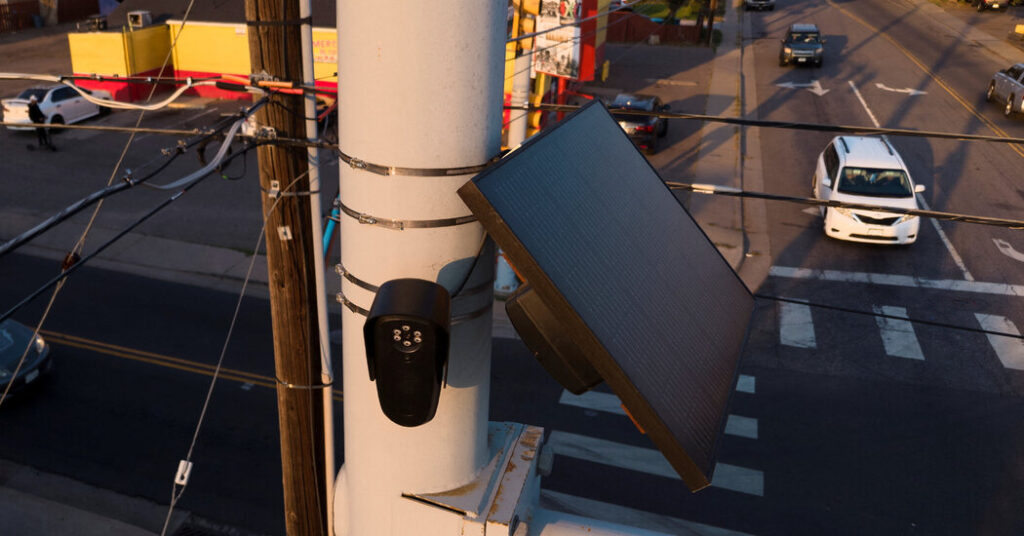
Three former Georgia sheriff’s deputies have been arrested on charges that they used Flock cameras to stalk people, the latest cases to raise concerns about potential abuse involving the widely used network of license-plate readers.
The Bibb County Sheriff’s Office said in a statement that an internal audit conducted with help from Flock revealed that the deputies had used the camera system’s license plate data for “personal, non-law-enforcement purposes.”
All three were involved in separate incidents tracking people with whom they had a “personal relationship at the time,” the sheriff’s office said.
The deputies were arrested on Monday on charges that included stalking, prohibited use of license plate data and violating their oaths as public officers. They have since been released on bond.
Two of those charged, Toni Lewis and Coznavian Stubbs, resigned from their positions as patrol deputies during the investigation, and the third, Joseph Callaway, resigned as a K-9 deputy shortly after his arrest, the office said.
The Bibb County sheriff, David Davis, said that a tool that Flock introduced in April, called Audit Assistance, had uncovered the deputies’ misuse of the system. Flock says the tool continuously monitors system activity and flags search patterns that “fall outside an agency’s typical usage,” allowing police departments to identify instances of potential abuse.
“I was saddened by it,” Sheriff Davis said in an interview on Wednesday. “Each one of these deputies were good deputies who had been here for several years and were doing a good job. However, they made some poor decisions and crossed the line.”
Mr. Stubbs said on Wednesday that he had been accused of using Flock cameras to stalk his girlfriend but that he had only used the system to look up the license plate on his own car. The case, he said, had been “blown way out” of proportion.
Mr. Callaway declined to comment on the charges. Ms. Lewis could not be reached at phone numbers listed under her name, and it was not immediately clear if she had a lawyer.
A national debate has been brewing over Flock cameras, which can be found on roads in every state but Alaska. About 7,000 law enforcement agencies, or 40 percent of all departments in the United States, have contracts with the company, which is based in Atlanta.
Flock’s cameras, which use artificial intelligence to automatically identify and track vehicles, are connected, creating a vast, searchable network. Investigators have praised the system as a valuable tool that helps them track down stolen cars, find missing or wanted people and solve crimes
Critics, including local watchdog groups and civil liberties organizations, have said the cameras create an umbrella of surveillance that can be easily misused.
In Milwaukee, an officer was charged with using camera data to track someone he was dating and the person’s ex. In Texas, an officer used the cameras to track a woman across state lines who was suspected of self-administering an abortion. In Georgia, a former Polk County officer was charged last week with using the camera system “for non-law-enforcement purposes.” Other officers across the country have been disciplined or fired for tracking romantic partners.
In Bibb County, which is home to about 158,000 people and includes Macon, Sheriff Davis announced in June 2023 that his office had been awarded a $1.6 million state grant to deploy Flock cameras and to set up a Strategic Information Center to monitor the license-plate data they collect.
Sheriff Davis said that at one more than 220 deputies had access to the cameras, but that number had since been cut to around 160. He said he planned to work with community members to ensure the system is only used for legitimate investigations.
“We will continue to monitor and audit the use of this technology and take appropriate action whenever those standards are violated,” Sheriff Davis said in a statement. “Protecting the public also means protecting the public’s trust.”
Kirsten Noyes contributed research.
The post 3 Ex-Georgia Deputies Used Flock Cameras to Stalk People, Sheriff Says appeared first on New York Times.