‘We Know They Are Coming’: A Syrian Holdout Province Fears Takeover
Aug. 11, 2026
When Syria’s government forcibly took control this year of a northeastern region long dominated by the Kurdish minority, the Druse in Sweida watched with growing unease.
The Druse, who, like the Kurds, have for years controlled their own region, saw the writing on the wall.
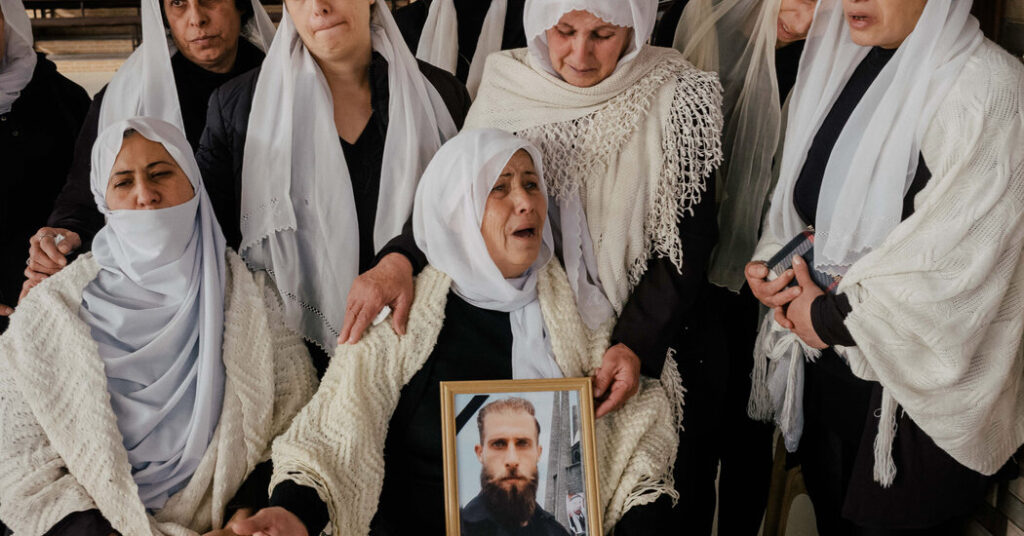
“We know they are coming,” said Sumayah al-Yousef, 65, a Druse resident of Sweida who was among the people displaced last summer by the wave of sectarian violence. After days of clashes between local groups and the entry of government forces into the fighting, more than 1,700 people, most of them Druse, were killed, according to the United Nations.
Sweida is the only Syrian province that has not submitted to the authority of the central government, headed by former rebels who ousted the longtime dictator Bashar al-Assad in late 2024. The government that replaced Mr. al-Assad initially struggled to extend its authority over all of Syria, then seemed to be turning a corner at the start of this year with its takeover of the Kurdish-led northeast.
Across much of Syria, the end of Mr. al-Assad’s rule has been greeted with relief and hopes that the country can finally reunite and move on after years of internecine war. Yet those hopes have been accompanied by questions about the new government and whether it can build a state that Syrians across the country trust.
Druse residents repeatedly told us — during two trips to Sweida Province in November and January, as well as in follow-up phone and text interviews in the months since — that it was only a matter of time before the government moved to assert control over the area.
We spoke to nearly two dozen civilians, civil servants, security officials, medical workers and religious leaders about the sectarian violence in Sweida last summer and its aftermath.
Varying interests complicate Sweida’s fate.
Syrian leaders say reunifying the country under one authority is necessary to restore order, bring stability and prevent further fragmentation after nearly 14 years of civil war.
Some Druse residents of Sweida fear the post-Assad authorities, whose leaders have roots in a group once linked to Al Qaeda and whose forces they accuse of carrying out massacres against them. Israel is also wary of Syrian government forces expanding their reach toward its border, concerned that the area could eventually become a launchpad for attacks.
This is how sectarian violence spiraled in Sweida.
Sweida Province stretches across rocky highlands roughly 60 miles southeast of the Syrian capital, Damascus, with stony fields and scattered orchards defining the landscape.
The Druse have called these uplands home for ages. Their faith emerged centuries ago as an offshoot of a branch of Shiite Islam, though many typically do not identify as Muslim today.
Driving to the province from Damascus, we passed through at least six government checkpoints set up on a desolate stretch of land. Villages along the route lie deserted, their charred remains a stark reminder of last summer’s violence.
In July 2025, skirmishes broke out between armed Bedouins, part of Syria’s Sunni majority, and Druse militias. The communities have long clashed over grazing land, property and access to water, disputes sharpened by sectarian divisions.
What began as localized fighting quickly escalated.
Government forces, along with allied fighters, descended on Sweida’s windswept highlands, killing civilians, destroying towns and villages and displacing tens of thousands, according to independent monitors and witnesses.
While the Druse bore the brunt of the violence, Druse fighters have also been accused in some of the killings last summer, according to activists and human rights groups. Some Druse leaders have denied or rejected responsibility for abuses or killings.
Syria’s Defense Ministry said last year that it was aware of “shocking and grave violations” committed in Sweida by “an unidentified group wearing military uniforms.”
A government body investigating the killings issued its final report in March and said there would be legal actions against some individuals, according to SANA, Syria’s state news agency. Some of the cases have been referred to a military court in Damascus, officials said.
Israel wants to keep Syria’s government out of Sweida.
The Syrian government’s effort to bring Sweida under its control is fraught in many ways, not least because of neighboring Israel’s keen interest in maintaining Druse control in Sweida.
Israel has a sizable Druse minority and has long cultivated close ties with the community, a relationship that extends to the Syrian Druse.
President Ahmed al-Sharaa of Syria has sought to project a more moderate image to the world, promising to protect minority rights and saying that Syria has no interest in fighting with neighbors or interfering in their internal affairs. Yet Israeli officials have voiced deep distrust of Syria’s leaders, some of whom have roots in extremist groups. They are also uneasy about the government extending its authority near its border, fearing it could become a staging ground for attacks on Israel.
After the clashes, Israel struck Syria’s Defense Ministry and an area near the presidential palace in Damascus. It also launched airstrikes against government forces in Sweida.
Israeli officials vowed to protect the Syrian Druse and demanded that the region remain demilitarized, without the Syrian Army or its allies deploying or operating in the area. At the time, Mr. al-Sharaa accused Israel of trying to sow “chaos” and undermining Syria’s unity.
“Israel stood with us,” Sheikh Hikmat al-Hijri, the Druse spiritual leader most vocal in welcoming Israeli support, said in an interview in January. “Israel was the first to extend a helping hand.”
Mr. al-Hijri likened the authorities in Damascus to their authoritarian predecessors, saying the government’s brutality persisted even as the faces changed. He said the Druse saw no future under Mr. al-Sharaa’s government and insisted that secession was the only viable option for Sweida.
His stance is more hard-line than some other Druse religious leaders, who have not publicly called for secession.
A year later, many remain in limbo.
After days of clashes in July 2025, a cease-fire was announced between the Syrian government and armed Druse factions in Sweida.
It has barely held in the year since.
Snipers occasionally take aim at one another across olive orchards and peach trees. Clashes break out in villages along the front line between the National Guard, a 28,000-strong militia in Sweida loyal to Mr. al-Hijri, and government forces and their allies.
The Guard is in constant contact with Israel, said Talal Amer, its spokesman, though he did not specify the nature of that coordination.
At the center of the provincial capital, also known as Sweida, life seems to have slowed to a crawl. Construction sites are abandoned, and once-bustling shops and vegetable markets are cloaked in an uncanny hush.
In the year after the eruption of sectarian violence, Sweida officials and residents say the government has intensified its pressure on the region to submit to its authority. It has repeatedly cut electricity and water, damaged power lines and pipes during military operations and blocked aid groups from repairing them, they say.
Humanitarian aid, including lifesaving food and medical supplies, has often been delayed or restricted before reaching the provincial capital, according to residents and Druse officials.
Mustafa al-Bakkour, the regional governor appointed by Mr. al-Sharaa last year before the summer violence, denied the accusations. He said the government was still paying salaries, helping residents rebuild destroyed homes and allowing aid in regularly. He also accused local forces of deliberately cutting electricity to drive demand for solar energy systems they sell.
And he called Mr. al-Hijri and his associates “a gang with personal interests” who have no “interest for matters to be resolved.”
For now, many of those displaced remain trapped in shelters in Sweida city.
One of them is Sheikh Merhej Shahin, whose life, until last summer, was measured in farm work, prayer and routine. When gunmen stormed his village, Al Thaala, he said he realized that life as he knew it was over. The assailants, he said, beat him, shaved his mustache and left him for dead.
“It was only God’s grace that protected me,” he said.
He dreams of returning home, even as he remains with his ailing wife, who is struggling to get the medication she needs. Despite everything, he said, “We will not break.”
The post ‘We Know They Are Coming’: A Syrian Holdout Province Fears Takeover appeared first on New York Times.