Two days before tens of thousands of migrants surged into Ceuta, one of Spain’s enclaves on Morocco’s northern coast, a newspaper there posted a video on TikTok and Instagram showing two young women walking in the city in wet suits, their hair still damp.
The posts didn’t say so explicitly, but the implication was clear: The women had just swum across the border from Morocco. “Ceuta can’t take it anymore,” the newspaper, El Faro de Ceuta, declared in the posts.
On the other side of the border, the video resonated very differently. Cropped and reposted in Arabic, the video seemed like an invitation. The women were smiling, flashing peace signs and thumbs up and, most of all, walking around freely.
The video seemed to legitimize rumors that had percolated for weeks on social media suggesting that a recent ruling by Spain’s Supreme Court meant migrants who arrived illegally by sea could stay in the country. As one account on Facebook put it, falsely, “Ceuta is turning into an open gate,” when in fact migrants still faced expulsion after a judicial review.
The responses to the posts about the swimmers were a critical part of a cascade of disinformation that experts described as one of the starkest instances in which social media contributed directly to a real-world tragedy.
On July 30, tens of thousands of people, many spurred by unwarranted faith in the claims circulating online, poured into Ceuta in a human surge that overwhelmed the authorities on both sides of the border. About 90 people died, most of them by drowning, inflaming an already contentious debate in Europe and beyond over illegal migration and the economic and social factors that drive it.
“It started off as a din,” said Moustafa Ayad, a researcher with the Institute for Strategic Dialogue, an international organization that tracks threats online, referring to the discussion online, “and then it avalanched.”
For nearly three weeks, millions of posts on Facebook, Instagram, WhatsApp, TikTok and Telegram speculated about how the Spanish court’s ruling had enhanced the chances of reaching Spanish territory, according to Mr. Ayad and other researchers who have studied what triggered the events that day.
The content appeared to spread organically, tapping into a seething desperation of many in Morocco and other parts of Africa to seek economic opportunities in Europe. That desperation was then exploited by online groups that organize human smuggling, which made offers on Facebook and WhatsApp to help those considering crossing.
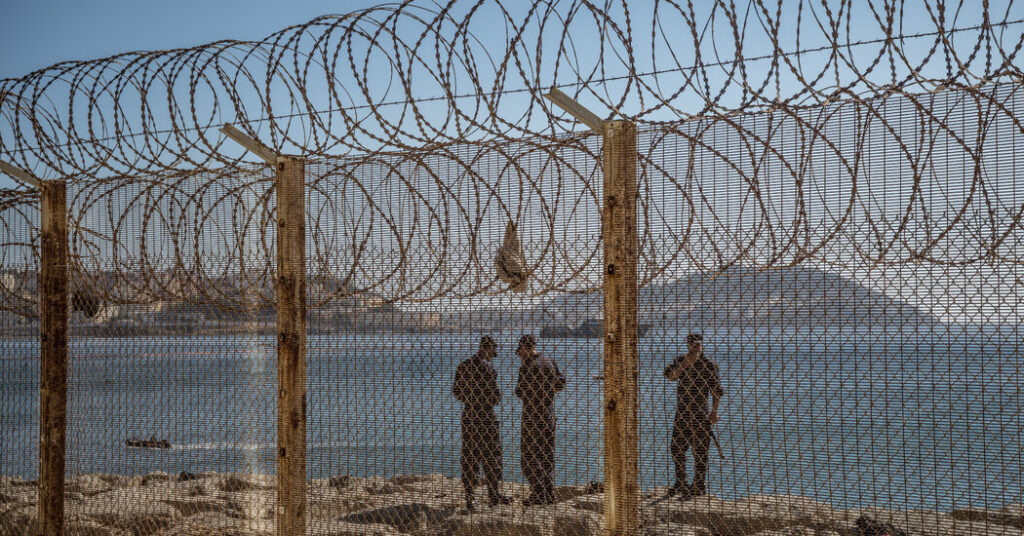
The posts accelerated late last month as an increasing but still small number of people attempted the swim around the physical barriers that extend into the sea at the southern edge Ceuta, just north of the Moroccan town of Fnideq. Images of those who succeeded only seemed to encourage more people to act.
It is unclear whether the authorities in Spain and Morocco — or the platforms themselves — were aware of the groundswell online or raised any red flags about it by the afternoon of July 30, when, for reasons still not entirely clear, the number of people trying to cross the frontier suddenly exploded.
At least 215 accounts on Facebook that day posted the same exact message about the Supreme Court’s ruling, claiming incorrectly that no one who swam to Ceuta or another Spanish enclave on the Moroccan coast, Melilla, would be expelled, according to Maldita.es, a research organization in Spain.
The repetition suggested a coordinated effort to spread the information, which was subsequently shared by seemingly unwitting users.
One of the most prominent accounts to share the post, according to Maldita, belonged to Youssef Belhaissi, a spokesman for Morocco’s Inter-ministerial Delegation for Human Rights, a government agency in Rabat, the country’s capital. (Mr. Belhaissi, who has 1.3 million Facebook followers, did not respond to a request for comment).
Rumors have long shaped how migrants settle on routes abroad, which are fraught with unpredictable risks. Social media has accelerated the process, said Jorgen Carling, a migration expert at the Peace Research Institute Oslo.
“Even if the Supreme Court decision was inconsequential,” he said, “it gave the rumors that kernel of truth that made them much more trustworthy.”
Some of the shadowy groups on Facebook and WhatsApp that have previously offered to help smuggle people to Europe had more than 100,000 followers. Several used variations of the Arabic word for “burners,” harraga, slang for people who cross borders illegally.
One Facebook group linked to a group on WhatsApp that called itself “the path to Ceuta” with an emoji of a swimmer.
The groups offered advice, maps, equipment and even rides to towns abutting the border, the researchers found. Spain’s Ministry of the Interior claimed in a statement that “human trafficking networks” were “exploiting a court ruling to encourage the flow of undocumented migrants, mostly young people.”
Some of the groups appeared to be administered by people using telephone numbers from Algeria, but no evidence has emerged that any state played a role, the researchers said.
“You could see these calls to action — and they were handling logistics — more focused on trying to monetize the situation than acting as something organized by a government or a foreign power,” said Marcelino Madrigal, an expert on disinformation in Spain who documented the evolution of the content online. “The groups there were meant for coordination, as if we wanted to organize a march.”
In a statement, Meta, which owns Facebook, WhatsApp and Instagram, said it had established a team to monitor the crisis in Ceuta as it unfolded and had removed “content that violates our policies — including content that offers to provide, facilitate or seek human smuggling services.”
Some accounts remain active and have, since the tragedy, turned into message boards for those desperate to learn the fate of loved ones who had not returned after the surge.
“This is my father, he has been missing since Thursday and there is no news,” one post said, sharing a photograph and a telephone number in Morocco if anyone had information.
From the start, misrepresentations of the Supreme Court’s ruling, which involved a case of a migrant who swam to Ceuta, laid the groundwork for the crisis. Under Spanish law, the authorities can immediately expel anyone who tries to breach a physical barrier to enter the country, but the court found that those who have not breached a barrier — say, by swimming in open water — would be subject to a judicial review.
The ruling was issued in late June and made public on July 8. In online discussions in Morocco, the nuances were lost. Over time, like a game of telephone, the ruling was portrayed as a significant reversal of Spain’s immigration laws, when in fact anyone who entered would still face expulsion if he or she could not substantiate a claim for refugee status.
The videos of the two young women swimmers were seen more than 32 million times, according to Marouane Lamharzi Alaoui, a co-founder of Firassa AI, a company that analyzes visual content. By contrast, a post on TikTok in French that sought to correct the record about the supposed border opening was viewed fewer than 2,000 times, he noted.
“I saw videos on Instagram that said: They will help you, they won’t send you back,” one of those who crossed said in a telephone interview. He spoke on the condition that he be identified only by his first name and his patronymic, Achraf Ben Ahmed.
Traveling by train from central Morocco, he said, he swam 12 kilometers, or almost eight miles, to Ceuta on July 29 after buying a wet suit and fins.
Within days of the surge of crossings, most of those who arrived in Ceuta returned to Morocco. Some remained, including Achraf, who said he was hiding in a forested part of Ceuta, venturing into town only to buy food. He still hopes to reach Europe after three previous unsuccessful attempts.
“I hope God facilitates things for us,” he said.
In the aftermath, some have questioned whether the groundswell online should have raised alarms. Mr. Madrigal blamed “the lack of responsibility from governments” and “insolence of platforms” that fail to monitor the content they spread.
“Nobody is responsible here,” he went on, referring to Mark Zuckerberg, the chief executive of Meta.
“Mr. Zuckerberg? The Moroccan government? The Spanish government?” Mr. Madrigal said. “If we haven’t identified that, it can happen again.”
Tiffany Hsu contributed reporting.
The post How Social Media Spurred a Refugee Crisis Between Spain and Morocco appeared first on New York Times.