Khloé Kardashian is off camera on Zoom, scrolling through her old emails. She’s looking for the date she started working on her protein popcorn brand Khloud, which over the past year has taken the snack aisle by storm. With pastel-colored bags and friendly clouds on its packaging, the product stands out both in the snack aisle and in a sea of bro-coded protein-maxxing. She finds the first emails: 2023. “It’s been a few years,” she says.
Of all the brands in the Kardashian-Jenner family—Skims, Kylie Cosmetics, 818 Tequila—Khloud may have had the best timing. Kardashian and her team started working on the brand before consumers’ protein craze really kicked off, and were ready to launch in spring 2025. “It just so happened that it was in this protein-frenzy era,” Kardashian says. “How long it takes to produce snacks and food and packaging and all of the really boring things—you can’t just wing that and get it on the shelves quickly.”
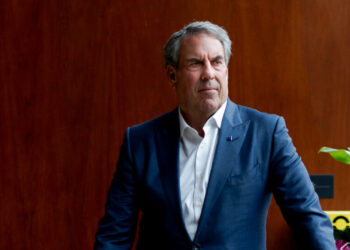
Last fall, the brand brought on Jeff Rubenstein as CEO; he’s an alum of Poppi who helped the soda brand secure a$1.95 billion acquisition by PepsiCo. With Kardashian, he’s turned Khloud over the past year into the “fastest-growing salty snack with protein at Target” and obtained a Starbucks deal that contributed to doubled sales on Amazon as consumers discovered the product.
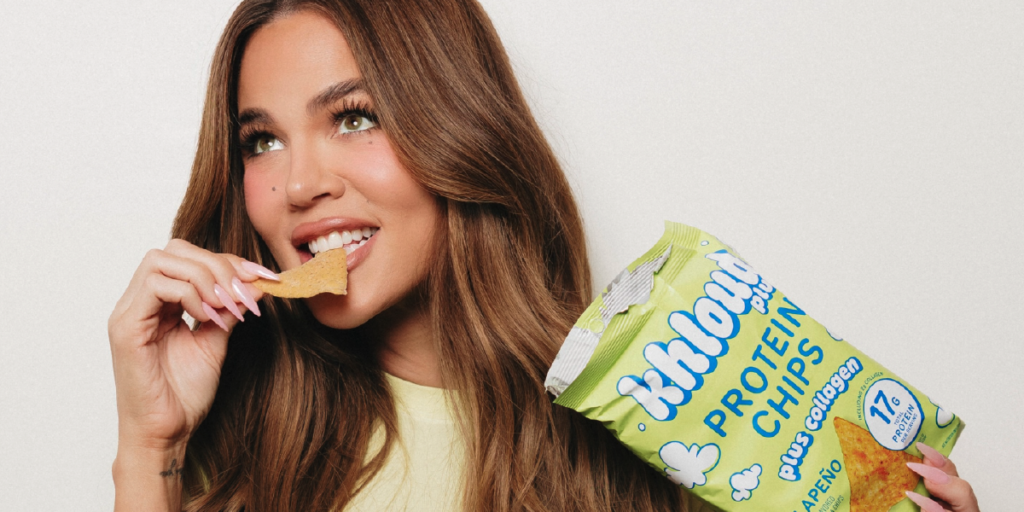
This week, Khloud is launching protein chips that also include collagen (official name: Khloud Plus Collagen Protein Chips), a Walmart exclusive that experiments with how many health-maxxing ingredients consumers want packed into their snacks. Kardashian and Rubenstein spoke with Fortune about the launch, the brand’s growth, and what prepared the reality TV star for this chapter of her career. This conversation has been edited and condensed.
Tell me about collagen. When did you start taking it and what has it done for you?
Khloé Kardashian: I love collagen. I started taking it in a powder form in my coffee maybe three or four years ago, and I just love the way it makes me feel. It helps with joints, all that kind of stuff, but aesthetically, I really do think it helps with the fine lines and wrinkles and all of that kind of stuff.
Where do you think we are in the consumer cycle with collagen? If you compare it to protein, does everyone know about it yet? What new ways do you think we will see collagen being offered to consumers?
K.K.: Collagen in food, I think that is a newer thing. I haven’t seen it really done in a lot of places. Collagen being baked into snacks that you could readily buy, I think that’s pretty innovative.
Jeff Rubenstein: I would agree with that. If you think about the history of where collagen has been found—bone broth and chicken cartilage—it’s very different, a lot less mainstream, and much more niche. What we’re doing is we’re democratizing collagen in food, and that I think is really novel.
Khloé, what have you learned over the years about what makes a brand of yours successful?
K.K.: A lot of it was trial and error. I’ve learned that I have to go after the things that I’m passionate about. Consumers are so incredibly smart, and they know when someone genuinely believes and uses a product versus someone licensing their name. When I first started, you’re just so green and you’re so excited and you can’t even fathom that you’re getting the opportunities that you’re getting. So maybe I did things or said yes to things that weren’t so much in my wheelhouse or weren’t things that I had such a passion for. The older I got and the more long-term and established I got, I got more confidence. I understood how much authenticity matters and how smart the everyday consumer is, and how I wanted to be proud of the brands that I’m building and what I’m standing for. I really do think it’s so transparent. People can smell it, they can breathe it, they can see it.
I will say every business definitely has its uncertainty. So I’m not saying just because you’re passionate about something and just because you believe in it means it’s going to be successful. But eventually, you’re just going to have to trust yourself and put yourself out there and say that you believe in this product or brand enough to start something. You believe in it enough to take that risk.
With Khloud, for example, it was created because there was such a lack in the market of protein snacks that weren’t so bro- or gym-focused. I wanted to create something that would fit into the way that I actually ate, the way I wanted my kids to eat. I didn’t just want another celebrity product out there and to put my name on it. Every single product genuinely needed to earn a place in my pantry before it earned a place on any market shelf.
That’s how Khloud started, and it just so happened that it was in this protein-frenzy era. But none of that was perfectly timed. How long it takes to produce snacks and food and packaging and all of the really boring things—you can’t just wing that and get it on the shelves quickly. The timing was everything. I kissed a lot of frogs to get here is what I’m trying to say.
Making a protein option that’s not so bro-y—what has the response been to your branding, the pastels, the clouds? Are women shopping the brand or is it being bought by everyone?
K.K.: I sort of see that it’s being bought by everyone. Kids even relate to the packaging a lot—the nostalgia of the packaging, the colors are soothing. We did a lot of research seeing what else was on the shelves, and we wanted something that had a lot of contrast so it stood out when you’re going up and down the store aisle. I don’t think we looked and were like, we need this to be female-oriented. That wasn’t really the plan there.
J.R.: With this new [collagen] product, we’re going into a set which is called the wellness set at Walmart, where you primarily have science-backed brands like Quest and Wild. These are chips that have 20, 30 grams of protein designed for the Bro Alpha. That entire area is masculine. The whole thing looks like a scientific GNC, right? And we’re coming with bright and light and fun and flirty, and I think we’re going to appeal a lot more to women. We serve as a disruptor.
Jeff, what strategies are you bringing over to Khloud from Poppi?
J.R.: The most important one is community. All the things that we did at Poppi, we are replicating here: college outreach, ambassador programs, affiliate programs, interactions with key influencers at sororities who make and define a culture on a campus. Nutritionists, we’re employing here, and that playbook is not unique to Poppi. It’s also being used by Bloom and Vital Proteins and all the other folks that have come before us. But it seems to be working really, really well on this brand, partially because of the packaging and partially because so many young people want to be the next Khloé.
What can you tell me about the size of the Khloud business right now?
We are the fastest-growing popcorn brand in America. We are the fastest growing salty snack with protein at Target. We are the No. 1 fastest-growing salty stack at Sprouts for protein. We have the No. 1 fastest growing overall brand in the natural channel. We’re only in our first full year of revenue, and we’re already tracking to do more than what Poppi did in year three.
We launched in April at Target. We then started picking up grocery like Kroger and Albertsons and natural channels like Sprouts and Fresh Market. But Starbucks was a big win for the business. We launched with them with one SKU in a test of 12,000 doors. They were so pleased with the performance they added a second SKU, and that was in May. And just two weeks ago, they came back to us and added another 5,000 doors, which are for the licensed stores—airports, college campuses, Barnes and Noble—and then they’ve added Canada and the Caribbean.
How big do you both think this brand can be? What scale are you chasing?
K.K.: For me personally, success is having it be a household name and a brand that you can trust and you feel good about. Listening to everything Jeff said, I am pinching myself. I can’t believe that there’s been that much growth so quickly. It’s really a pinch-me moment.
J.R.: In my opinion, this is a once-in-a-generation brand, and I really mean that. This is so different from what everybody else is doing in protein. This appeals to a different audience for a different occasion. It becomes much more routine-oriented, and it’s speaking in a very different voice. Today we’re playing in popcorn. We have other innovation that’s coming, all designed to reach a $25 billion total addressable market size. That’s the goal. We’re thinking about all kinds of other ways that consumers can bring protein into their lives.
Khloé, after building brands in fashion and beauty, what have you learned from entering this new category?
K.K.: I’ve never done snacks or anything like that before. Food is so incredibly personal, and I think that’s also what was so intimidating about it. But it’s also something that people interact with every single day. I loved the challenge of creating a product that would fit into people’s lives. It’s so different from anything I’ve ever done. I’ve learned so much about the thoughtfulness–the ingredients, what stores really need, which ones we go to first. Those are things that I’ve learned even from owning my Dash store. Listening to your consumer–it’s not just about you. So many of those things were definitely stepping stones in building my business confidence. It reminded me that my job is to build a fantastic team, ask great questions, make thoughtful decisions, and rely so much on my team to help me do the rest.
Is there anything in particular that you learned from Good American that you’re bringing to Khloud, and how are you balancing those two today?
K.K.: Good American has turned into this really fabulous business that now survives on its own, and I’m so proud of that. With Good American, I learned about all these issues you can have with factories, the delivery dates, the deliverables, all of that. We have so many of those issues with food, so those things have definitely prepared me for some of the hiccups that we’re having. Obviously, snacks and denim are different. Good American definitely sustains on its own. It has a great group of people that are all part of the team. I’m not needed as much over there, and that was always the goal.
What does a successful exit look like for Khloud? Every food giant is trying to figure out protein, so I imagine there would be a lot of interested parties.
J.R.: You have no idea. That’s an understatement. The amount of inbound phone calls that we have gotten from all walks of life is unbelievable. But at the moment, our heads are down, and we are very focused on execution, winning this week, winning this month, winning this calendar year. We are planning a three-year, long-term strategy, but an exit is not currently part of any conversation. We’re just focusing on execution.
Khloé, what would it mean to you one day to have a very large, successful exit to a Fortune 500 company?
K.K.: That would be a dream. It would be phenomenal. I really would be proud for many reasons, but really because we’ve never sacrificed on quality. It’s just a non-negotiable. Being able to be at that level and still have all of your morals and the ethos of the brand from start to finish—to me, that’s real success.
You guys have done popcorn, tortilla chips. Any other products or categories on the horizon?
K.K.: I have the longest list of categories that I would love to do, and my sisters just think that I’m a magical protein fairy because the amount of things that they ask me to do is crazy. So I have a long list.
Khloé, what has really fascinated you the most about this whole experience?
K.K.: Not all flavors do well with protein. We tried to make one snack, and it didn’t do well with the protein. And I don’t know if we are mixing it all together, or we’re just going back to the drawing board, trying to see how we can do it where it doesn’t have that that protein-coated taste to it, and then there’s other snacks when you can bake things right into it that are so much easier to conceal. So I’ve learned a lot about all of this stuff. It’s very interesting, even when we were doing the popcorn. Our corn is from Nebraska—things like, where we can get the freshest ingredients, the best-quality items. It’s all very new to me.
The post How Khloé Kardashian’s snack brand Khloud got ahead of the protein craze: ‘The timing was everything’ appeared first on Fortune.