If you’ve spent any time with dogs, it’s probably not news to you that they can sense the difference between positive and negative human emotions. A pup may match your excited energy when it’s time for a walk or check on you if you appear glum. But canine brains might have a deeper understanding of human emotions than you might think, a new study suggests.
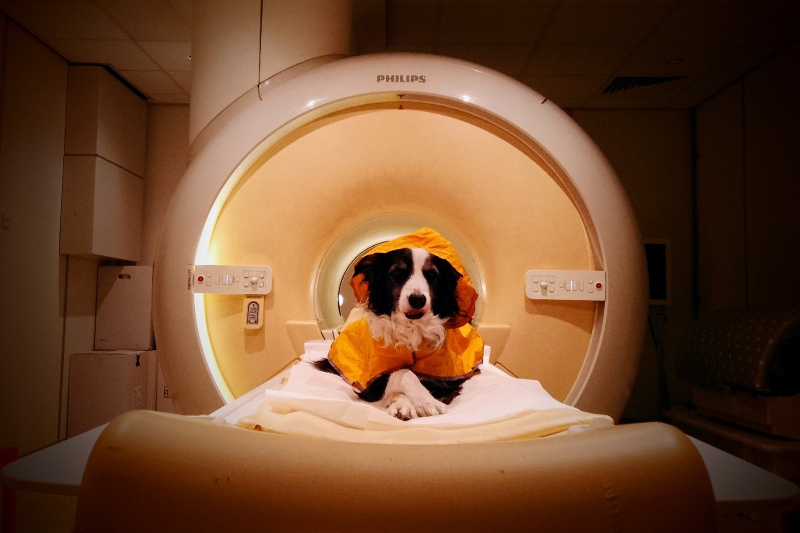
Researchers put dogs (awake and unrestrained) in MRI scanners to see the activity in different regions of their brains while the pooches looked at images of human facial expressions.
They found one thing they already knew: Dogs can tell the difference between joyand a blank stare, and between happyand angry faces.
But then the brain scans showed something novel: The dogs were making distinctions between fear and anger, and fear and sadness, showing they can tell the difference between somewhat nuanced negative emotions.
“As far as we know, it’s the first time there is proof that dogs can distinguish between faces expressing two [similar] emotions,” said Laura V. Cuaya, a co-author of the study and postdoctoral researcher at the SCAN-Unit, University of Vienna.
The study, which included two separate experiments, was published in August in the Cell Press journal iScience. It was started at the National Autonomous University of Mexico then expanded to Eötvös Loránd University in Hungary.
In the first experiment, eight pet dogs were shown images of happy and neutral human faces that were unfamiliar to them. Happy faces elicited a stronger response in a part of the brain known as the right temporal cluster extending to the caudate nucleus, which is notable because it’s associated with rewards, explained Cuaya.
“Other studies show, for example, that this activation is related when the dog is expecting a snack or a food reward, but also when they hear praise,” she said.
The team was interested in learning whether the same brain regions would be activated if dogs were exposed to images of negative human emotions as well as happy ones.
They designed the second experiment with 12 pet dogs, comparing brain regions where happy faces as well as those exhibiting sadness, anger and fear were processed.
Their results suggested “there is a distinction between happiness and the negative emotions,” said Raúl Hernández-Pérez, a postdoctoral researcher at the SCAN Unit, University of Vienna, and author of the study.
The researchers ran a whole-brain analysis to look at patterns of response between those three negative emotions. “We found that in a different part of the brain, there can be a distinction between fear and anger and between fear and sadness” said Cuaya.
She added that there did not seem to be a difference in processing between sadness and anger.
The researchers stressed that these findings do not mean dogs understand or experience emotions in the same way humans do.
“What they have demonstrated here is that the dog brain can distinguish human faces that are showing different emotions, but it does not show that the dog brain is perceiving, processing those emotions,” said Clive Wynne, founding director of the Canine Science Collaboratory at Arizona State University, who was not involved with this study.
The study’s limitations
Undergoing an MRI is hard enough for a human who understands why they need to remain still, so “the dogs that are able to do this MRI work are very specific types,” said Molly Byrne, principal investigator of the Dog Lab at Pace University. The researchers mostly worked with border collies, and they pointed out that this breed is highly skilled at following social cues and particularly willing to interact with humans.
More studies are needed to determine whether other breeds show similar brain activity, the researchers said.
“A border collie is bred for a job like herding,” explained Byrne, who was not involved in this study. “Over the course of many generations, they selected the dogs that listen the best and pay the most attention to what humans have to say.”
It’s also notable that the dogs studied are family pets, said Wynne. “These are dogs who are around people more or less 24/7 and have to keep paying close attention to people.”
The dogs in this study were shown a static photograph of a human face, but in real life, whole-body cues probably help canines gauge human mood. “People look at faces to find emotion,” said Wynne, noting that as a species, we have flexible, expressive faces. Dogs are known to use different signals for emotional expression, wagging their tails to show happiness or raising their hackles in anger.
“If you imagine the world from the dog’s perspective, the body is more important,” said Cuaya. With this in mind, she and Hernández-Pérez are now running an experiment in which the dogs watch videos of people acting out various emotions with faces digitally obscured.
Unanswered questions about how dogs perceive human emotions
Dog cognition is a relatively new field, and very few labs in the world do these kinds of studies. The hope, said experts, is that future research can address bigger questions not only about how dogs perceive us but the nature of animal minds in general.
While we can peer into a dog’s brain using an MRI, for example, we don’t know whether they’re thinking about our emotions with real meaning.
“We know how we feel when we see a lot of happy faces,” said Cuaya. “But we are not sure if for them it is a happy face.” An interesting next step, said Byrne, would be to see whether dogs behave differently after exposure to human emotions: Are they more eager to cooperate with a smiling face than a frowning one?
There’s also some debate among experts about how big a role domestication has played in a dog’s ability to pay such close attention to humans, noted Evan MacLean, director of the Arizona Canine Cognition Center at the University of Arizona. Have domesticated dogs evolved to be fundamentally tuned-in to us? Or would other species behave similarly if they had the same opportunities to observe and interact with humans?
Either way, it’s clear that dogs are able to make “some pretty fine distinctions with respect to human emotions,” said MacLean. “Certainly, their behavior suggests that they can discriminate between emotional states in people, but this is a rare look inside the brain at what’s going on.”
The post Dogs can tell when you’re happy, sad or frustrated, study shows appeared first on Washington Post.