Turkey adopted a law on Monday aimed at advancing its peace process with the Kurdistan Workers’ Party, a potentially significant step toward ending the outlawed militant group’s decades-long battle with the Turkish state.
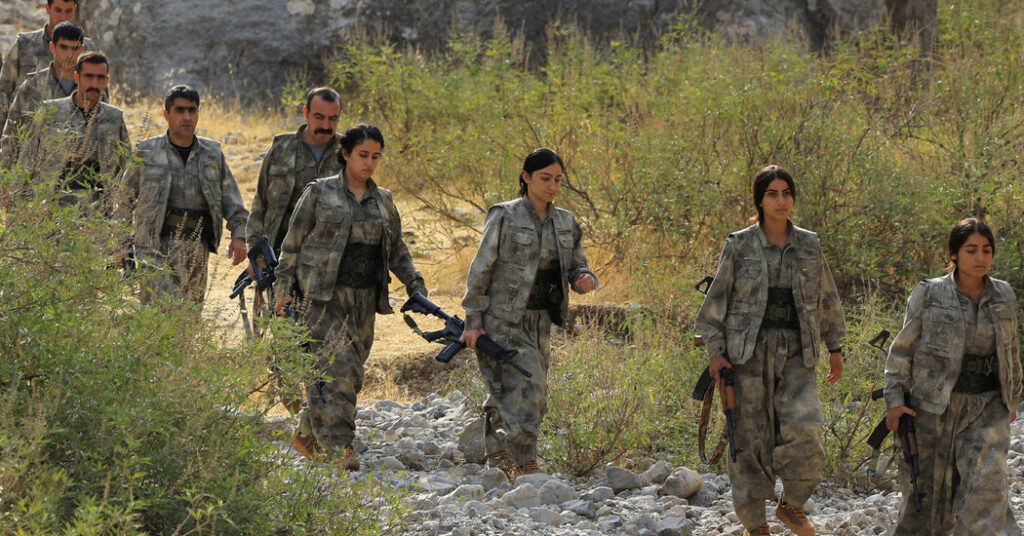
The law, which passed by a vote of 468 to 88 in Parliament, could allow for the repatriation of thousands of militants from the group, known as the P.K.K. It may also lead to the suspension of prison sentences for people convicted of belonging to or supporting the group.
The legislation is the most concrete step yet by the Turkish government to formalize a peace process that began in 2024 and aims to end a bloody ethnic insurgency that has killed more than 40,000 people in Turkey since the 1980s. The conflict has spilled across the borders into Syria and Iraq.
Supporters of the bill included President Recep Tayyip Erdogan’s Justice and Development Party, its governing coalition partners and Turkey’s largest Kurdish party. The government has hailed the process as a major step against terrorism.
Efkan Ala, the deputy chair of Mr. Erdogan’s party, said in a television interview on Monday before the vote that the law sought to ensure security inside Turkey to strengthen the country against turmoil in the Middle East.
“This is to transform a situation where everybody was being hurt to a situation where everybody is benefiting,” he said. “The arms will be surrendered entirely, and the group will be dissolved.”
Turkey, the United States and other countries consider the P.K.K. a terrorist organization.
The new law sets the terms for the group’s disarmament and the decommissioning of its fighters. It stipulates that Turkey’s National Security Council must confirm that the P.K.K. has given up its arms, and it establishes a committee composed of senior government officials and the head Turkish intelligence to oversee the process, including the returns of militants from neighboring countries.
The law does not include a blanket amnesty, but it offers reprieve to militants who were not involved in killings, suspending their prison sentences and giving those in exile six month to return to Turkey without facing prosecution. Those who do not commit new crimes will eventually have the right to enter politics, the law says.
The terms of the law appeared to open a path out of prison for Selahattin Demirtas, Turkey’s most prominent Kurdish politician. He has been in prison since 2016 on charges including supporting terrorism and insulting Mr. Erdogan. Human rights organizations and European legal bodies have dismissed his prosecution as politically motivated.
Government officials have not said publicly whether Mr. Demirtas would be released under the law.
The legislation will not change the status of those wanted for or convicted of violent crimes, nor those with convictions preceding June 2005. That rules out the P.K.K. leader Abdullah Ocalan, who has been serving an aggravated life sentence since 1999, much of it in near isolation in an island prison south of Istanbul.
Mr. Ocalan, 77, issued a public call last year for the group to disarm, arguing that its armed struggle for Kurdish rights had outlived its time and that it should pursue further progress though politics.
The group announced that it would heed his call last May and held a public ceremony in northern Iraq last July, during which militants burned weapons in a giant bonfire.
Some nationalist politicians have criticized the peace process, saying it would reward militants and accusing Mr. Erdogan of using it to woo Kurdish voters.
Addressing the Parliament before the vote, Musavat Dervisoglu, the chairman of the Iyi Party, called the law a “betrayal.”
“Terrorism is not ending,” he said.
He said the measure would allow the P.K.K. to “do whatever it couldn’t do with weapons with politics.”
The P.K.K. also criticized the legislation in a statement before the vote for not releasing Mr. Ocalan from prison or giving him an official role in the disarmament process. The statement, released by a P.K.K.-affiliated news agency on Sunday, said that the law failed to address broader issues of Kurdish participation in social and political life in Turkey.
But the group stopped short of calling on its supporters to oppose the law,.
The P.K.K. began as a secessionist movement to create an independent Kurdish state in territory that includes southeastern Turkey. Later, Mr. Ocalan shifted the group’s ideology to focus more on expanding Kurdish rights in the countries where they live, which include Iraq, Syria and Iran.
Turkey’s Kurds have long suffered from discrimination by the Turkish government, which over many decades denied that the Kurds were a distinct ethnic group and suppressed their language and cultural traditions.
In recent years, some of these restrictions have been loosened, but Kurdish activists and politicians have continued to campaign for Kurdish language education and broadcasting and against the government’s frequent removal of elected Kurdish mayors from office, many on suspicion of links to the P.K.K.
The post Turkey Moves to Advance Peace Process With Kurdish Militants appeared first on New York Times.