Summer in the New York City subway, where temperatures can exceed 100 degrees on train platforms, can feel like a sauna — to say nothing of the aromas.
Now, Mayor Zohran Mamdani and state transit officials want to try something new: an underground air-exchange system that could cool stations in the summer and heat nearby buildings in the winter.
On Monday, they announced a study to test the feasibility of the system, called a thermal energy network, at the Brooklyn Bridge-City Hall and Chambers Street station complex in Lower Manhattan. The study is expected to cost $800,000 and will be funded by the New York State Energy Research and Development Authority. If the findings are positive, design work could begin early next year.
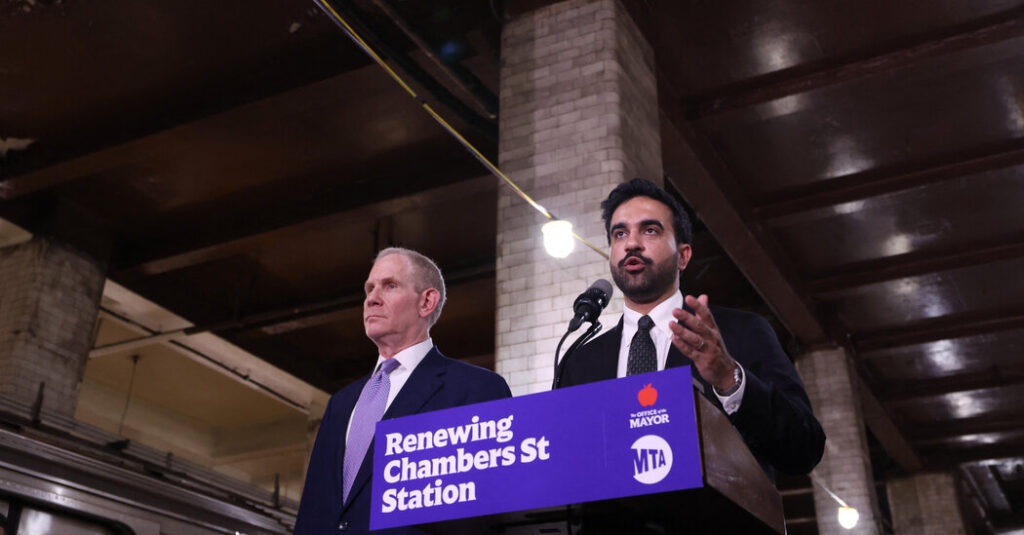
Mr. Mamdani, standing on a steamy platform in the complex, compared the space, which serves several train lines, to a “chamber of horrors,” and said the upgrade would be the first of its kind for an American transit network.
“We are bringing that legacy of abandonment to an end,” he said about the Chambers Street station, one of the hottest and least inviting in the century-old subway system. More than 18,000 riders use the station on an average weekday.
The plan would involve digging holes more than 500 feet below an unused station platform to siphon excess heat into a network of pipes connected to municipal buildings nearby, including City Hall and the Surrogate’s Courthouse. Similar geothermal heat-capture systems have been used at St. Patrick’s Cathedral and apartment buildings in New York, and in several European cities.
Janno Lieber, the chief executive of the Metropolitan Transportation Authority, the state agency that runs the subway, said the plan could create a model that could be applied elsewhere in the city’s 472-station network.
Previous plans, including for air-conditioning, have produced mixed results because of the porous and complicated layout of stations, which have multiple vents and exits that make them harder to cool. (Subway trains are air-conditioned, but the hot air removed from train cars is vented into stations and tunnels, compounding the problem.)
It is not yet clear how much cooler the heat-exchange system could make the station, Mr. Lieber said, but he noted that lowering the temperature “even a few degrees” would mean “the difference between total misery and merely sweltering.”
Mark Levine, the city comptroller, said the plan could have the added benefit of reducing utility bills for a number of city-owned properties, including the David N. Dinkins Manhattan Municipal Building, which spends roughly $1.5 million a year on heating.
The study comes a week after Gov. Kathy Hochul announced plans to renovate the Chambers Street station, which opened in 1913 and has long been derided as one of the most neglected in the subway.
That project, which does not yet have a timeline but is expected to cost tens of million of dollars, includes new flooring, additional security cameras and lighting, leak mitigation, and the restoration of damaged features, like mosaics, marble trim and terra-cotta details. The M.T.A. said the project would be funded in part with revenue from Manhattan’s congestion pricing toll program.
The post The Subway Is Sweltering. Is There a Way to Put That Heat to Good Use? appeared first on New York Times.