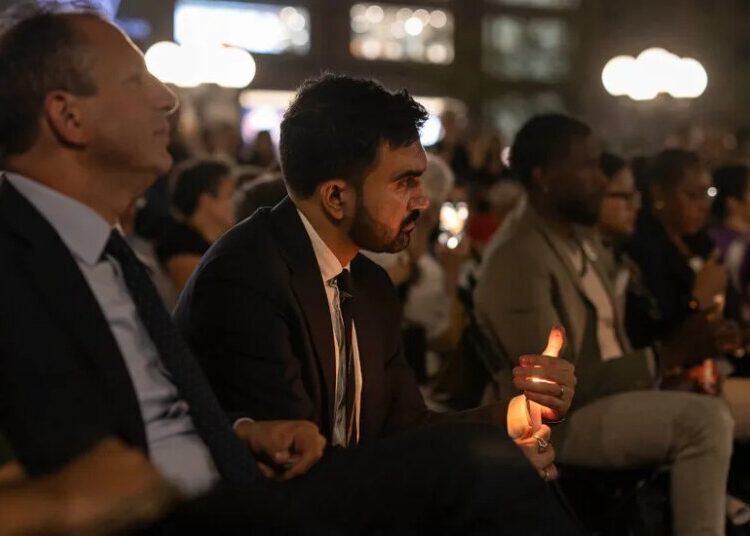
John Ondrasik, a singer-songwriter, performs as Five for Fighting.
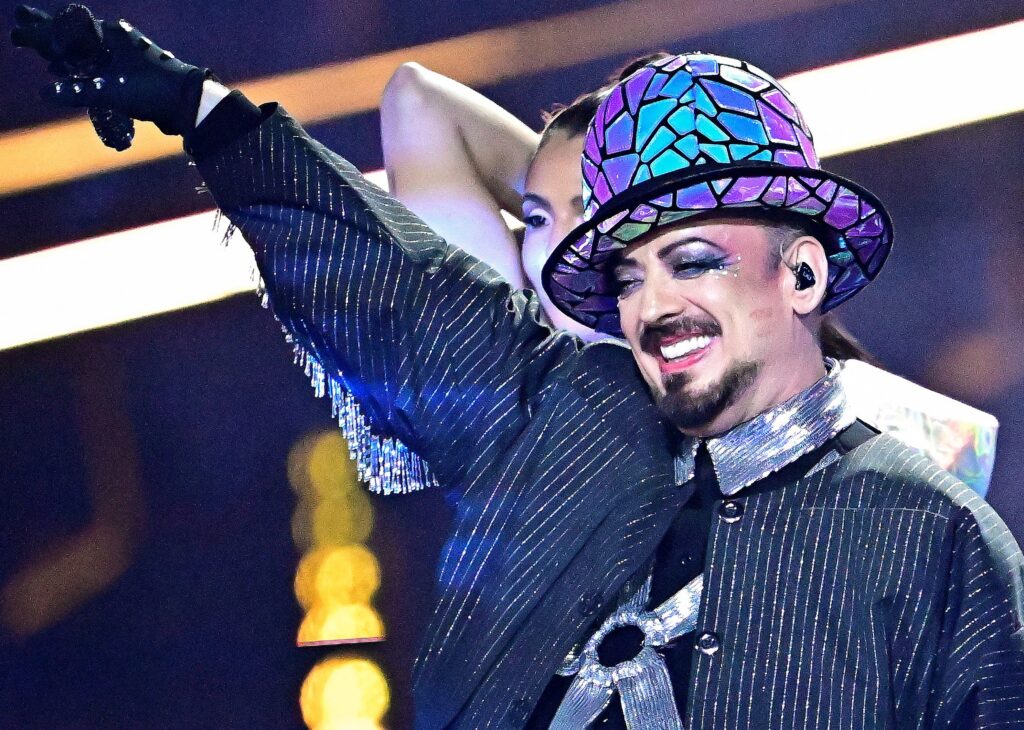
It has been said that the arts are a reflection of the times. If so, then we may be entering a dark age. The latest evidence involves Boy George, the flamboyant British singer who shot to fame in the 1980s and recently released a song entitled “We Will Dance Again.” He said he wanted to support his Jewish friends still reeling from the atrocities committed by Hamas terrorists in Israel, in particular at the Nova music festival, on Oct. 7, 2023. “I stand with the Jews,” the lyrics go.
How dare he.
Reactions were immediate and overwhelmingly furious. Mine, in this order: surprise, satisfaction and sadness tinged with joy.
Surprise and satisfaction that someone in the music business had the courage to stand for basic humanity. Saddened by the knowledge of what was in store for him.
In December 2023, I wrote and released a song entitled “OK (We Are Not OK).” It was meant to address a broken world, where the grotesque Oct. 7 massacre could be celebrated on college campuses and the streets of many cities around the world. The song name-checked Harvard, where a student group issued a statement calling Israel “entirely responsible” for Hamas’s orgy of murder, rape and hostage-taking. And I spoke out publicly about the eruption of moral relativism and clear antisemitism that followed the attack.
When the Israeli government shared the “OK” music video on social media, I quickly learned the price of principle.
I know personally the vitriol and death threats now coming for George Alan O’Dowd. I know that few artists of stature will come to his defense. And that he will have to hire more security for his concerts.
What about the hint of joy I mentioned? That comes from knowing what a shot in the arm his song would give to Jews around the world who feel abandoned, scorned, by members of the performing arts.
One may ask why Boy George is subject to such attack while many artists freely spout anti-Isreal, antisemitic rhetoric with seemingly little consequence.
Then there are our colleagues in the music industry, particularly global icons, who have been moral cowards on a historic scale. Virtually every artist I shared the stage with at “The Concert for New York City” after 9/11, who stood for America 25 years ago, has been silent (or worse) in the aftermath of Oct. 7.
It was thus understandable that Boy George, after the Bandcamp music platform recently removed “We Will Dance Again,” accused its operators of censorship. Bandcamp responded that they had done so because the song, as Boy George had acknowledged, used artificial intelligence in its composition. Whatever you think of AI, the practice is common in the music business these days. But that spat was a sideshow in the main story: the angry response to a song memorializing young people slaughtered at a music festival.
What makes Boy George so enraging to the haters is that he, like me, is not Jewish. That fact sends a signal: This is not a religious battle but a moral one. One of good versus evil, without relativity or equivocation. To the haters, that means Boy George must be ridiculed, marginalized or intimidated, lest he give license to others who might have been cowed into not voicing their support for the Jewish people.
In 1982, Boy George, with Culture Club, released the hit song “Do You Really Want to Hurt Me.” In this battle for civilization, the answer is, indisputably, yes. But he is unbowed, defiant, as he stands up for what’s right. Boy George: good man.
The post The haters come for Boy George over Israel. I know what it feels like. appeared first on Washington Post.