Russia’s only antiwar party, Yabloko, has been barred from running in next month’s parliamentary elections, the latest sign that the Kremlin will not tolerate any political forces that question its determination to continue fighting in Ukraine.
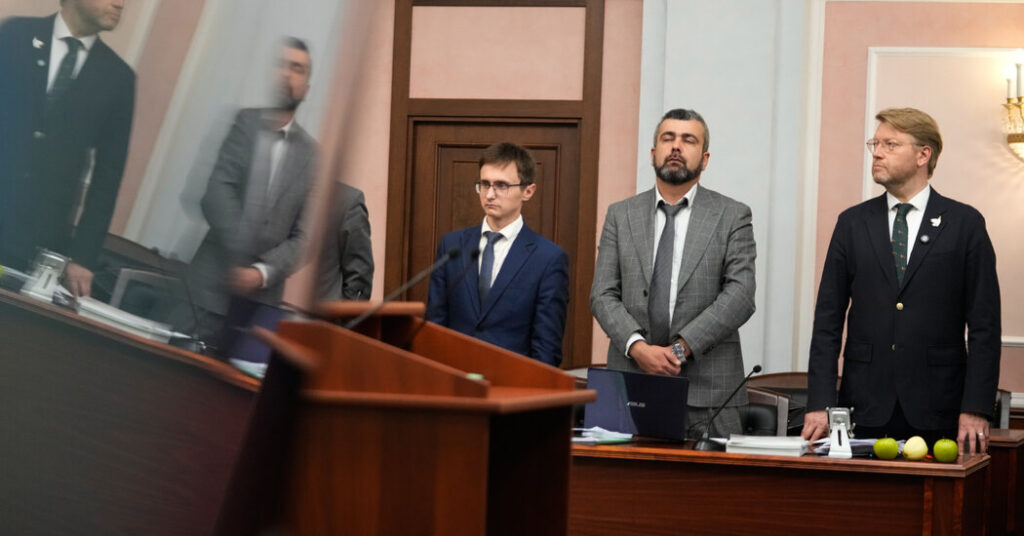
The Supreme Court, in a hastily called hearing on Monday, upheld a lawsuit seeking to strike Yabloko from the ballot for the Sept. 18 election.
Kirill Goncharov, head of the party’s Moscow chapter, said Yabloko had been bracing for that decision.
“We were aware that the more popular we were getting, the more trouble we’re creating for the Kremlin,” he told The New York Times shortly after the verdict. “People want peace, freedom and a life without fear — people want what this party represents.”
Unless its appeal is upheld within the next five days, Yabloko will not be able to run in the elections.
The decision is yet another example of the Russian authorities’ trying to sideline antiwar voices ahead of an election that is widely seen to be sewn up for President Vladimir V. Putin’s governing United Russia party.
Even apparent fringe threats to the Kremlin’s power have stoked fear within the political elite about the risks of allowing any pluralism during wartime.
In the run-up to the presidential election in 2024, a relatively unknown antiwar candidate, Boris B. Nadezhdin, was barred from running as his candidacy began to gain steam. He was also arrested. He fled the country last week as he prepared to run in the parliamentary election.
Yabloko is the only Russian political party that did not support the war and openly called for a cease-fire. It has been criticized, however, for failing to clearly condemn Mr. Putin’s invasion of Ukraine. Such statements have landed hundreds of Russians in prison on criminal charges linked to war censorship laws.
Yabloko’s short-lived campaign in recent weeks have attracted young voters who took to social media to profess their love of apples — “yabloko” in Russian. Danya Milokhin, a singer with a huge following among Russian teenagers, posted a supportive video over the weekend.
Before the verdict, several hundred people, mostly young Russians, showed up at the Supreme Court on Monday morning to cheer on the party, singing “Yabloko” on the steps of the building after most of them were not allowed in.
The case for striking Yabloko off the ballot was started by Rodina, an obscure nationalist party whose leader, Aleksei Zhuravlyov, accused Yabloko of “working for the West” and betraying Russia by opposing the war in Ukraine.
A trial that would normally take at least a few weeks to set up was scheduled for Monday, the next working day after the claim was filed.
Rodina’s representatives on Monday asked the court to disqualify Yabloko over several alleged instances of copyright infringement, including quoting from a Soviet-era children’s song in an interview of the party’s founder and failing to display credits for a photo on its webpage.
None of the copyright owners, including the newspaper and the heirs of a Soviet composer, voiced any issues with Yabloko.
Even the pro-Kremlin observer Sergei Markov, a political scientist, on Monday said on social media he “cannot get his head around” the accusations.
The lawsuit also said Yabloko should not be allowed to run as it had been encroaching on “Russia’s territorial integrity” by calling for an end of the war.
In response to the claim, Nikolai Rybakov, the party’s leader, cited in court on Monday Mr. Putin’s recent remarks saying that Russia was pursuing peace talks.
As the judge announced the verdict late Monday evening, Grigory A. Yavlinsky, Yabloko’s co-founder and former longtime leader, said in a statement that Russia’s “political system has exposed itself by barring Yabloko from running.”
Russian society wants “peace and freedom way more than the authorities thought,” he said.
The party, which has not held a seat in Russia’s lower house of Parliament, known as the Duma, since 1999, has become an unlikely magnet for antiwar Russians at home and abroad after election officials gave it the green light last month to run. Its 43-word election manifesto focused on two things: peace and freedom.
Allowing Yabloko on the ballot could make the party a protest vote at a time when much of Russian society is exasperated with the war and wants it to end, analysts say. The Kremlin apparently does not want to take even that risk.
Some of the party’s most prominent members have already been disqualified: Mr. Rybakov, the party leader, cannot run because of a court decision punishing him for posting a photo of Aleksei A. Navalny, the Russian opposition leader who died in a penal colony in 2024. Maxim Kruglov, deputy chairman of the party, was sentenced to seven years in prison in June over a 2022 social media post calling out what experts have described as Russian war crimes in the suburbs of Kyiv in the first weeks of the invasion.
Yabloko has also been barred from fielding candidates in St. Petersburg and Karelia, where it has been historically strong in the local legislatures.
Years before Yabloko was accused of submitting to the Kremlin’s war censorship, elements of the Russian opposition have accused it of being too soft on Mr. Putin’s increasingly authoritarian regime.
But most of these critics rallied around Yabloko and called on their supporters to vote for the party in the upcoming election.
Yulia Navalnaya, widow of Mr. Navalny, last week said she and her allies would “set aside all disagreements and help” Yabloko at the polls.
Ms. Navalnaya, commenting on Monday’s ruling, said that “the Kremlin got spooked” by Yabloko’s growing popularity. She called on her supporters to “vote for any party other than United Russia.”
The post Russian Court Bars Country’s Only Antiwar Party From Running for Parliament appeared first on New York Times.