Crime in San Francisco, Jarico Anderson announced last year, “is over with.” Anderson, who raps under the stage name Dreamllife Rizzy, would know—he’s a convicted felon. Lately, though, he says that cameras have been making criminal life inconvenient. “Soon as you slide past that motherfucker with some stolen plates, they going to issue a warning to every SFPD station in that area, if not the entire city, and they going to start dispatching” officers to that area, Anderson said on an episode of the popular hip-hop and culture podcast No Jumper. “And when they catch you, they’re going to catch you.”
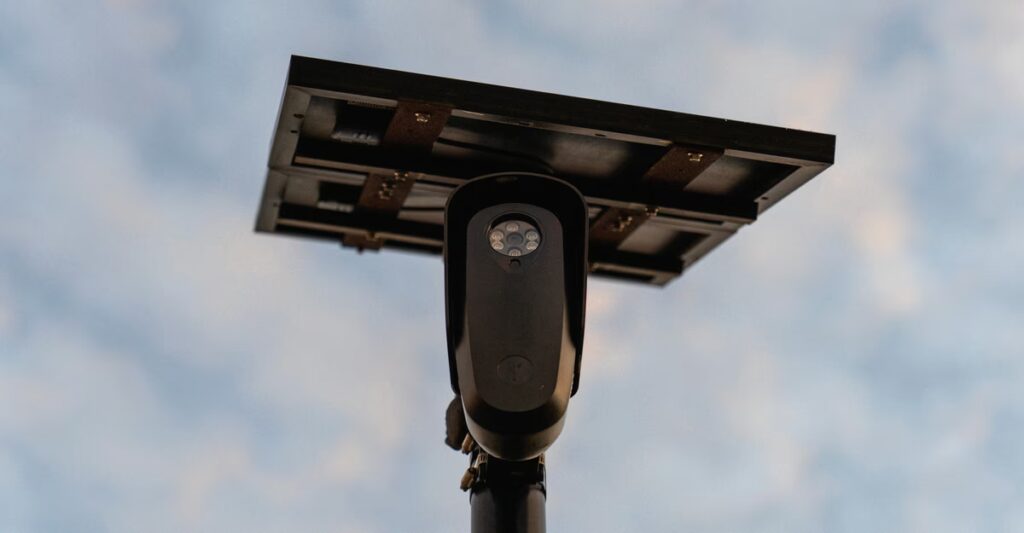
The “motherfucker” in question is an automatic license-plate reader (ALPR)—a camera installed on a light pole or a building that photographs and identifies license plates as they pass below, then adds the image to a centralized database. San Francisco’s roughly 500 ALPRs are provided by Flock Safety, a police-technology firm that claims its ALPRs are deployed in the jurisdictions of more than 5,000 agencies nationwide, recording billions of plate images a month. Networked together, Flock cameras can enable police to track cars in real time, giving them eyes across a city. The cameras also create a record of where cars have been, providing a view of millions of drivers’ movements.
Criminals aren’t the only ones upset about the system. Privacy and civil-rights groups call ALPRs an Orwellian threat to the Fourth Amendment. In cities such as Oakland, California; St. Petersburg, Florida; and Pocatello, Idaho, people have started vandalizing or blocking the cameras. Recently, Flock has become a fixation of the populist right. Last month, Tucker Carlson released an hour-long video claiming that Flock represents the “largest mass-surveillance operation in history” as part of “the coming slave state.” The populist firebrand Representative Thomas Massie of Kentucky wants to withhold federal funds from cities that use Flock cameras; Representative Anna Paulina Luna of Florida wants to ban them outright.
That’s an overreaction. Although research on Flock’s effectiveness is still in the making, ALPRs are likely a valuable tool for any modern police force. Privacy concerns can be best addressed through smart regulation, not bans. Indeed, in our surveillance-saturated society, police cameras can help make the criminal-justice system both fairer and less punitive—if we let them.
[Adam Serwer: Trump should need a warrant to see your phone]
The case for Flock is simple. Cameras help police catch criminals. That reduces crime through two channels: incapacitating offenders who are caught and convicted, and increasing the certainty of apprehension, which theoretically should deter criminals from offending in the first place. But is it true in practice? Although the research base is still developing, the answer is “probably.”
An initial wave of randomized controlled trials from the early 2010s generally found little or no crime-reducing benefit of ALPRs, except a possible reduction in drug-related crime. But these studies collected small samples from small areas and relied on now-decades-old technology. A handful of more recent papers gave reason for optimism, but use weaker research designs that do less to isolate causality. A 2017 study found ALPRs were correlated with a reduction in violent crime; a 2019 paper found suggestive but not conclusive evidence of a reduction in auto theft and robbery; and a 2025 evaluation of Atlantic City’s ALPRs found a reduction in shootings, car thefts, and property crimes. But none of these papers could prove that ALPRs caused these improvements.
There are, however, studies that look at so-called natural experiments—where chance makes an intervention random enough to study it like a randomized trial—that show that cameras in general reduce crime. An analysis exploiting the quasi-random distribution of cameras in Medellin, Colombia, found that they reduced crime by about 19 percent. Another paper showed a 25 percent reduction in crime in subway stations in Stockholm, Sweden, after cameras were installed in them. A third found a 20 percent reduction in areas of Montevideo, Uruguay, where cameras were introduced. And a fourth estimates that nearly tripling cameras per capita in China reduced crime by about 10 percent. ALPRs aren’t exactly the same thing as surveillance cameras, but the consistent effect of the latter on crime should give people more confidence that the former can reduce it, especially in combination with the newer ALPR literature.
Still, many will blanch at using evidence from China to support putting more cameras in American cities. Even if ALPRs make us safer, we are trading at least a little privacy for that security. There are legitimate concerns, too, regarding police abuse of the technology. The Institute for Justice, a libertarian public-interest law firm, has counted 30 cases where officers have used Flock cameras to “stalk romantic interests.” And surveillance critics have warned that ICE has used Flock data in its immigration crackdown.
These are legitimate concerns, and the privacy threat here is real—but, compared with other intrusions, minimal. In principle, ALPRs collect information about cars’ license plates—a government-issued registration that is required for driving on publicly funded roads. The Supreme Court has been quite clear that “a person traveling in an automobile on public thoroughfares has no reasonable expectation of privacy in his movements.” Additionally, Americans have, through the camerass nearly everyone carries in their pockets, voluntarily made far more invasive surveillance a regular feature of daily life. Many people may not like that, but it’s hard to see ALPRs as a major intrusion by comparison.
Although a single photo of a moving car is not a major intrusion, a database full of billions of such photos might be. Such “mosaic” surveillance—so named because many small police actions can add up over time to what counts as a “search” in constitutional law—has faced increasing scrutiny from the Supreme Court over the past decade. A single ALPR photo isn’t a search for purposes of the Fourth Amendment’s prohibition on “unreasonable search and seizure,” but the Court has recently found queries of similarly detailed data sets to be a search that requires a court-issued warrant to conduct. (Most queries to a department’s ALPR database currently do not require such a warrant.)
The theory of “mosaic” searches is still evolving, and it’s not obvious whether Flock’s system meets the emerging standard for a search. Still, the general concern is sound—most people would consider a police department keeping unlimited, detailed information on everyone’s movements highly intrusive.
Concerns about such systematic surveillance aren’t trivial, especially when that surveillance is done by the government. The Fourth Amendment’s protections exist exactly because of the very real potential for abuse of police officers’ extraordinary powers. The question, though, is whether we need to forego the crime-reducing benefits of ALPRs in order to minimize the risks to our privacy. Such absolutism is unwarranted: Smart regulations can help obviate these concerns without getting rid of ALPRs entirely.
One easy step would be to set limits on how long departments can retain ALPR data, something several states have already done. (Flock defaults to a 30-day retention period, which some states have lowered by statute to 21—reasonable windows of time for catching criminals while avoiding creating a permanent record of everyone else’s movements.)
States and police departments can also impose stricter rules about access to ALPR data, including requiring supervisory approval and mandating a log of all access to the database to deter abuse and make it easier to identify. Actual ICE queries are a tiny fraction of total searches, but if a city or state doesn’t want ICE accessing their database, they can make that rule easily. Both states and departments can also increase penalties for abusing an ALPR system—there’s no reason to treat cops as immune if they engage in such wrongdoing.
[Read: How license-plate readers have helped police and lenders target the poor]
When critics fixate on abuses, they miss the way that cameras can make policing and punishment more humane. Many approaches to reducing crime rely on increasing the severity of punishment—ratcheting up prison sentences or expanding mass incarceration. The promise of high-tech policing, using cameras and DNA databases, is that it can deter crime without such extreme measures, and as a result demand less overall punishment from the system as a whole.
Take Anderson’s car-thief associates. If they know that a camera will help catch them, they become less likely to steal. If they don’t offend, they aren’t caught, arrested, and incarcerated. Consequently, both crime and punishment fall, leaving everyone better off.
The benefits of that arrangement accrue, in a sense, to criminals. But they accrue far more to the law-abiding. Crime imposes an enormous cost on society—trillions of dollars in time, money, suffering, and lives lost. Criminal victimization can scar people for years after, a fact that shows up in everything from how much they work to how dependent they are on government benefits. Assuming we take reasonable precautions to protect our liberty and privacy, having ALPRs help reduce these costs is clearly worth it.
Flock cameras are an easy target for a populist backlash. But although some of the concerns are reasonable, a panic about a “slave state” shouldn’t determine public policy. Intelligently regulated, ALPRs can be one among many tools in the toolbox of smarter—and therefore less severe—police forces. Dumping the cameras would just be foolish.
The post In Defense of Flock appeared first on The Atlantic.