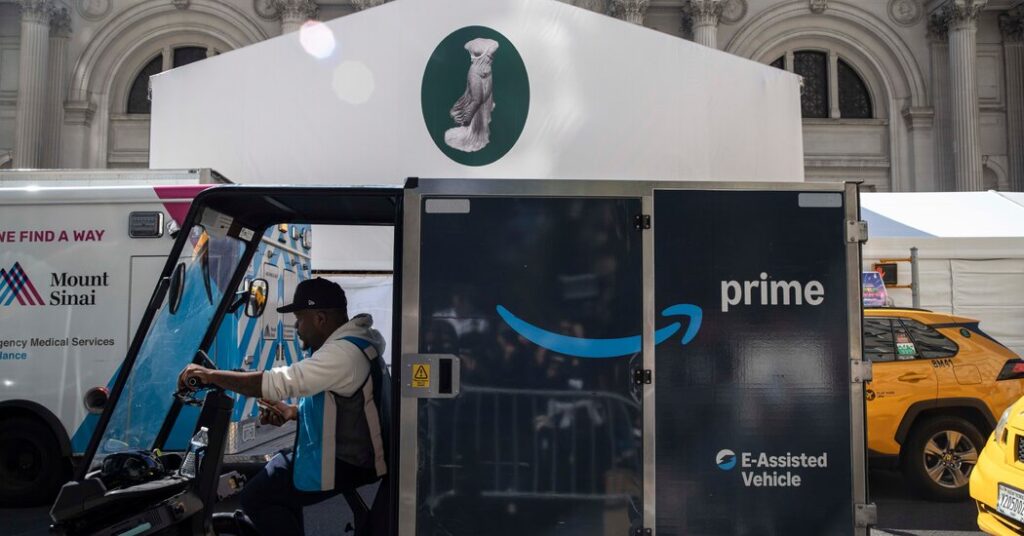
On the streets of New York City, thousands of workers hustle to deliver nearly one billion packages a year. Now, a high-stakes battle that could force Amazon and other big delivery companies to take full responsibility for those workers has reached a turning point.
Mayor Zohran Mamdani is throwing his support behind the union-backed legislation that is at the core of that battle. On Monday, Mr. Mamdani announced that he backs the Delivery Protection Act, a measure pending before the City Council that is aimed at regulating the “last-mile” operations of Amazon, FedEx and other distribution companies. It would require them to hire delivery workers rather than relying on contractors.
“Corporations like Amazon build billion-dollar business models by insulating themselves from accountability through a system of exploitative subcontracting,” Mr. Mamdani said in a statement. He called the Council bill “common-sense regulation that protects delivery workers, safeguards the communities where these facilities operate and ensures that the corporations benefiting from workers’ labor are responsible for the consequences of their business practices.”
The campaign to regulate the last-mile operations is playing out in a city in which consumers are enthralled with delivery to their doorstep, often within hours of placing an order online.
Global distribution companies save money by using contractors to provide the labor needed to get packages from their distribution networks to customers. That model allows the companies to avoid regulations regarding minimum pay and benefits that would apply if they employed those workers, supporters of the measure argue.
The bill’s opponents — including Amazon — counter that the measure would drive up the costs of delivery to consumers while slowing the arrival of packages. And they warn that it could force Amazon to move its distribution hubs out of the city to evade the new rules, eliminating thousands of local jobs.
Amazon has marshaled a coalition of business groups, including chambers of commerce and the Real Estate Board of New York, to oppose the legislation. Union officials estimate that Amazon has spent more than $5 million on an opposition campaign that includes TV ads. A study commissioned by an Amazon-funded group found that the regulations could increase the cost of delivery by as much as $5.20 per package, or $664 annually per household.
“We’re committed to creating good jobs, supporting our thousands of employees and local small business partners in New York City, and providing fast, reliable delivery for New Yorkers,” said Kelly A. Nantel, a spokeswoman for Amazon. “But as written, this legislation would directly undermine that commitment — threatening the small businesses that deliver to customers, putting the jobs of more than 5,000 of their employees at risk and forcing us to consider relocating delivery operations outside of the city.”
If the legislation passes and Mr. Mamdani signs it, New York could become the first city in the United States to regulate these last-mile operations, according to the International Brotherhood of Teamsters, which has been lobbying for the bill. The delivery workers in New York start at about $20 an hour, and, Amazon said, average close to $24 an hour. The Teamsters reached a deal with an Amazon contractor in California to pay about $30 an hour.
“We’re in a new era of politics in the five boroughs, one where workers and their advocates are in the driver’s seat,” said Thomas Gesualdi, president of Teamsters Joint Council 16.
Eric Blanc, an assistant professor of labor studies at Rutgers University, said that the bill would be “a great fight for the administration to pick” because it pits “young Black and brown working-class New Yorkers against Jeff Bezos,” the billionaire founder of Amazon.
Mr. Blanc, who studies union organizing efforts, said that by supporting low-paid delivery workers against one of the nation’s biggest employers, Mr. Mamdani is demonstrating his willingness to spend political capital for workers beyond “just showing up at the picket line.”
Mr. Mamdani, who was elected with the backing of the Democratic Socialists of America, has spoken at several rallies of unionized workers and walked picket lines with striking nurses and Starbucks employees. But the delivery protection bill could be the first major test of his willingness to take on big corporate interests on behalf of low-paid workers.
With his statement of support, the mayor signaled that he was ready to confront one of the world’s most profitable industries over a practice that it has spent significant sums to defend.
The bill, sponsored by Tiffany Cabán, a councilwoman from Queens, has drawn more than 30 co-sponsors.
Jumaane Williams, the public advocate, testified at a hearing of the Council’s Committee on Consumer and Worker Protection in April and said the measure could help to ensure that delivery workers’ rights to organize are protected.
“Companies that bust unions and skirt labor laws like Amazon will no longer be able to hide behind subcontractors and will be held liable for any and all violations,” Mr. Williams said.
Luc Rene, 27, who has driven Amazon vans for nearly four years, works from a depot in Queens that the Teamsters organized last year. He said that he delivers as many as 400 packages a day. But he said that when he has asked for a lighter load during a heat wave or after a snowstorm, the contractor he works for has told him that Amazon wouldn’t allow it. The contractor whom Mr. Rene identified as his employer, DNA Logistics, could not be reached for comment.
Amazon did not address Mr. Rene’s allegations specifically but said that the company regularly adjusts drivers’ routes to account for inclement weather.
Some Amazon contractors said that the city could wind up hurting delivery workers more than helping them.
Rudy Cazares, who owns companies that deliver in the city for Amazon and FedEx, said that although his employees wear uniforms bearing the names of those brands, those companies do not decide whom he hires and fires and promotes.
“It’s very easy to say it’s workers against big corporations and that Amazon is the big bad wolf here,” Mr. Cazares said. But he said the city is full of small businesses like his that are key to the distribution industry.
Mr. Cazares’s company, Cazar Logistics, is a member of the New York Delivers Coalition, which is led by Amazon. Amazon also funded a group called Five Borough Jobs Campaign, which commissioned a study by the consulting firm AKRF that calculated the potential consequences of the bill for the city’s economy. The study said that the bill “would destabilize the city’s delivery ecosystem” and suggested that its impact would fall disproportionately on lower-income communities.
The consulting firm estimated that 83 percent of the “last-mile facility” workers live in boroughs other than Manhattan and that about 80 percent of them are minorities.
“I believe what’s at stake is thousands of local jobs,” said Christine Chan, who owns a Harlem company that uses cargo bikes to deliver about 5,000 packages a day in Manhattan for Amazon. She said that her company, Highgate Logistics, had about 175 workers making about $20 an hour and “plenty of applicants.”
Her message to the Council: “You’re betting that Amazon is going to employ these people directly. I’ll take the other side of that bet.”
The post A Fight Brews Between Mamdani and Amazon Over Delivery Workers appeared first on New York Times.