When Mike Hotz approached a man standing on the edge of a bridge in Nashville, the man rebuffed him.
“Stay back,” the man told him. “Don’t come any closer.”
Hotz, a lieutenant for the Metropolitan Nashville Police Department, was sent to the scene on July 23 after calls came in about a man who was livestreaming on social media and saying he was on a bridge and about to take his own life.
“I was the first vehicle that arrived,” Hotz, a police officer of 16 years, said in an interview with The Washington Post. “I just stopped and got out and attempted to speak to him.”
While other officers were stopping traffic on both sides of the Victory Memorial Bridge, Hotz spent 45 minutes talking with the man and trying to understand what led him to this point. Hotz previously served as a leader on the department’s crisis negotiation team, he said, and has been trained on how to talk to people in crisis.
“It was emotional. This was an individual who had reached a level of frustration where he was having the worst day of his life,” Hotz said. “I just wanted to be able to develop trust with him and help him realize that tomorrow is another day and it will get better.”
Slowly, the man began to open up.
“It was a combination of life circumstances that happened that brought him to a level of ultimate frustration and desperation,” Hotz said.
Even as they talked, Hotz said he remained afraid of what might happen next.
“He was standing on the bridge and did lean over several times,” he said.
Hotz, who served two tours in the Army infantry, said he drew on his own experiences to reach the man.
“Military veterans are disproportionately affected by the mental health crisis, as well as suicide,” Hotz said. “All of my brothers out there have had intimate contact with individuals who are contemplating suicide. Some of them have gone through with that terrible plan.”
The man on the bridge was not a military veteran, Hotz said, but Hotz shared those stories anyway, along with some of his own struggles to help the man feel less alone.
“I just let him know that we love him and we are there to help him and he wasn’t in any kind of trouble,” Hotz said.
Eventually, Hotz extended his hand, hoping the man would step off the bridge and shake it.
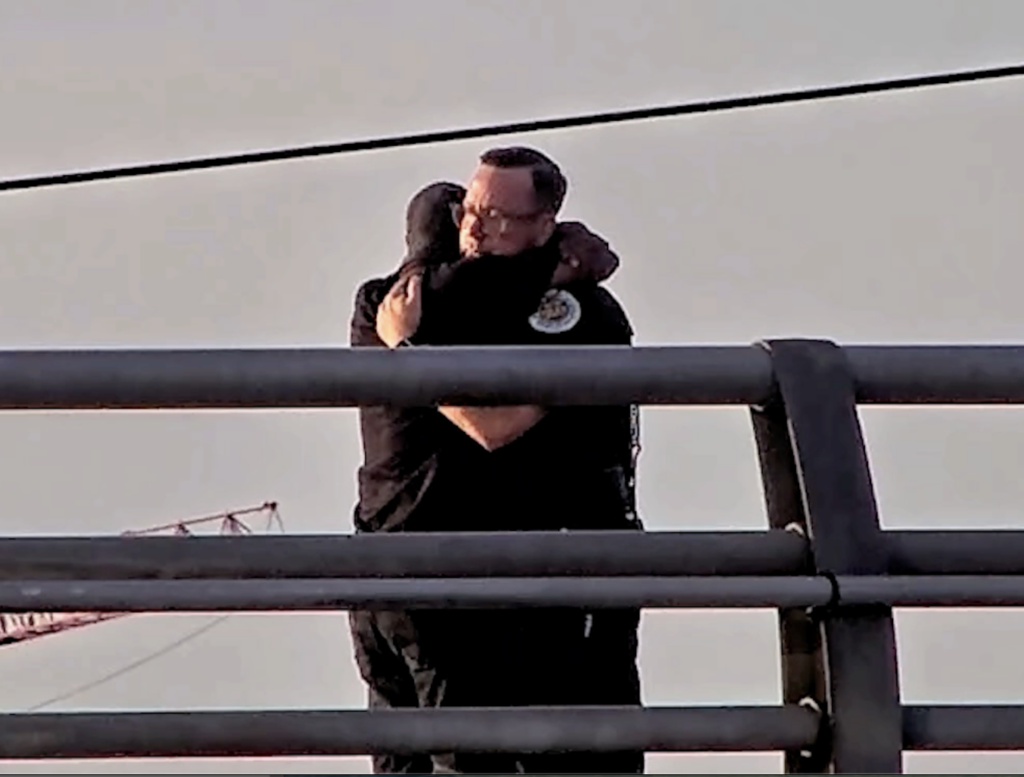
“He stepped forward from the bridge and he just kept walking toward me while I had my hand extended, and I could tell he was going to go in for a hug,” Hotz said. “He just kind of broke down.”
The man wept in Hotz’s arms. The poignant moment was captured on Hotz’s body camera. As he held him, Hotz told the man he loved him.
“This guy needed to know that people cared about him,” Hotz said. “When I was thinking about how to communicate with this individual, that is what I felt, and it is what I meant.”
About 30 minutes later, once a counselor from the department’s Partners in Care program had arrived, Hotz stepped away.
“I just had to take a deep breath,” he said. “I’m just grateful that it happened the way it did, and I was in the right place at the right time to help somebody.”
The man is now receiving care, Hotz said.
“Anybody who’s going through any kind of crisis: Know that while it seems like life is really bad and couldn’t be worse right now, it gets better. … It’s all right not to be all right,” Hotz said. “I don’t care who you are in this world, there is someone or a group of someones that love you.”
If you or someone you know needs help, visit 988lifeline.org or call or text the Suicide & Crisis Lifeline at 988.
The post What this officer said to a suicidal man to talk him off a bridge’s edge appeared first on Washington Post.