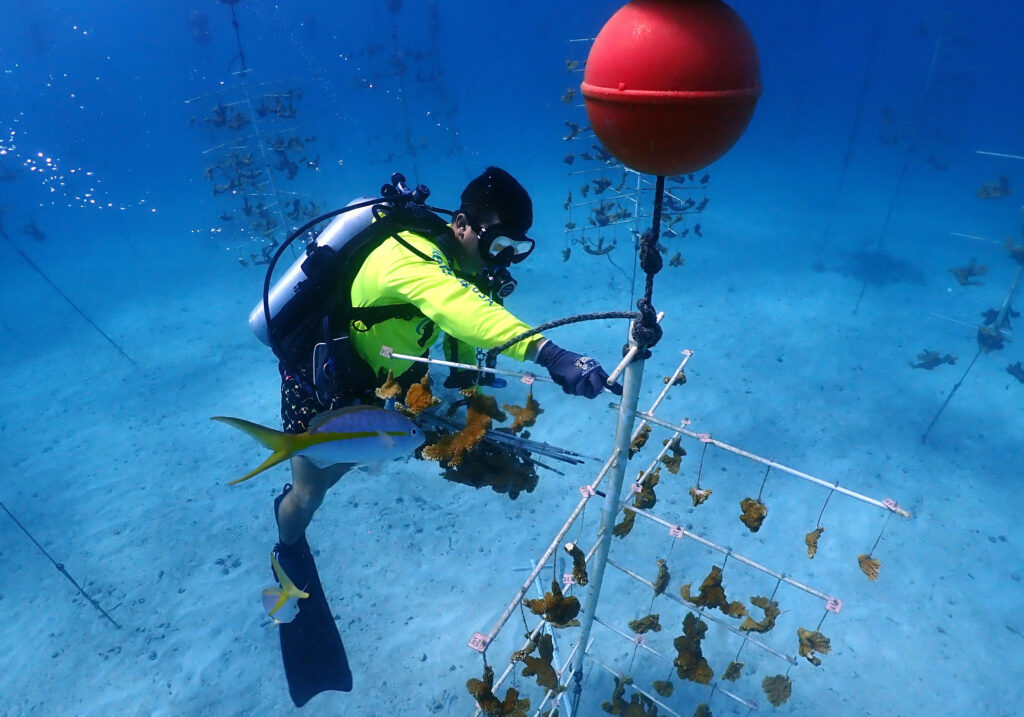
The waters off the coast of South Florida were already growing warm by late June — ominously warm to Ken Nedimyer and other scientists and conservationists still scarred by a devastating 2023 marine heat wave that led to the worst mass coral bleaching event on record in the state.
Nedimyer, technical director for the nonprofit Reef Renewal USA, and other colleagues kicked into gear. They moved dozens of vulnerable elkhorn and staghorn corals from offshore nurseries into deeper, cooler water. They took other specimens to onshore labs, where temperature-controlled systems will offer refuge until ocean temperatures return to safer levels.
“It was like Noah’s ark,” Nedimyer, weary from a late night spent off Key Largo, monitoring corals during their annual spawning, said of the recent effort. “Keeping them alive is our main focus right now.”
Three years after a blistering marine heat wave created a full-blown emergency along the only living coral barrier reef in the continental United States, researchers determined to prevent coral species from extinction are taking steps to be better prepared as another potentially scorching summer unfolds.
The National Oceanic and Atmospheric Administration has warned that the most intense El Niño event in 150 years is contributing to exceptionally warm waters. Already, the agency has issued an “alert level 2” for parts of the Florida Keys, meaning there is a risk for reef-wide bleaching and mortality, particularly among heat-sensitive corals. An even higher alert level could soon follow.
Climate models predict that perilously warm seas could linger into fall, and the stress on corals could continue.
“The temperatures we are seeing right now are basically mimicking what we saw at this same time in 2023,” said Cynthia Lewis, director of the Florida Institute of Oceanography’s Keys Marine Laboratory. “It’s the calm before the storm.”
For Lewis and others who work on coral conservation, the memory of that catastrophic marine heat wave and the damage it inflicted on Florida’s roughly 360-mile-long reef — the third largest on the planet — looms large.
“It was traumatic. It was horrible. I’ve never seen anything like it in my life,” Lewis said, recalling the months-long frenzy to rescue and rehabilitate as many stressed corals as possible in land-based labs around the state.
Coral bleaching is a stress response. It occurs when heat upends a coral’s metabolism, causing it to turn white as it expels the symbiotic algae that provide it with nutrients and color. Prolonged bleaching, which scientists say rising sea temperatures are making more frequent and severe around the globe, can lead to mortality.
That is what happened along much of Florida’s reef in 2023, one of multiple bleaching events the region has faced in the past decade. Underwater temperatures reached 93 degrees in some spots, more than five degrees above normal.
A NOAA-led study publishedlast year found that around the Florida Keys and Dry Tortugas, the event left ecologically critical elkhorn and staghorn corals functionally extinct — at least 98 percent of their colonies died. Along southeastern Florida where cooler sea temperatures remained, mortality was lower but still nearly 40 percent.
Derek Manzello, coordinator of NOAA’s Coral Reef Watch program, later described the episode as “unprecedented,” saying it “started earlier, lasted longer and was more severe than any previous event in that region.”
The ripple effects are shaping how scientists around the state are responding.
“Everybody who experienced that in 2023 has a little PTSD from it,” Lewis said. But, she added, “I think we are better prepared mentally and physically, as well as structurally.”
At her laboratory on Long Key, that preparation has meant the recent completion of a new temperature-controlled system, which added 20 more seawater tables to support coral restoration. Each is equipped with the machinery needed to keep rescued corals thriving until they can be returned to the reef.
“It’s keeping them as happy as possible, keeping them growing so they can propagate,” Lewis said.
Meanwhile, a group of 11 of the state’s leading coral conservation and restoration organizations recently announced an effort to team up during what could prove to be another record-breaking summer for ocean temperatures.
In recent days, dive teams from the groups have headed out repeatedly into the waters near Key Largo to collect coral eggs and sperm before transporting them to a temporary laboratory set up by Mote Marine Laboratory at nearby John Pennekamp Coral Reef State Park.
The effort is part of a NOAA-funded partnership to collect, fertilize and grow a more resilient generation of elkhorn and staghorn corals. Many of the corals selected for the effort survived the crippling 2023 heat wave, making them among the most heat-tolerant in Florida’s waters.
“We have the parents of the corals of the future, if we just take care of them,” Nedimyer said.
Katey Lesneski, research and monitoring coordinator for a NOAA program created to restore iconic reefs throughout the Keys, said other scientists will soon experiment with a different approach, placing shading structures above corals off Big Pine Key to try to reduce the sunlight and heat they receive.
“This is the first real field trial during an actual bleaching event,” she said. “This is a perfect opportunity to test this new intervention.”
The approaches unfolding all along the reef matter more than ever, say advocates who are intent on preventing another disaster like the one in 2023.
“Nobody is giving up,” said Lewis, because so much is at stake.
The sprawling reef, she said, protects the state’s coastline against hurricane-fueled storm surges. It attracts tourists that boost the economy and supports fisheries. The reefs are also “are an incredibly diverse ecosystem of all kinds of plants and animals and fish,” she said.
For all those reasons, Nedimyer said, the long days and significant investment he and many others have put in to prepare is worth it.
“The outcome if we do nothing,” he said, “is pretty clear.”
Ben Noll contributed to this report.
The post Scientists race to save Florida’s coral reef as El Niño heats the ocean appeared first on Washington Post.