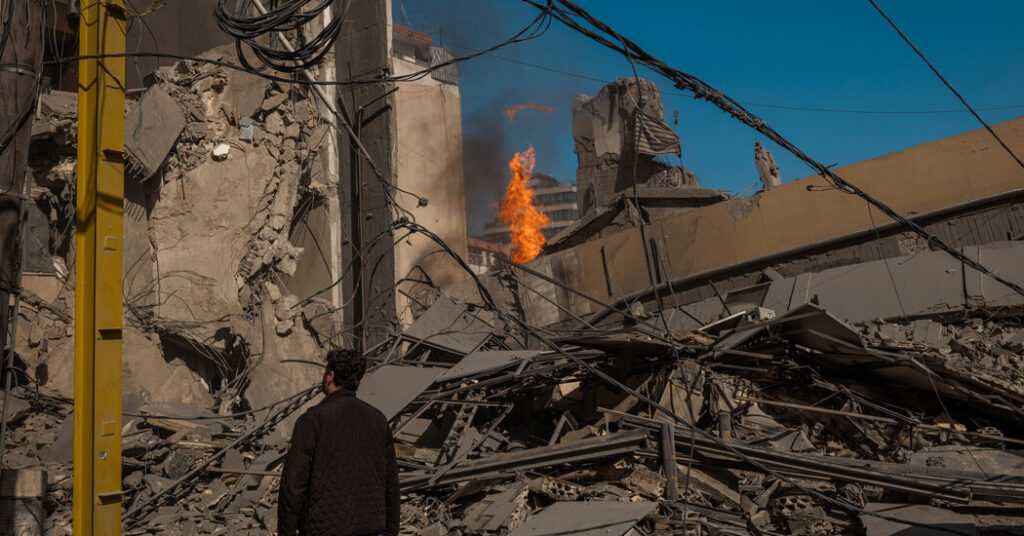
When Israel launched its latest war against Hezbollah in March, the first targets the military warned it would strike were not weapons depots or underground command centers.
They were banks.
Israeli fighter jets leveled more than a dozen branches of a shadowy financial institution known as Al-Qard al-Hassan, long accused of operating as Hezbollah’s bank in Lebanon. More airstrikes followed on exchange shops that Iran used to funnel money to Hezbollah, its Lebanese proxy, and on gas stations that generated revenue for the group.
With these strikes, Israel was sending a clear message: Hezbollah’s money, not only its arsenal, was in the cross hairs.
The bombings capped the most aggressive campaign yet by Israel, the Trump administration and Lebanon’s own government to squeeze Hezbollah financially by disrupting the group’s funding channels, particularly from Iran.
For months leading up to the war, Lebanon’s government, under pressure from the Trump administration, worked to choke off the routes that the group used to receive and move money, such as Beirut’s international airport. Washington also pressed the Lebanese central bank to tighten controls over the country’s cash economy, which Hezbollah had long exploited.
Now, Hezbollah is grappling with its most severe economic strain in years, according to documents reviewed by The New York Times and interviews with Lebanese, U.S. and Israeli officials and Hezbollah insiders. Most spoke on the condition of anonymity, citing confidential intelligence assessments, diplomatic protocol or fear of retribution.
The war that began in March was the second in less than three years between Israel and Hezbollah, one of the world’s most heavily armed militias. In the previous conflict, which began in late 2023, Israel killed Hezbollah’s longtime leader, Hassan Nasrallah, along with many other top figures in the movement.
Seizing that moment, leaders in Washington and Israel sensed that Hezbollah was vulnerable and coordinated their efforts to clamp down on its funding. They went after the financial networks that had long underpinned the group’s power, while also turning up the pressure on Lebanon’s government to disarm Hezbollah.
While the wars with Hamas in Gaza and Iran have drawn global attention, the financial squeeze on Hezbollah represents a quieter front in a campaign by Washington and Israel aimed at crippling Tehran’s ability to project power through its proxy militias across the Middle East.
Founded in 1982, Hezbollah has long stood as the crown jewel of that network.
The group’s finances are secretive, and the full extent to which the crackdown has affected its vast operations remains unclear. Both Hezbollah and its chief backer, Iran, have also proven resilient in the face of the efforts to weaken them, able to bounce back militarily and to find new ways to keep the money flowing.
Nevertheless, Hezbollah is struggling to finance its sprawling social welfare network, which has long underpinned its support among its Shiite Muslim base in Lebanon. The group has also increasingly prioritized military spending after Israel’s offensives took a heavy toll on its capabilities.
Hezbollah’s chief spokesman, Youssef al-Zein, told The New York Times in May that the group had halted the compensation payments it had pledged to supporters as it struggles to meet the needs of hundreds of thousands of people displaced by the war.
The State Department estimated before the war that Iran’s funding to Hezbollah was about $700 million per year, providing a majority of the group’s billion-dollar annual budget. Iran has increased its financial support for Hezbollah over the past year, according to Lebanese, U.S. and Israeli officials, but the money is still not enough to cover Hezbollah’s considerable war-related expenses.
“The scale of the battle’s demands and the displacement have placed significant burdens on Hezbollah,” Mr. al-Zein said. As a result, “resources are being managed according to priority,” he added. “There is undoubtedly pressure, but Hezbollah is able to overcome it.”
U.S. Pushes Lebanon to Get Tough
The crackdown on Hezbollah’s finances began in earnest in late 2024. Soon after a U.S.-mediated cease-fire halted the Israel-Hezbollah war, the sudden fall of the dictator Bashar al-Assad’s regime in neighboring Syria left the group more isolated than ever from Tehran.
Hezbollah had lost a crucial smuggling route at precisely the moment it needed money to rebuild and sustain its operations.
For decades, Hezbollah oversaw a state within a state in Lebanon — one that fed, housed and paid its loyal followers. It built a media network, established hospitals and schools, drew revenue from gas stations and pharmaceutical companies and amassed an arsenal more powerful than the state’s own military with Iran’s financial backing.
But when the Syrian land route into Lebanon was effectively severed, Iran scrambled to find other methods to finance the group, according to U.S. and Israeli officials and people familiar with Hezbollah’s finances.
Iran turned to Beirut’s airport, which for years had effectively operated under Hezbollah’s control and was used to receive Iranian funding and arms, according to a U.S. official and a senior Lebanese official briefed on the matter.
But U.S. and Israeli officials were on that trail.
Early last year, U.S. officials relayed an Israeli warning to Lebanon’s government. Iran was sending suitcases stuffed with U.S. dollars to Hezbollah on civilian flights to Beirut — in some cases carried by Iranian diplomats — according to two Lebanese officials and an Israeli official. U.S. officials declined to comment. The warning led Lebanon to suspend all flights from Iran, a measure that remains in place.
Hezbollah-affiliated airport staff were also removed from their roles, and the Lebanese authorities installed security officers who work in coordination with American officials, according to a U.S. official and two Lebanese officials.
When Ali Larijani, Iran’s national security chief, visited Lebanon last August, his meeting with Prime Minister, Nawaf Salam, showed just how much had changed inside the country.
“Our message to the Iranians was very clear,” Mr. Salam said in an interview with The Times not long after the visit. “We cannot allow the Iranians to interfere in our domestic affairs,” he added.
“This wasn’t music to their ears,” he said.
Mr. Larijani was killed months later in the U.S.-Israel war with Iran.
Lebanon Tightens Oversight of the Cash Economy
Washington then turned its sights on Lebanon’s central bank, an opaque institution that had long operated with little scrutiny. Lebanon operates on a largely cash-based economy, which the U.S. Treasury Department says Hezbollah has exploited to launder illicit funds and funnel money from Iran.
Last year, the Trump administration worked to influence the appointment of a new Lebanese central bank governor, according to a senior Lebanese official briefed on the process. U.S. administration officials did not respond to requests for comment on their role.
The new governor, Karim Souaid, quickly proved himself willing to move against Hezbollah. He sidelined or fired top bank officials suspected of ties to the group, ordering his office swept for listening devices and refusing to use bank-issued computers amid fears of surveillance, according to a senior central bank official and an internal memo obtained by The Times.
The central bank did not respond to a request for comment.
With the new U.S.-backed governor in place, the central bank started an investigation into the country’s largest money service businesses and their suspected use by Hezbollah to move funds, according to internal documents seen by The Times and the senior central bank official. Since the investigation began, the Lebanese authorities have tightened oversight of money transfers.
“Hezbollah was able to continuously generate substantial amounts of money through the abuse of those networks,” Brian E. Nelson, a former top Treasury official who oversaw sanctions on the group under the Biden administration, said in an interview.
Hezbollah’s media office called the claims that it had exploited Lebanon’s cash-based economy “false and entirely baseless.”
As large money service businesses came under greater scrutiny, Hezbollah continued to rely heavily on a less regulated network of exchange houses, which has rapidly become the primary channel through which Iran finances the group, according to a senior Israeli defense official and another person familiar with Hezbollah’s finances.
The funds move from Iran through the United Arab Emirates, Turkey and Iraq using hawala, an informal system of broker-to-broker transfers without the underlying cash necessarily crossing borders, these two people said.
When the U.S. Treasury Department imposed sanctions on Lebanese money exchangers in last November, it said Iran had already funneled around $1 billion to Hezbollah that year, largely through the hawala method.
Hassan Moukalled, an exchanger whom the Treasury Department imposed sanctions on and described as a “key Hezbollah financial adviser,” told The Times that the international pressure had made it harder to move money but that Hezbollah was adapting.
“In a country like Lebanon, where there’s a large amount of cash, there are always possibilities,” he said.
Hezbollah Feels the Pinch
As the crackdown picked up speed, Hezbollah’s welfare system began to show signs of strain. Hezbollah officials and beneficiaries told The Times that while salaries are largely still being paid to its tens of thousands of fighters, some social services have been rolled back as the group triages its spending.
Hezbollah has tried to drum up cash where it can.
In February, weeks before the latest Israel-Hezbollah war began, the Treasury Department said that senior officials from Al-Qard al-Hassan, Hezbollah’s de facto bank, had established a chain of gold-trading companies to raise cash. Ledgers reviewed by The Times and assessments by analysts who track Hezbollah’s cash economy indicated that gold sales have climbed over the past year.
One reason Hezbollah wanted to turn gold into cash was that Israeli airstrikes had destroyed much of Hezbollah’s foreign currency and gold reserves, according to Israeli and U.S. officials.
Last year, Lebanon barred the country’s banks and brokerages from dealing with Al-Qard al-Hassan, further isolating Hezbollah from the formal financial system.
Hundreds of thousands of Lebanese people, many of them Hezbollah supporters, rely on Al-Qard al-Hassan for interest-free loans and war-related compensation payments. The organization describes itself as a charitable lending association rather than a bank, and its director has said that Hezbollah maintains separate organizational finances.
Still, the Trump administration is now pushing Lebanon’s government to shutter it altogether.
Hassan, a taxi driver from southern Lebanon whose daughter was married to a Hezbollah fighter killed during the recent wars, said that although she was still receiving the stipend earmarked for families of slain fighters, the organization is no longer covering some medical procedures. Like thousands of supporters whose homes were destroyed, Hassan said he was still waiting on promised financial support.
After the 2024 war, Hezbollah said Al-Qard al-Hassan would distribute $12,000 to $14,000 per household to families whose homes were destroyed. But those compensation payments, repeatedly delayed, have now been halted entirely, according to the Hezbollah spokesman, Mr. al-Zein.
“They are totally silent,” Hassan said.
Aaron Boxerman, Dayana Iwaza and Patrick Kingsley contributed reporting.
The post Inside the War on Hezbollah’s Finances appeared first on New York Times.