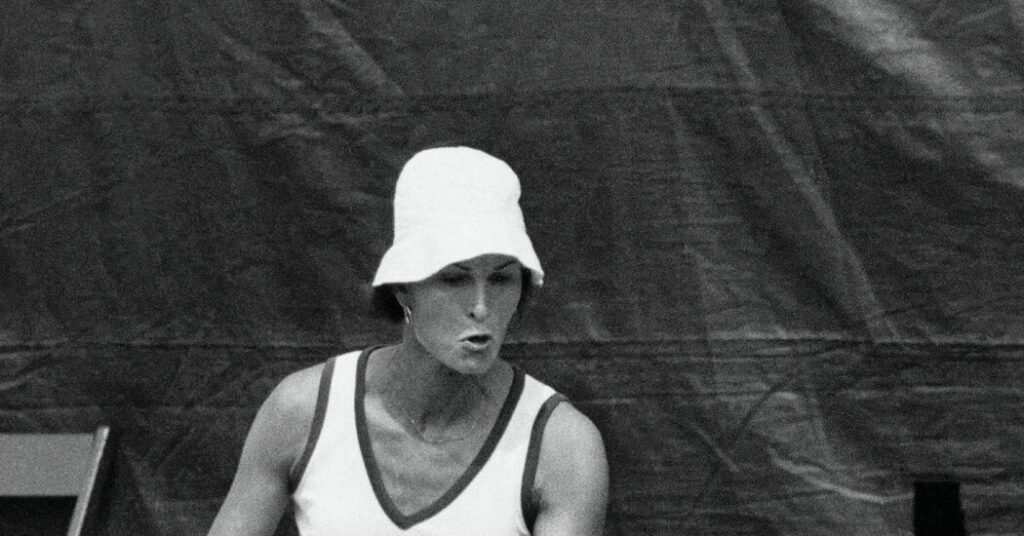
FINDING RENÉE RICHARDS: The Groundbreaking Story of Tennis’s Trans Pioneer, by Julie Kliegman
In “Finding Renée Richards,” an earnest, grappling new biography of the transgender tennis player and ophthalmologist, the broadcaster Keith Olbermann provides some comic relief.
According to Julie Kliegman’s book, in 1980 a 21-year-old Olbermann smacked his forehead on the side of the No. 7 train at Shea Stadium (accidental, but understandable for a Mets fan). Two years later his vision started going wonky in the stands of a U.S. Open match.
A doctor told him with obvious titillation that the top eye-muscle specialist in New York City happened to be Richards, then a figure of curiosity for a 1977 State Supreme Court ruling that had allowed her to qualify for the Open on the women’s circuit.
“I don’t care if it’s a chimpanzee smoking a cigar with a little candle out of its … I did not say backside.” Olbermann remembers replying. Richards fixed his problem in five minutes with a $1.98 pen light.
Hers is not an unexamined life. Now almost 92, Richards has written three memoirs, “Second Serve” (1983), which was made into a TV movie starring Vanessa Redgrave; “No Way Renée” (2007); and “Spy Night and Other Memories” (2014). (Also a 1991 textbook on strabismus surgery.)
But Richards hasn’t been forecourt in the heated current exchanges about trans athletes in sports. This might be because, inconveniently, she regrets her lawsuit against the United States Tennis Association (filed with the help of Roy Cohn), and believes people who have gone through male puberty should not be allowed to play on women’s teams.
This volte face leaves Kliegman — who identifies as asexual, nonbinary and transgender, and uses they-them pronouns — “floored,” “flustered” and “gobsmacked.” Interviewing Richards’s friend Martina Navratilova, who has spoken against biological men participating in women’s athletics, has the biographer “startled” and “shocked.”
Kliegman’s first book, “Mind Game,” was about athletes and mental health, and they have written for many publications, including Sports Illustrated and The New York Times. Their research is careful and thorough, enriched by transcripts and correspondence collected by the feminist activist Eleanor Foa Dienstag in the late ’70s.
There are plenty of fresh conversations and revelations here; Richards admits to “a little sleight of hand,” switching in a friend’s buccal smear on the chromosome test that became the crux of her court case.
But sometimes it seems Kliegman is not so much “Finding Renée Richards” as fighting with her. Distractingly, they struggle with Richards’s wish to have her given name, Richard Raskind, and masculine pronouns used to describe her pre-transition life.
“Agree to disagree,” they write of Richards’s denunciation of androgyny to GQ in 2015, when she called “the binary system that God designed for us … the spice of life.”
Kliegman is respectful of Richards, but also visibly frustrated with her as a champion for the cause. “She wants to have her expertise heeded somehow without ever being called on,” they conclude of her absence from present-day debates. “She wants to be in the zeitgeist without making a peep.”
In between bouts of authorial angst, a life story gets told, and told well. Richard was born on Aug. 19, 1934, joining an older sister, Josephine, a tomboy who bullied him emotionally and physically, including tucking in his penis and calling him “a little girl.” (Josephine has dementia, Kliegman writes, and could not be interviewed for this book.)
They were raised in Queens by their mother, Sadie, a Freudian psychiatrist, and father, David, an orthopedic surgeon who avoided discussing the medical elephant in the room but kept scrapbooks of his younger child’s accomplishments as both genders. Who else has been recognized by both the Jewish Sports Hall of Fame and Helen Keller Services for the Blind?
At Horace Mann, a private school in the Bronx, Richard played baseball and claims to have been recruited by a scout for the Yankees. (A classmate recalls “the lethality of Raskind’s curveball, in particular.”) At Yale, he became captain of the tennis team. At the University of Rochester’s medical school, he dithered over what specialty to choose; “gynecology and obstetrics were hard noes,” Kliegman notes without irony.
Back in Manhattan for his ophthalmological residency and living with a girlfriend nicknamed Sally Peanutbutter, Raskind underwent extensive analysis trying to rid himself of a persistent desire to dress in women’s clothing. He served in the Navy, calling it “a great experience.”
Kliegman painstakingly reconstructs the glamorous but difficult interval after Raskind was wed to a former model, Barbara Mole, with whom he seemed to have little in common but a love of rum-raisin ice cream. (They had a son, Nicholas, who died by suicide at 47 in 2019.)
There is palpable liftoff in this fairly short book after their marriage ends. After a long search that includes a trip to Chicago in a mink jacket and dress from Bergdorf Goodman, Richard found a doctor who would perform bottom surgery. He became Renée, French for reborn, and moved to California, ground zero for fresh starts.
Richards would succeed Christine Jorgensen as the most famous transgender person in America, and in turn be succeeded by Caitlyn Jenner.
“How did her legacy vanish so quickly, in the span of just a few decades?” Kliegman wonders. Maybe because for all the tumult about Richards’s participation in women’s tennis, the farthest she got in the majors was the doubles final of that ’77 Open. Her tour ranking peaked at No. 20 two years later.
After retiring from the sport at 47, she went back to being an excellent eye doctor, to Norman Mailer, Susan Sontag, Nora Ephron — and, well, heeere’s Olbermann again!
Her playing “didn’t destroy women’s tennis and it didn’t lead to a generation of guys at a later time who couldn’t quite make it in the N.B.A. suddenly playing as women,” he tells Kliegman. “Boy, [people] made an awful big deal out of something that really did take care of itself.”
FINDING RENÉE RICHARDS: The Groundbreaking Story of Tennis’s Trans Pioneer | By Julie Kliegman | HarperOne | 272 pp. | $28.99
The post In ‘Finding Renée Richards,’ Writer and Subject Volley Over a Legacy appeared first on New York Times.