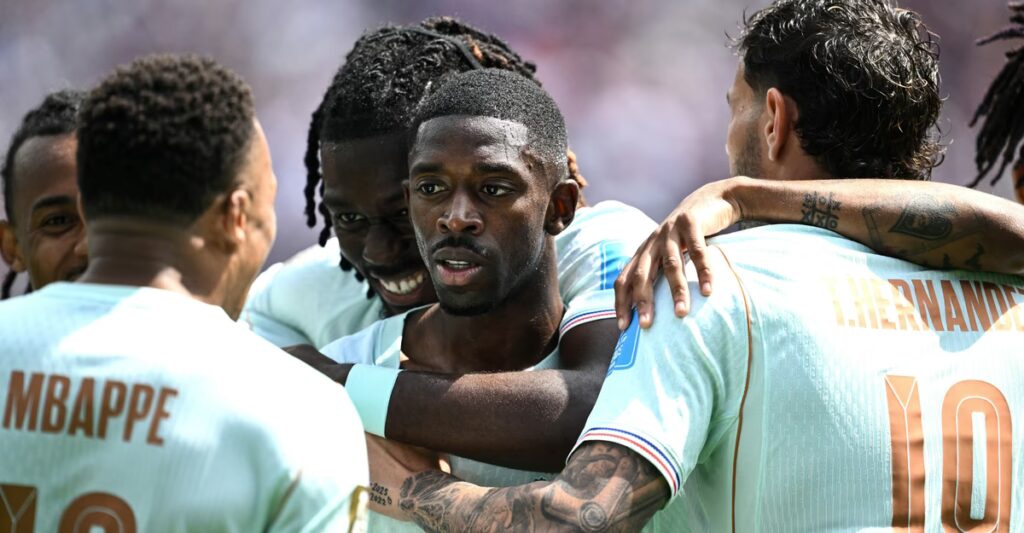
Last month, the French striker Kylian Mbappé recorded the 22nd goal of his World Cup career during the bronze-medal match, establishing himself, at the age of 27, as the greatest scorer in tournament history. Even though the French national team, Les Bleus, failed to win the championship, Mbappé has become one of the country’s two most celebrated figures. At the final the next day, the camera panned across the audience and easily found the other one: Victor Wembanyama, the 22-year-old, 7-foot-4 basketball player who is widely considered to be the future of the NBA. Their success points to a stark irony: France’s most beloved men reflect a demographic shift that a growing share of their country rejects.
Born in France, Mbappé and Wembanyama are the sons of African fathers; Mbappé’s mother is of Algerian descent; and many members of Les Bleus are Black and French Arab. As they’ve become more popular, so has the far-right party National Rally, or RN, which has promised to curtail immigration and promoted a racially restrictive notion of Frenchness that would seem to exclude Mbappé and Wembanyama.
Along with soccer stars such as Ousmane Dembélé and Michael Olise, Wembanyama and Mbappé are living rebukes to the far right’s ideology of ethnic resentment. Indeed, they are the nation’s most compelling argument against it—an accomplished, elegant, and omnipresent representation of a multicultural France. But their argument is losing: After decades outside the political mainstream, the RN seems well positioned to win the presidency next year. As France shows, cultural representation won’t change politics. That requires something much more.
France won its first World Cup in 1998, fielding a diverse team whose mass appeal briefly suggested that the country would embrace its multiracial future. The slogan “Black, blanc, beur” (“Black, white, Arab”), a play on the Tricolor, became shorthand for the idea that France’s racial identity had broadened. Jean-Marie Le Pen, the founder of the party that became the RN, had deemed it “artificial to bring in players from abroad and call them the French national team,” and claimed that they couldn’t sing “La Marseillaise.” But while the far right commanded a substantial protest vote at the time, it was still largely denied legitimate governing power.
[Sally Jenkins: When France plays soccer, you can’t look away]
Over the next two decades, the country grew more diverse as a result of greater immigration, particularly from Africa. Riots and terrorist attacks prompted debates about France’s identity and Islam’s place within it. Meanwhile, the RN became more viable at the polls. After Les Bleus lost in the 2010 World Cup, Le Pen’s daughter Marine—who would be the runner-up in the 2017 presidential election—accused some players of having “another nationality at heart.” A few years later, she called them “a bunch of badly brought up boys.”
Then, in 2018, the French won the World Cup again. I watched the final in Paris at one of the many cafés that set up flatscreens along their terraces. Compared with Les Bleus of 1998, this version looked less like a liberal aspiration than a genuine reflection of France’s demographics. During the game, my two-week-old son slept beside me, a new French American with seawater eyes and African ancestors who’d been sold as slaves in territories that were later absorbed into France’s sprawling network of colonies. (It is a point of great familial pride that his maternal great-grandfather Marcel Pinel played for France in the first World Cup, in 1930.) Mbappé, then 19, became the second-youngest player in history to score a goal in a final, putting Les Bleus up three. As the game ended, a multihued crowd erupted around us. White French pensioners embraced Muslim teens whom they might have crossed the street to avoid in another context.
I have only ever witnessed such colorblind fraternity on one other occasion: the night in 2008 that Barack Obama was elected president of the United States. In hindsight, both moments show that lasting political progress requires more than fleeting euphoria. Still, France’s win seemed to matter, at least for a while. One illustration of this came soon after the victory when the comedian Trevor Noah joked that “Africa won the World Cup.” For Noah, this was cause for celebration. But the quip provoked a broad backlash because it echoed the far right’s complaint that the team was “not French enough.”
Gérard Araud, the French ambassador to the U.S., said that Noah’s joke “legitimizes” racism. “Unlike the United States of America, France does not refer to their citizens based on their race, religion or origin,” he wrote, emphasizing a tenet of France’s republican universalism. Many of the French players reiterated Araud’s sentiment. “The France of today is a France full of different colors,” the midfielder Paul Pogba said. “We all feel French. We are all happy to wear this jersey.” The defender Benjamin Mendy replied to a post that had added foreign-flag emojis to various players’ names, changing them back to the Tricolor. “Fixed  ,” he wrote.
A broad consensus emerged after the 2018 victory and during the early days of President Emmanuel Macron’s first term that discouraged racial division and identity politics—what the French call communautarisme. It sidelined the far right’s complaints of “replacement” and emphasized an accommodating, assimilating color-blindness.
Today, France has become the world’s greatest incubator of soccer talent. The Paris region accounted for more players in the World Cup than any other metropolitan area on earth. The country has become so dominant that it produces too many players for Les Bleus: Of the 1,248 athletes in this year’s tournament, 99 were born in France. In acknowledgment of their popularity, Jordan Bardella, the 30-year-old head of the RN, praised the team as it advanced through the competition—and held his tongue when it was eliminated.
[Thomas Chatterton Williams: The homicide upending French politics]
Mbappé, the captain of Les Bleus, has begun to channel the team’s growing cultural capital into politics. Speaking with Vanity Fair earlier this year, he expressed concern about a potential National Rally victory in 2027. “People sometimes think that because you have money, because you’re famous, these kinds of problems don’t affect you,” he said, referring to the social divisions that the party’s rhetoric foments. “But it affects me, because I know what it means, and what kind of consequences it can have for my country when those kinds of people take control.” Wembanyama, for his part, has been more reserved. In 2024, shortly before parliamentary elections in which RN won its largest ever number of seats, he spoke diplomatically: “Political choices are personal. But I think that, at least for me, it’s important to move away from extremes.”
Still, no matter how vocal they are or how desirable they make diversity seem, athletes or other exceptional individuals can never legitimize a multicultural society on their own. As Americans have learned in the post-Obama era, symbols of integration are necessary but insufficient. In fact, they can even help racists and xenophobes conceal regression. Many people on the far right, for example, point to the popularity of an Obama or an Mbappé as evidence that their society is already tolerant enough.
For all that the French right gets wrong, some critics of rapid demographic change identify serious problems, even if they go on to draw grotesque conclusions. A 10-minute walk from the plaza where I watched Les Bleus win in 2018, a quasi-permanent tent city is populated by migrants from Africa and the Middle East, one of the many lingering reminders that France has failed to address a refugee crisis that has been exacerbated by increased migration.
Cultural representation cannot solve this problem. France needs leaders who can improve the material outcomes of all citizens, irrespective of racial, religious, or ethnic lines. Moreover, politicians must safeguard France’s common life, which means addressing the instability that migration can cause, rather than forfeiting that task to the ascendant far right. Only then can representation lead to mutual recognition, obligation, and belonging.
Any society should applaud diversity in moments of triumph. But that applause won’t mean much if its leadership can’t manage demographic change in the intervals between.
The post France’s Best Argument Against Racism Isn’t Working appeared first on The Atlantic.