To the Editor:
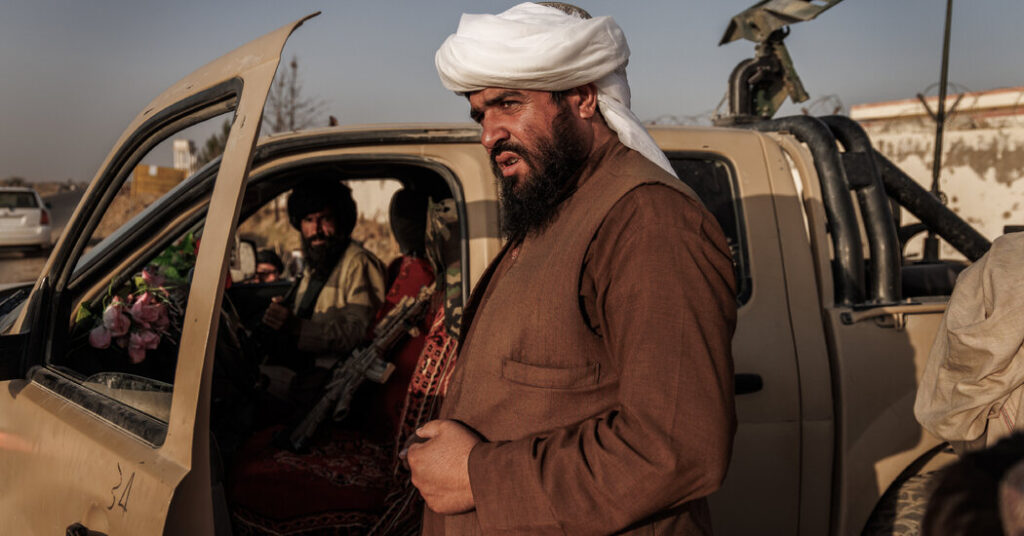
Re “Seeking Out Taliban Commander I Once Fought,” by Thomas Gibbons-Neff (essay, front page, July 27):
Mr. Gibbons-Neff’s essay about his return to Afghanistan offers a moving account of a veteran’s search for moral and psychological closure, and I am glad he seems to have found something like it.
But his reflection falls into a troubling moral trap. Mr. Gibbons-Neff appears to admire the Taliban’s psychological certainty and moral clarity, setting them against the burden borne by American troops, left to determine the meaning of the war for themselves. Yet what he perceives as clarity is, in reality, the chilling serenity of religious absolutism.
The same ideology that produces this mind-set mandates the stoning of women for alleged adultery, the massacre of ethnic and religious minorities and the erasure of Indigenous cultures — most visibly in the destruction of the Bamiyan Buddhas. It is an ideology so ruthlessly absolute that it recently outlawed the sound of a woman’s voice outside the home.
This is not a peace of mind to admire. It is the calm of the zealot who has never had to question his own righteousness. To envy such certainty is a profound category error. In war or its aftermath, the absence of moral doubt is not a virtue. It is a warning.
Azmat Khan Crawfordsville, Ind.
To the Editor:
Thomas Gibbons-Neff’s essay seamlessly carries on the post-Vietnam literary traditions pioneered by writers like Tim O’Brien and Tobias Wolff, a tradition that relentlessly makes the battlefield look like some kind of necessary crucible for the soul. The establishment’s warmongers and war enthusiasts, with their endless war aspirations, have always loved this tradition.
This confessional era of war narratives seductively shifts the focus entirely to the service member’s conscience. And that is precisely where it fails us morally. Mr. Gibbons-Neff (like Mr. O’Brien and Mr. Wolff before him) turns state-sponsored crime into his own private therapy session, and we comfortably absorb our collective guilt through empathy for the perpetrator. And the net effect is that the machinery of perpetual war keeps on running undisturbed.
I wish young war writers like Mr. Gibbons-Neff would turn away from this tradition of battlefield confessionals and learn more from writers like Ambrose Bierce and the young Ernest Hemingway, who recognized that under the gears of industrial slaughter, human beings do not have the luxury of poetic self-reflection.
E. Spencer Hopton Amherst, Mass.
To the Editor:
I was struck with profound sadness after reading Thomas Gibbons-Neff’s essay. And I was surprised by the Taliban commander’s question about the suicides of returning American service members.
Mr. Gibbons-Neff’s observations about the hard fate of the ordinary rank and file, so different from the lucrative defense jobs obtained by the members of the military hierarchy after their service, were all the more telling.
Larry Lomrantz Towaco, N.J.
To the Editor:
I thank Thomas Gibbons-Neff for his courageous service in Afghanistan and for his fascinating essay. But I wonder why he never mentions the reason we were there in the first place: The ruling Taliban, without regret, hosted the terrorists of Al Qaeda who attacked the United States on Sept. 11, 2001, killing some 3,000 innocent civilians.
Lewis Regenstein Atlanta
Uber’s Victims
To the Editor:
Re “Pressing Victims in Courtroom; Uber Digs Deep Into Accusers’ Pasts in Fighting Sexual Assault Lawsuits” (front page, Aug. 6):
Your article sadly details the classic misogynistic tropes used by Uber’s lawyers to defend against thousands of sexual abuse cases. “What were you wearing?” “Do you recall how many drinks you had?”
My heart goes out to these women, who are being shamed in a pitiful attempt to save corporate money — dollars that should have gone toward proper screening of the drivers.
This is why Waymo is a godsend to women everywhere: A robot will never assault you.
Jill Ley Greenbrae, Calif.
The post A Young Marine’s Reckoning With the Afghanistan War appeared first on New York Times.