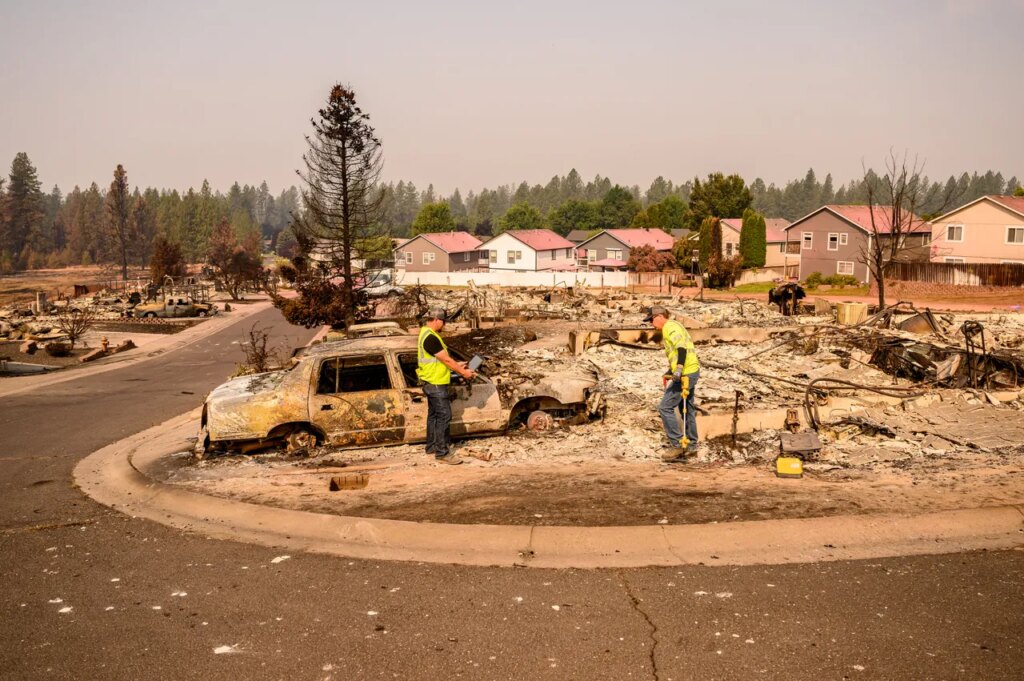
Betsy Robertson was standing in the center of the Spokane Convention Center on Monday afternoon, but she wasn’t there for a gala or a conference. Instead, the event space in the middle of Washington state’s second-largest city had been transformed into a Red Cross emergency shelter as a trio of wildfires, just a few miles away, burned down entire neighborhoods.
Nurses and volunteers were moving between the rows of cots around Robertson, making sure that the hundreds of evacuees—from the mothers with their babies to the elderly with their caretakers—had blankets and enough to eat. Just outside, the air was noxious with smoke “thick enough to burn your eyes,” she said.
Robertson, a communications director for the Red Cross, is from Washington and has been with the organization for 10 years. She has seen communities devastated by wildfires before. But never like this.
“The scale of homes destroyed and lives changed forever—this is a new level,” she said. “We are bracing ourselves for seasons like this getting worse and worse, and starting earlier and going later.”
A historically dry winter, extreme drought, and heat waves set the stage for the hundreds of wildfires that have burned across the Pacific Northwest this summer. Dozens of large ones have broken out in the past week alone. Though it’s still early in the fire season, Oregon recently broke its annual record for acreage burned with nearly 2 million acres scorched.
Washington is also in the middle of its most destructive season on record, with more than half a million acres burned and at least 65,000 residents ordered to evacuate across the state. The three large fires that started on Saturday around Spokane had destroyed more than 700 buildings by Monday afternoon.
“I’ve been trying to wrap my mind around how we’re going to house all these folks,” said Kitty Klitzke, a member of the Spokane City Council representing a hard-hit area where two fires were burning on Tuesday morning. Many of the people displaced by the fires in Spokane are senior citizens and their caretakers. “It’s a miracle that, so far, we know of no fatalities and no reported missing people,” Klitzke said.
As the planet heats up, the conditions that fuel extreme wildfires are becoming more common. A warmer atmosphere can hold about 7 percent more water vapor for every 1 degree Celsius of warming, drawing more moisture from soils and vegetation and leaving forests and grasslands primed to burn. That dynamic also causes rain to fall more intensely but less frequently, leading to long periods of drought.
“This fire, and what we’re expecting to come, makes no sense unless you connect the dots through a changing climate,” said Bob Freitag, who recently served as director of the Institute of Hazards Mitigation Research and Planning at the University of Washington. “The science is known, and this is not something that is a one-off.”
According to Paul Pastelok, a senior meteorologist at AccuWeather, a lack of snowfall across the region helped set the stage for these fires. Normally, snowpack builds up during the winter and melts gradually through the rest of the year, providing a steady source of moisture. This year, the already-small snowpack was hit with hot spring temperatures, causing this reserve to melt early and leaving the landscape parched. Spokane had half of the typical snowfall this year, Pastelok said. Other parts of the state had even less, with many areas reaching historic lows.
In the past few days, powerful winds carried hot embers from the Little Giant fire, a 70,000-acre blaze in central Washington, for more than 3 miles, sending the flames clear over the waters of Lake Chelan and into the forests on the other side. Ryan Rodruck, a communications manager at the Washington Department of Natural Resources, called the overall situation “extremely tragic” and said that it had been an exceptionally challenging season for the thousands of wildland firefighters deployed across the state.
In Spokane, more high winds forecast for this weekend could further worsen conditions, said Benjamin Cossel, a wildfire public information officer from California working with firefighting crews in the city.
The situation is comparable to the Los Angeles fires in 2025, Cossel said. Both outbreaks began in wild areas before moving into partially forested suburban neighborhoods. The urban setting also makes the smoke especially toxic, he said. A recently released study found that the Los Angeles fires, which sent more than 200,000 residents fleeing, had exposed an estimated 3.3 million people to high concentrations of a cancer-causing toxin.
Klitzke, the city council member, said the affected neighborhoods in Spokane were known to be vulnerable to fires. Steep terrain and abundant plant life helped the fires spread quickly over the weekend, while the winding cul-de-sac layouts of the neighborhoods slowed evacuations and made it difficult for emergency responders to reach the fires.
“These are neighborhoods with thousands of people and only two ways in or out,” Klitzke said, adding that many evacuees were stuck waiting in traffic for hours, watching the houses around them burn down.
Areas where homes mingle with natural areas are known as the wildland-urban interface. This kind of suburban housing is the fastest growing type of land development in the United States, and research shows that the homes built in these areas are more likely to burn down when wildfires spread.
“We already knew that this was a dangerous situation,” she said. “We need to get really serious about addressing climate change.”
Increasingly, fire-prone states like California are requiring homeowners to clear the trees and shrubs in a radius surrounding their home. This buffer zone, known as a defensible space, can dramatically reduce the risk that a wildfire will ignite a building.
People chose to live in these neighborhoods precisely because they love the vegetation, Cossel said. “I understand why people don’t want to remove them,” he said. “But we can’t live in that world anymore because of these fires.”
This story was originally published by Grist and is reproduced here as part of the Climate Desk collaboration.
The post Spokane Shows What the New Era of Wildfires Looks Like appeared first on Wired.