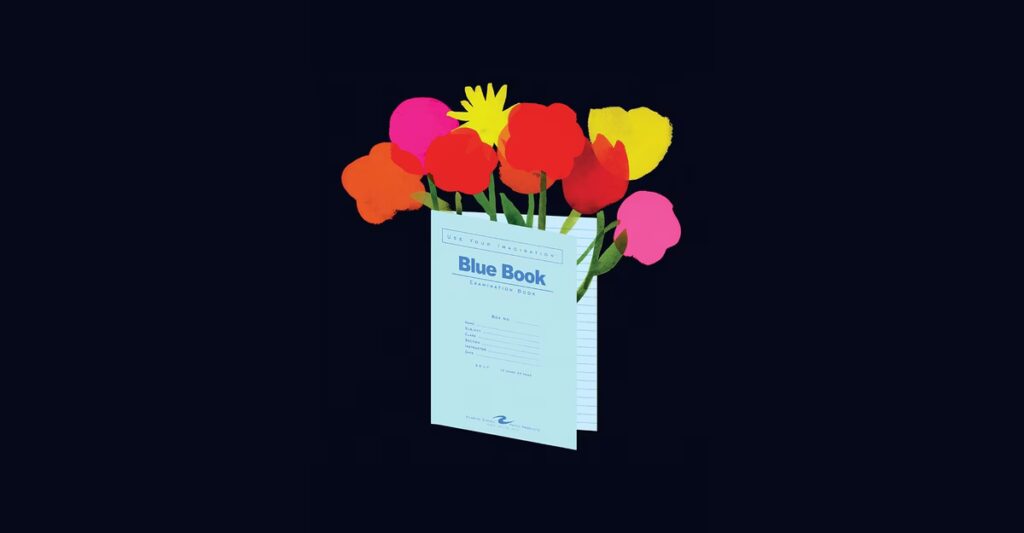
Across the faded blue covers of the exam books in my attic, I can trace the arc of my academic career. I can still see the grades I received on tests in “The Meaning of Abstraction in Modern Art” (A) and in Neurobiology (B–). Just the sight of the booklets is enough for me to feel the pressure to perform, to sculpt the contents of a semester’s worth of knowledge into some fresh shape. But by the time I became a college professor myself, in 2013, the blue book had begun to disappear. Why struggle to discern student penmanship, or risk misplacing a final exam in the trunk of one’s Subaru (to cite a completely hypothetical example), when tests, like everything else, can be administered on a laptop?
The coronavirus made every aspect of education virtual, but even after it abated, in-person final exams remained out of favor for many classes. Part of the reason was simply administrative—the challenge of finding faculty or graduate students to watch over the test-takers. But there was also a shift in how teachers appraised student learning. The blue book meant timed essays and handwritten work, modes of assessment that felt regressive, cruel. It recalled an age of higher education—punitive and bleak, the domain of Dickens’s stern Mr. Gradgrind—that the modern university was eager to outgrow. Not entirely, of course; some faculty still lugged boxes of blue books home in the snow and scribbled grades in red on the covers. But alternatives to the in-person exam proliferated: the capstone project, the take-home essay, the portfolio of selected work from the semester.
The blue book seemed destined to become a relic, as obsolete as cursive. But it had one virtue that hasn’t been easy to replicate: Cheating on a blue-book exam is difficult. When faculty moved away from in-person pen-and-paper exams, they assumed that cheating would be kept in check by honor codes, or by “locked” browsers, which would prevent students from accessing sites that would jog their memory or simply give them the answers. But these measures were never wholly effective. In a survey of undergraduates published in 2020, 62 percent admitted to cheating in some manner.
The advent of AI has only exacerbated the problem. In a matter of seconds, students can create an entire essay with the help of a chatbot. If they’re savvy, they can spend a bit more time to make it sound authentically human enough to evade detection by their professor. As my colleague Rose Horowitch has reported, such cheating has become so prevalent that Princeton recently gave up on its venerable honor code. For 133 years, students had signed a pledge not to cheat, and professors had trusted them to do the right thing. In May, in the face of rampant AI-enabled cheating, the university’s faculty voted to begin proctoring exams for the first time since the Gilded Age.
[Rose Horowitch: How AI killed a 133-year-old Princeton tradition]
Universities find themselves in a surprising position. The only reliable way to evaluate what students have learned may be to bring back pen and paper. Faculty are reverting to in-person, handwritten assignments and timed essays—anything that keeps assessments offline. The unlikely hero of the day is the blue book, sales of which are up by as much as 80 percent for some universities since 2023.
Yet the blue book is more than a last redoubt against cheating. Despite its antiquated appearance, the blue book encourages experimentation, even virtuosity. It deserves to live on not because of what it rejects but because of what it makes possible: thinking on the page, a hallmark of the humanities that is indispensable to their value—and essential to the kinds of human beings that a liberal-arts institution hopes to send out into the world.
The blue book hasn’t changed much for a hundred years or more, with its sky-blue tint and pale-red margin lines, its two neat staples and wide-open spacing, and its austere list of requirements on the cover (NAME, SUBJECT, CLASS, SECTION). The precise history of the blue book is lost to time. One origin story pinpoints its emergence in the 1920s at Butler University; the pamphlet is said to have borrowed its distinctive hue from the university’s colors. Harvard lore suggests that the blue book is older still: By one account, a classics instructor, Evangelinus Apostolides Sophocles, burned a stack of blue-book exams to protest the university’s move from oral to written examinations in 1857.
I realize that by advocating for the blue book in 2026, I might be engaging in the same opposition to progress as old Professor Sophocles. But to me, the blue book represents a timeless human activity—namely, trusting your mind to discover unknown capabilities.
[Walt Hunter: Stop meeting students where they are]
I think of my college-age self, looking up at the clock as I turned the page, crossed out a sentence, broke the tip of my pencil. I recall the satisfaction of filling one book and getting up from my desk to take another, the adrenaline of using my knowledge to improvise something and then having more to say. What I learned by writing this way was distinct from what I learned by composing a five-paragraph essay, with its thesis statement, staid structure, and rote deployment of argument and evidence. Any AI agent can mimic that template.
Taking a blue-book exam is an almost athletic endeavor, and not just because of the stamina it requires of both mind and hand. The test-taker is forced to compose an essay that will demonstrate their command of a semester’s or year’s worth of material. They have to summon the verve to tackle a prompt about the place of freedom in the American novel, or the value of a human life in Hamlet, or what Whitman meant when he said that “the United States themselves are essentially the greatest poem.” Staring down the empty pages of a blue book, I learned to throw myself into my writing. In the process, I discovered what I was capable of as a writer and a thinker. When you’ve done the reading and reviewed your lecture notes, you can feel like a basketball player whose hours in the gym made possible a transcendent playoff performance, or like a musician whose endless runs of arpeggios in a soundproof practice room allowed for a spectacular solo in the concert hall.
Not every student can put pencil to paper for 90 minutes without looking up. Even the strongest students can struggle, at first, to answer the question, or to organize their thoughts. But this, too, is a reason to love the blue book. When students write, they write into uncertainty. They court risk. No surrogate exists for feeling an idea form in your mind and trying to express that idea on the page. And wonderfully, for the instructor, the blue book documents how students strain their way to an answer or an argument. The marks on the page are indelible, and efforts to amend them leave marks of their own: furious erasing or hasty strike-throughs. The blue book is a record of first thoughts, instincts, intuitions.
These fits and starts and failed experiments are a good thing—for the education of the individual and for the health of a society. The humanities are distinguished by the habits of mind that they inculcate, not for their success in forcing students to memorize facts. Among the most significant of these habits are a nimbleness of thought and a flexibility of argument, the ability to draw connections between diverse sets of facts. Those habits are honed by writing under pressure. Challenged by the blue book, students learn to identify and stand behind their individual commitments. As their professor, I hope they carry that lesson beyond the classroom, beyond the university, and into the fractious world they enter as citizens.
[From the July/August 2023 issue: A defense of humanity in the age of AI]
Often the key insight arrives just as time is expiring, and I love how no part of the book is out of bounds for a final thought at the buzzer. “Education is the single greatest thing Thoreau believes in,” one student sneaks into the margins of the final for my American-literature course. For the teacher, this is the pleasure of the blue book—despite its uniform presentation and its rigid lineation, any part of it might reveal a sudden moonshot of an idea. Many of the best sentences appear on the back inside cover, such as this ending to an essay on Toni Morrison: “A good life is what we make it to be—now all we have to do is live it.”
Students, of course, know what they’ve been taught: the timeline of the English Civil War, the structure of a sonnet by Gwendolyn Brooks, the development of a motif in a Mahler symphony. But the blue book demands more than a recitation of facts. It asks students to demonstrate not just that they know when or where something happened, but why it did. It asks them not just who wrote a poem, or when, but what the poem conveys about the world in which it was written. The best-prepared students, the ones who inhabit the history and poetry and music that have made up the semester’s syllabus, find that they understand the material in ways they didn’t appreciate before they opened the blue book and the clock started ticking.
Proponents of artificial intelligence have promised that, by removing certain elements of the craft of writing, students can concentrate on making their work more polished and their ideas more clearly defined. That’s a dangerous ruse. To see what a student has learned, look at the moment when they struggle to begin—and then transcend that struggle to create something genuinely surprising. That’s the moment the full force of the writer’s mind takes possession of the process.
When we eliminate the possibility of writing badly or incoherently, we eliminate writing’s greatest satisfaction: the feeling that we have stepped outside ourselves and are watching our own words fall together in the right order. What I describe sounds like a state of grace, but it’s also a furious act of intellection and expression undertaken with only one’s study and wits to guide them. I’ve come to love handing out blue books on exam day and seeing the look of ready intelligence on my students’ faces. The essay they are about to write will be better than they think it can be. All they have to do is write it.
This article appears in the September 2026 print edition with the headline “The Blue Book Is Back.”
The post Why I Love Blue Books appeared first on The Atlantic.