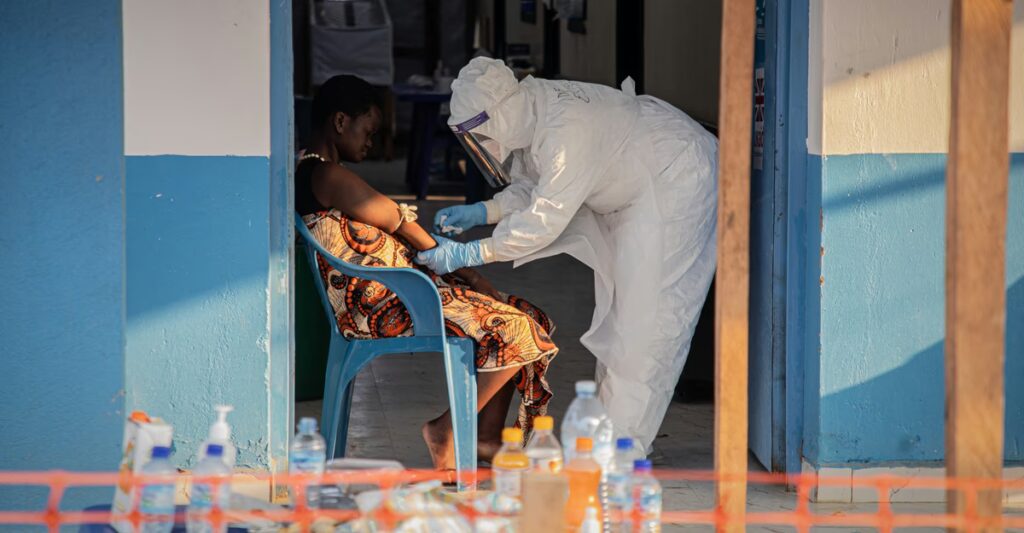
The fight against Ebola is not going well. Last week, the head of Africa CDC, Jean Kaseya, announced that the ongoing outbreak of the virus in the Democratic Republic of the Congo had ballooned into the second worst of all time, a milestone he had thought was possible to avoid only weeks before. Rather than the spread of the virus slowing, cases are doubling about every 10 days; more than 1,800 people have died, though the actual toll is likely at least twice as high. His organization is now fighting to keep this Ebola outbreak from becoming the worst on record, Kaseya said at a press conference.
This outbreak is spreading more quickly than any other in history partly because one of the basic tools needed to control infectious disease—testing for the pathogen—is not working. So the Congolese government, along with scientists, aid groups, the World Health Organization, and the world’s biotech companies, is racing to fix it.
In its early stages, Ebola can resemble several more common viruses, including malaria, so health-care workers rely on tests, rather than symptoms, to diagnose the disease. After the 2014 West African Ebola outbreak, which killed more than 11,000 people, Congo began stockpiling machines that could detect the Zaire species of Ebola virus, which causes most outbreaks. Hundreds of these GeneXpert devices are now in hospitals all over Congo, along with cartridges that can test a patient’s sample for the virus within an hour, Christian Happi, a molecular biologist who leads a team in Congo working on surveilling this outbreak, told me.
Health officials in Congo began using those stockpiles to test patients for Ebola on April 30, after a smattering of health-care-worker deaths, a calling card of the virus. The results came back negative. So did more samples a couple of weeks later. Ebola, we now know, was circulating. But the species turned out to be Bundibugyo, which is far rarer than Zaire, and which cannot be detected by the existing supply of GeneXpert cartridges. That didn’t become clear until officials had sent samples more than 1,000 miles away, to Kinshasa, for more robust PCR testing, creating a disastrous four-week gap between when the first known patient developed symptoms and when officials received laboratory confirmation of a new Ebola outbreak.
PCR testing is still the only reliable way to detect the Bundibugyo strain in Congo. Under the current system, a car drives to Ebola-treatment centers in affected regions, picks up tests, then drives back to labs that can run the tests, Trish Newport, a lead on Doctors Without Borders’ Ebola programs, explained to me. Some routes take longer than they otherwise would because the samples have to be driven over uneven roads that are frequently blocked by fighting between the Congolese military and the armed group known as M23. After the PCR is run, the car returns handwritten results to the centers.
Nineteen laboratories in Congo can now run PCR tests to detect Bundibugyo, which is a major improvement since the beginning of the outbreak, when only two labs had that capacity in a country of more than 116 million people. But according to figures released by Africa CDC in July, one in eight Ebola tests still took more than 72 hours to return a result. Despite the increase in Ebola testing, the proportion of tests that come back positive has stayed constant, about 45 percent. That probably means the country is still dramatically undertesting, Abraar Karan, an epidemiologist at Stanford, told me.
Meanwhile, Ebola is expanding into new parts of the country. Bringing the outbreak to heel will almost certainly require upping testing to catch more cases, trace chains of transmission, and isolate people who are contagious before they spread the disease further. Modeling done after the 2014 Ebola outbreak suggested that diagnosing 60 percent of patients within one day rather than within five days could have drastically reduced the infection rate.
The fastest solution to Congo’s testing crisis would be to distribute GeneXpert cartridges that can detect Bundibugyo. After all, hundreds of hospitals already have the machines, and each can run 80 or so patient samples at once, which would allow many patients to get same-day results, Happi said. A GeneXpert cartridge that tests for every human strain of Ebola does exist: The U.S. Department of Defense funded its development as part of a biothreat-preparedness program in 2020. The FDA approved the panel earlier this year—but only for use by labs at DOD, which intended to continue conducting research on them. (The Department of Defense did not respond to repeated requests for comment.)
In June, with DOD’s permission, Cepheid, the company that makes GeneXpert machines, donated at least some of the tests meant for U.S. government research to Congo’s national health system, Larry Kelmar, the vice president of government relations for Cepheid, told me. (Kelmar did not say how many.) But before they can be used, their accuracy will still need to be compared with PCR tests. Shanelle Hall, a principal adviser at Africa CDC, told me that the GeneXpert cartridges have been tested and that data from those tests are currently being analyzed. A decision on approval is expected in a matter of “weeks, maybe days.”
Other companies and institutions are scrambling to speed up testing, too. Last month, the Gates Foundation issued a Global Grand Challenge to fund teams that will work urgently to develop “field-ready” diagnostics. The World Health Organization has selected eight Ebola diagnostics capable of detecting Bundibugyo—including the GeneXpert cartridges—for fast-track testing, and has already approved two. A test made by a South Korean company, the RADIONE, was approved for use in patients earlier this summer and has become the cornerstone of the WHO’s plan to decentralize and speed up Ebola testing. A senior official at Africa CDC told reporters in early June that 50 RADIONE machines would be in Congo by the end of that month. As of this week, 37 have been delivered. But the machines can test only 24 or so patient blood samples at once, too few to make the dent in diagnosis times needed, Happi said. In a statement, a spokesperson from the WHO said the organization has “established a joint validation platform to rapidly evaluate the performance of a selection of diagnostic products” and that the introduction of new PCR machines has increased testing capacity from 200 tests a day to more than 2,000. KH Medical, the small manufacturer that makes the RADIONE tests, did not respond to a request for comment.
Meanwhile, Happi told me, some Ebola-treatment centers without enough isolation wards are sending suspected Ebola patients home to wait for test results and, potentially, expose other people during that wait. Africa CDC also plans to intensify its contract-tracing efforts by sending thousands of health workers door-to-door, which would require still more testing capacity to support.
The wait for results can discourage the feverish from presenting themselves for testing, Newport, who has been in Congo most of this summer, said. In part because of the delays—and in part because many people in Congo are skeptical of international responders, or believe that treatment centers are places people go to die—those who show up to the hospital typically do so late in disease progression. That’s a real problem, not just because they stay in the community infectious for longer, but also because Ebola cases are far more survivable when they’re caught early, Newport said. Currently, most Ebola deaths are happening at home, rather than in a treatment center or hospital, meaning that many of these infections are never recorded and that teams meant to disinfect homes and sanitarily bury the dead to prevent further spread of the disease never intervene.
The shortage of tests throughout this outbreak has resulted in a shortage of answers to fundamental questions about how the disease has been spreading. Experts still disagree on whether the outbreak began in January or in April. Patient zero remains a mystery. Currently, 80 percent of people who test positive for Ebola haven’t had contact with any other confirmed patients. If that number doesn’t go down, Kaseya told reporters last week, “we will not stop this outbreak.”
The post The Most Basic Step of the Ebola Response Is Falling Short appeared first on The Atlantic.