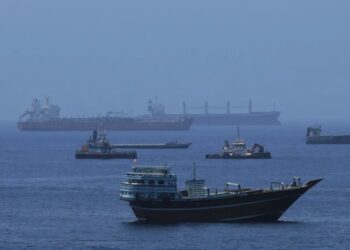
Iran and Oman have been in talks for weeks on a plan to reopen the Strait of Hormuz, and the agreement coming together would deliver a huge geopolitical win for Tehran.
A proposed deal between the two countries that sit on opposite ends of the narrow waterway would give Iran control over inbound traffic, sources told Reuters.
The U.S. and other countries in the Persian Gulf have insisted that the strait must return to its prewar status, when ships enjoyed total freedom of navigation.
But months of U.S.-Israeli bombardment failed to break Iran’s ability to threaten ships attempting to cross without its authorization, keeping Hormuz effectively closed and the Gulf’s oil supplies bottled up.
At the same time, President Donald Trump has repeatedly balked at renewing all-out war as the U.S. military’s inventory of key munitions have reportedly hit critically lows while global oil markets also are running out of reserves.
Iranian officials and Trump have indicated that talks for an agreement to reopen the strait are making progress with a deal expected soon.
But major details still need to be worked out, according to Reuters. One is how to define Iran’s control as well as what the Islamic Republic’s role would be in overseeing outbound traffic.
Another issue is what fees ships would have to pay. Iran is demanding 5%-7% of the price of cargoes from ships using the strait, and Oman has floated a fee of around 3%.
In public comments, Iranian officials have indicated the regime would also have control over outbound traffic and would bar U.S. or Israeli ships from using the strait.
Despite some of the sticking points that remain unresolved, the emerging deal still recognizes Iran’s authority over the strait. “The concession has already been made regarding some form of control over Hormuz,” one source told Reuters.
An Oman-Iran deal would be temporary, allowing the U.S. and Tehran to restart negotiations for a longer-term ceasefire. Oman’s foreign ministry and Iran’s ambassador the United Nations didn’t immediately respond to requests for comment.
Iran has cautioned that Hormuz won’t fully reopen until the U.S. fulfills its commitments under the earlier memorandum of understanding, including the lifting of its naval blockade and the unfreezing of Iranian assets.
Sensing its increased leverage over the region, Iran has warned Gulf neighbors that any new U.S. attack would trigger retaliation against critical energy infrastructure, sources told Reuters.
And amid reports that supplies of U.S. interceptors are running low, the threat of fresh Iranian attacks raises the risk that Gulf states would be more vulnerable.
For its part, the U.S. said traffic in the Strait of Hormuz must be completely unfettered. But it is not part of the Oman-Iran talks.
“Any temporary routes will be without any impediments — meaning no approvals or permissions and no tolls or charges,” a U.S. official told the Washington Post. “The Strait of Hormuz is an international waterway, and no party controls the lanes or the ability to transit through them.”
Regardless of any formal acknowledgment of Iran’s control, it has already demonstrated the ability to damage tankers and regional oil infrastructure, giving it a de facto hold.
Even Gulf officials have acknowledged that a temporary deal recognizing Iran’s authority over Hormuz may be their best option right now, according to the Wall Street Journal.
Meanwhile, they are scrambling to add pipeline capacity to bypass the strait, meaning Iran’s leverage over oil markets will diminish over time.
In the near term, however, the U.S. may have to look the other way as Tehran cements its grip, Gregory Brew, an Iran expert and senior analyst at the Eurasia Group, predicted.
“US accepting Iranian control of the strait without explicitly acknowledging that control seems a likely endgame here,” he posted on X on Thursday.
The post The emerging deal to reopen the Strait of Hormuz reportedly recognizes Iran’s control—and the U.S. may have to accept it appeared first on Fortune.