Zohran Mamdani, the democratic socialist mayor of New York City, champions buses more than any modern mayor before him, and his town hall for bus riders on Thursday evening seemed routine.
In many ways, it was, with Mr. Mamdani and other government officials talking to Brooklyn residents about the steps they were taking to improve service on the frequently derided bus system.
But one participant in the evening’s activities stood out.
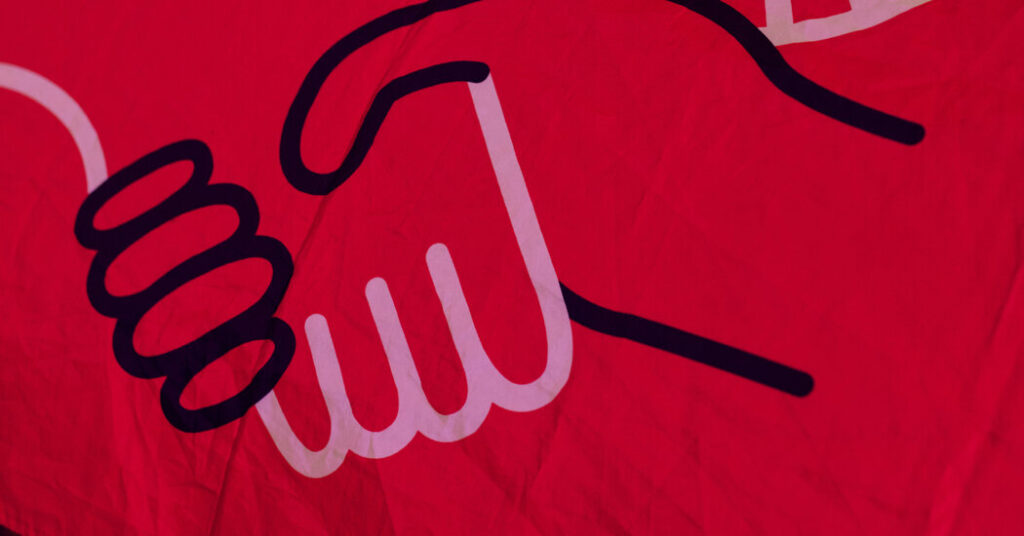
The Democratic Socialists of America had a table at the event, covered in a bright red tablecloth with the organization’s logo, according to footage by Spectrum News NY1, which was granted access to the town hall. It was next to a table for the Mayor’s Public Engagement Unit, where staff members were handing out bus-themed coloring sheets and crayons, one attendee said.
Two other nongovernmental groups, both focused solely on transportation, also had tables there: Transportation Alternatives and Riders Alliance. So did the Mayor’s Office for People with Disabilities and the Mayor’s Office of Climate and Environmental Justice, according to the attendee, who asked not to be named in order to speak freely about a sensitive topic.
Grace Rauh, the executive director of Citizens Union, a good-government group, said the D.S.A.’s presence at an event organized by the mayor’s office raised questions about the separation of government from politics.
“The public needs an explanation from City Hall about how a partisan political organization was able to set up a table at an official city event, and what steps will be taken to ensure there is a bright line between partisan activity and government-run civic engagement going forward,” she said.
The D.S.A. is the mayor’s political home. It helped elect him mayor, and its members populate his administration and influence his policymaking. His chief of staff is a D.S.A. member, as is the commissioner of the Mayor’s Office of Mass Engagement, which promoted the event.
“N.Y.C.-D.S.A. does extensive community organizing and social welfare work, such as housing, transportation and environmental advocacy,” Gustavo Gordillo, a co-chair of the New York City chapter, said in a text message. “We were one of many nonprofit community organizations that tabled at the event to give New Yorkers a way to fight for fast and free buses.”
Dora Pekec, a spokeswoman for the mayor, also defended the organization’s inclusion, saying “a number of community and advocacy organizations that work on transit issues” had been invited to set up tables at the town hall, including the D.S.A.’s transit working group. “These organizations provided a variety of resources and perspectives on transit advocacy for New Yorkers,” she said.
Rather than a political party, the D.S.A. is a nonprofit “social welfare organization,” or 501(c)(4), which can engage in political activity. (Riders Alliance has both a traditional nonprofit and a 501(c)(4) organization).
Ms. Pekec said that city agencies can collaborate with groups that engage in political activity at city-sponsored events, provided they are invited for their subject-matter expertise.
But John Kaehny, the executive director of Reinvent Albany, another good-government group, argued that the D.S.A. is distinct.
“At a minimum, it’s completely obtuse by the mayor’s office to invite the caucus of the Democratic Party that got him elected,” he said. “This is an inherently political organization. They make no bones about it.”
“While some City Hall lawyers may have dotted the I’s, in some ways it doesn’t matter,” he continued. “It creates the appearance of partisanship and politicization of an event that is of broad public concern.”
Mr. Mamdani has made public transportation a central policy focus, vowing to make the city’s buses both fast and free.
About one in five New Yorkers struggle to pay for public transit, a burden disproportionately borne by Black and Latino commuters and working mothers, according to a 2024 report from the Community Service Society of New York, an economic justice group. The city’s bus fleet is also one of the slowest in the nation, with an average speed of eight miles per hour.
Making the bus free for all could cost more than $1 billion a year in forgone fare revenue, according to the Metropolitan Transportation Authority, the state entity that runs the system. Gov. Kathy Hochul, who is wary of raising state taxes, has not endorsed the plan. Some transportation advocates also point out that many bus riders transfer to the subway, and would still have to pay to complete their trips.
In the meantime, the mayor has advanced a series of ambitious street redesign projects aimed at making the bus network faster. Last month, he and the governor unveiled a plan to speed up bus commutes by up to six minutes along 50 of the most congested routes in the city.
The post Mamdani Hosted a Town Hall About Buses. Why Was the D.S.A. There? appeared first on New York Times.